

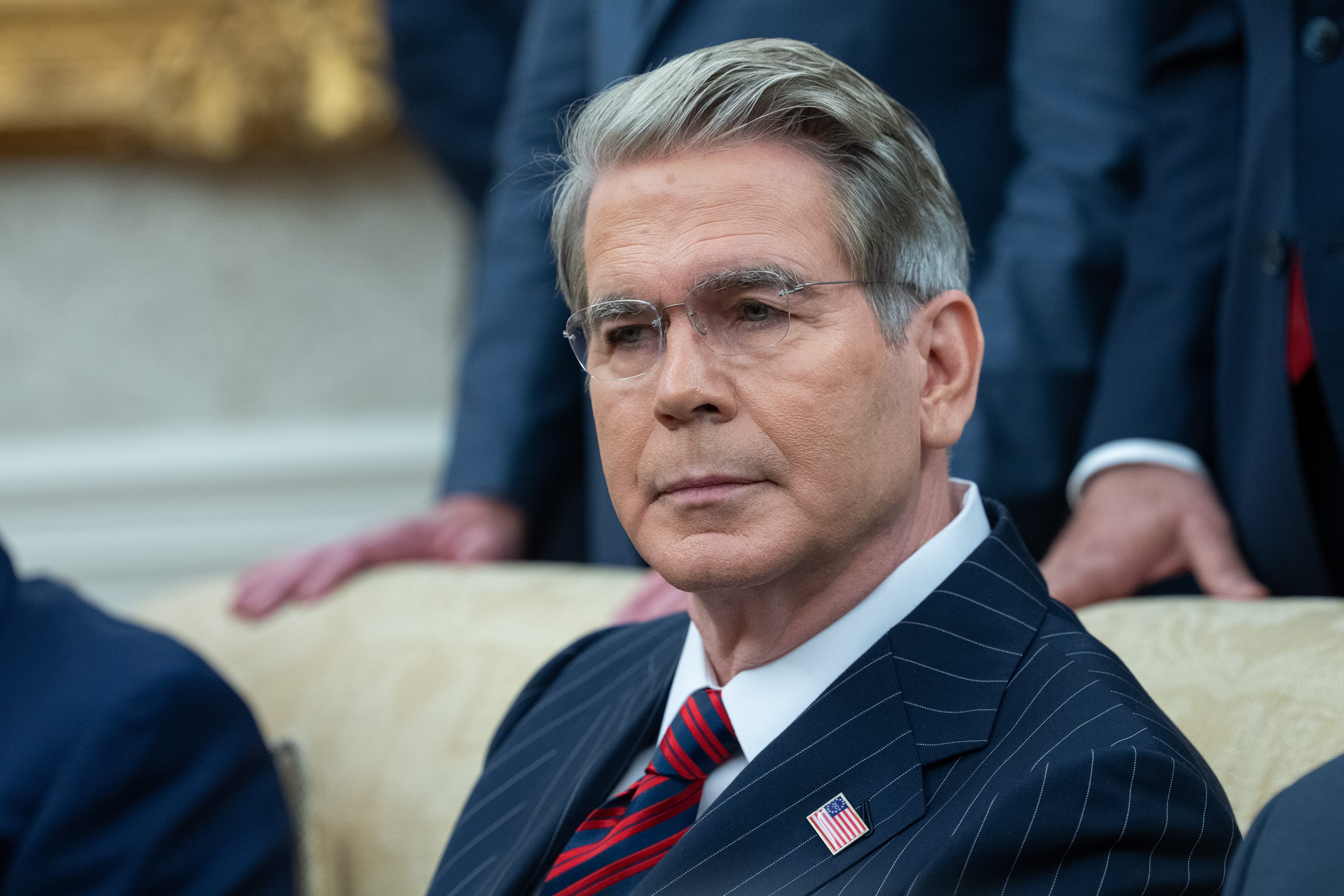
Treasury Secretary Scott Bessent announced today the launch of Operation Economic Outcast, the next phase of the Trump administration’s campaign against Iran following Operation Epic Fury (the military dimension) and Economic Fury (Iran’s shadow-banking system and the commercial pipeline connecting Iranian oil to China, which is mainly constituted by shell companies and shadow-fleet vessels to independent teapot refineries).
For those who have been following my writings on the war, I wrote back in May that Iran’s economy is already collapsing. Read here.
What is different now, I think, is that the economic pressure is approaching a point of no return, in the sense that it is ultimately going to lead to a power struggle within the IRGC. In fact, for all the IRGC’s rhetoric of “survival,” repeated by its propagandists with memes, and too often amplified by outlets invested in portraying the United States as losing, the scale of the damage can no longer be concealed with AI videos. The numbers speak for themselves: the rial has fallen to a record low, inflation is approaching 70 percent, and the economy is contracting by 5.4 percent this year.
More importantly, figures at the top of the political system are now acknowledging the economic cost of the war. President Masoud Pezeshkian and Parliament Speaker Mohammad Bagher Ghalibaf are openly arguing that Iran must find a way out of the war and turn its attention back to the economy. Pezeshkian was pretty much blunt about it: “It would be better to end the war today, when we have power and dignity, and with the whole world acknowledging our victory.” But as long as the IRGC maintains its aggressive posture, Trump has little reason to ease the pressure.
“Treasury has mapped every node, every facilitator, and every network that Iran has used to smuggle oil and evade sanctions. Beginning today, the actions of Treasury and other agencies will tighten the noose and block every potential source of revenue that funds the IRGC and the evil Iranian regime. We are enforcing a zero-leakage approach. There will be no minimal breathing space for the regime to rebuild its capacity to inflict terror against America and the world. The final refuge of this regime is a mistaken conclusion of nations that still finance the Iranian threat in the hopes of evading it. It is no longer acceptable to operate in the gray spaces of this conflict. Countries cannot claim they are blind to enabling this activity. Iran's enablers purchase, transport its petroleum. They facilitate the flow of its finances through exchange houses and free trade zones. They welcome Iran's flights and maintain registries on its behalf. They turn a blind eye to seaborne fuel transfers and overland transits. They condone illicit use of their banks, all the while concealing the extent of their complicity. The President is making phone calls to world leaders with specific requests to cease their interaction with the regime. We are already seeing results.”
U.S. Treasury Secretary Scott Bessent (Transcript)
Bessent’s speech made clear that the campaign has entered a new phase, with economic pressure moving beyond containment and toward the economic and political incapacitation of the IRGC. Treasury itself describes the strategy as one of total “isolation”, but my personal working assumption, especially given the behavior of neighboring states, is that Iran is already politically isolated across much of the region. Gulf governments that once tried to hedge between Washington and Tehran increasingly see Iran as a security and economic liability, while the UAE has already halted trade and others are tightening their exposure to it. Iran isn’t economically sealed off, especially as long as China and its shadow networks remain available, but the political space around the regime has already narrowed considerably.
The distinction matters because Treasury is now trying to turn Iran’s existing political isolation into an unbearable economic constraint, closing the routes through which the regime can still convert oil, currency transactions, and foreign intermediaries into usable cash. In practice, the goal is to leave the regime with fewer resources to rebuild its arsenal, maintain repression at home, and finance the militias it has created across the region. That last point is often overlooked. The IRGC sits at the coercive core of a parallel state and serves as the expeditionary arm of a transnational revolutionary project, sustained by a vast proxy network whose weapons, salaries, logistics, and operations are financed with wealth extracted from ordinary Iranians.
For perhaps the first time in its history, the IRGC is forced into a choice it has spent decades avoiding. It can retrench, abandon parts of the regional system it built, and preserve resources at home, or it can continue financing a war and a network of proxies that are steadily consuming the financial and industrial foundations of its own power.
What also transpires from Bessent’s speech, beyond his willingness to impose enormous costs on the IRGC’s enablers, is that he is capitalizing on Tehran’s own strategic errors. The Strait of Hormuz was supposed to be Iran’s ultimate coercive card. Before the war, 20.9 million barrels crossed the Strait daily, representing one-quarter of maritime oil trade. Tehran’s geostrategic calculation had two goals: to inflict an energy shock severe enough to force Washington and its partners to retreat, and then to exploit the Gulf states’ dependence on the Strait of Hormuz to divide them. Neither objective was achieved.
First, Washington blunted the initial energy shock. At Trump’s request, the International Energy Agency approved the largest emergency stock release in the agency’s history, totaling 400 million barrels, including 172 million from the U.S. Strategic Petroleum Reserve. U.S. crude and refined-product exports reached a record 12.9 million barrels per day, flows to Asia nearly doubled, and political-risk insurance and naval escorts helped keep commercial traffic moving.
Second, Iran’s weaponization of Hormuz accelerated investment in alternatives to the Strait. The UAE is moving to double the capacity of its 1.8-million-barrel-per-day Habshan–Fujairah pipeline, TotalEnergies is investing in that expansion and in a route carrying Iraqi oil through Syria, while Saudi crude is increasingly exported through Yanbu and Egypt’s Sidi Kerir.
China is also reducing its exposure, as Chinese state-owned shippers have pulled back from the Strait of Hormuz and Bab al-Mandeb. Iran International reported that COSCO Shipping Energy Transportation and China Merchants Energy Shipping have avoided both chokepoints since late July after receiving guidance from Chinese central authorities, according to sources cited by Reuters. The two firms operate more than 100 large crude carriers, each capable of transporting around 2 million barrels.
Crucially, Iran’s actions have immensely damaged the image the IRGC has spent decades cultivating as the champion of resistance to “American and Israeli imperialism.” By attacking Muslim countries it claims to defend and lead, the IRGC exposed its coercive and aggressive behavior, weakening the regional legitimacy on which much of its influence depends.
In many ways, Economic D-Day is the logical culmination of Iran’s own miscalculations. For years, the regime survived on the assumption that its adversaries would never fully close the financial and commercial channels that kept it afloat. That era is over. Iran is losing its financial lifelines, its partners are stepping back, and Syria and Iraq are offering a glimpse of what the region can look like without the IRGC. That makes the old excuse and convenient talking point that the United States is responsible for every regional disaster harder to sustain. And sooner or later, Iran’s leaders will face a more dangerous question at home: why did so much of the country’s wealth go to militias and proxies abroad while Iranians themselves were left with stagnation and decline?
One obvious point that I keep returning to is that the Iranians can only play the Strait of Hormuz card once. They've now played it and it will be all downhill from here.
"What is different now, I think, is that the economic pressure is approaching a point of no return, in the sense that it is ultimately going to lead to a power struggle within the IRGC."
pardon my cynicism but i heard this about Russia, too, and seems to me that everyone just fell in line. i am sure that iran is not putin's russia, and the IRCG may be much more fractured than the kremlin-oligarch plutocracy... i hope the sanctions work and they're not just more wishful collapse-thinking.
that's just me being a pessimist.
fantastic writing per usual... learn a ton over here.