

I cannot address everything in one article, but my humble attempt is to give a better picture to situate things within their context.
What the Words Are Hiding
In geopolitics, what governments do almost always matters more than what they say. It is obvious, very obvious, but it is worth repeating at moments like this.
Indeed, public statements during a conflict rarely function as transparent windows into operational military plans. More often, they become part of the conflict itself. Leaders speak to signal resolve, reassure allies, manage escalation, and just as importantly, to confuse their enemies. Treating statements from figures such as Rubio, Hegseth, or Trump as straightforward indicators of operational intent, thus, risks producing a deeply misleading picture of events.
It’s a 101 Clausewitz rule: “The deceiver by stratagem leaves it to the person himself whom he is deceiving to commit the errors of understanding,..”
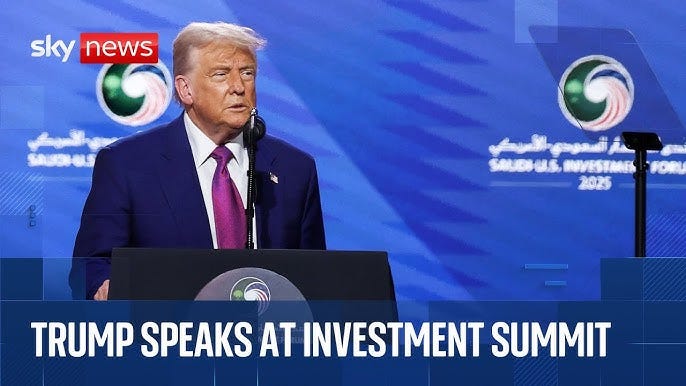
A better approach, I think, is to step back to a moment before the pressures of active conflict began shaping public messaging. In this case, I believe that moment was May 13, 2025, when President Trump addressed the Saudi–United States Investment Forum in Riyadh. The speech did not receive the attention it deserved at the time. Yet in retrospect it stands as one of the most consequential statements delivered by an American president in the region in recent years. One passage in particular was revealing:
“I want to make a deal with Iran. If I can make a deal with Iran, I’ll be very happy. We’re going to make your region and the world a safer place. But if Iran’s leadership rejects this olive branch and continues to attack their neighbors, then we will have no choice but to inflict massive, maximum pressure: drive Iranian oil exports to zero, like I did before. They were a virtually bankrupt country because of what I did. They had no money for terror. They had no money for Hamas or Hizballah. And take all action required to stop the regime from ever having a nuclear weapon. Iran will never have a nuclear weapon. The choice is theirs to make. This offer will not last forever. The time is right now. One way or the other, make your move.”
Trump was transparent about his intentions, and so the real discussion isn’t in what he said or didn’t say, but in what he meant and how the word “deal” is understood.
In Trump’s vocabulary, a deal carries none of the meaning it held under Obama, nor does it resemble the negotiated compromises typically described in “the language of international relations”. For Trump, a deal means the other side accepts the core conditions he has set. Complete surrender. Tehran simply chose otherwise, and that decision was not really the result of miscalculation. Let me explain:
The Islamic Republic possesses a certain tactical and political flexibility. It can negotiate, delay, posture, and maneuver. What it cannot do, however, is concede on the foundations of its regional strategy, because those foundations are not, in any meaningful sense, separable from the regime's own identity.
The cultivation of proxy networks, the sustained pressure on Israel, and the projection of power from the Levant to the Arabian Gulf, all these things, are not bargaining chips the regime can trade away in exchange for sanctions relief. They are the very foundations through which the Islamic Republic justifies its revolutionary purpose, maintains its claim to leadership within political Islam, and sustains relevance beyond its own borders.
A regime that accepts Trump's terms would dismantle the instruments through which it exercises power.
A Region Held Hostage
But that’s not the whole story, the crux of it is that Trump’s own broader Middle East strategy carries ambitions that go well beyond security.
The Middle East, in his conception, is a real estate opportunity for the United States. Not simply a theater to be stabilized but a pivot between continents, a commercial and technological hub through which American-aligned economies would grow more deeply connected.
Gulf sovereign wealth funds would flow into American industry and technology. New corridors would reorder the movement of goods, energy, and data across Asia, Europe, and North America. That transformation, however, presupposes a Middle East in which Iran no longer holds the conditions for integration permanently at risk.
Which is why once Iran continued projecting pressure across the region, managing the status quo for Trump is no longer a viable policy. It is as properly understood a concession, a tacit acceptance that the regional order Washington sought would remain permanently out of reach.
Operation Epic Fury should, therefore, be seen not as a “sudden” or “abrupt” escalation but as the point at which inaction itself became politically the greater risk (militarily I explained it in this article on missiles), and the stakes of that decision can only be measured against the scale of what Trump is attempting to build as it rests on five objectives:
The first is the gradual reduction of the American military footprint in the region. Trump’s withdrawal of roughly 1,000 troops from Syria reflects a broader judgment that large permanent deployments, once justified by the wars of the previous two decades, had begun to produce diminishing strategic returns at mounting political cost.
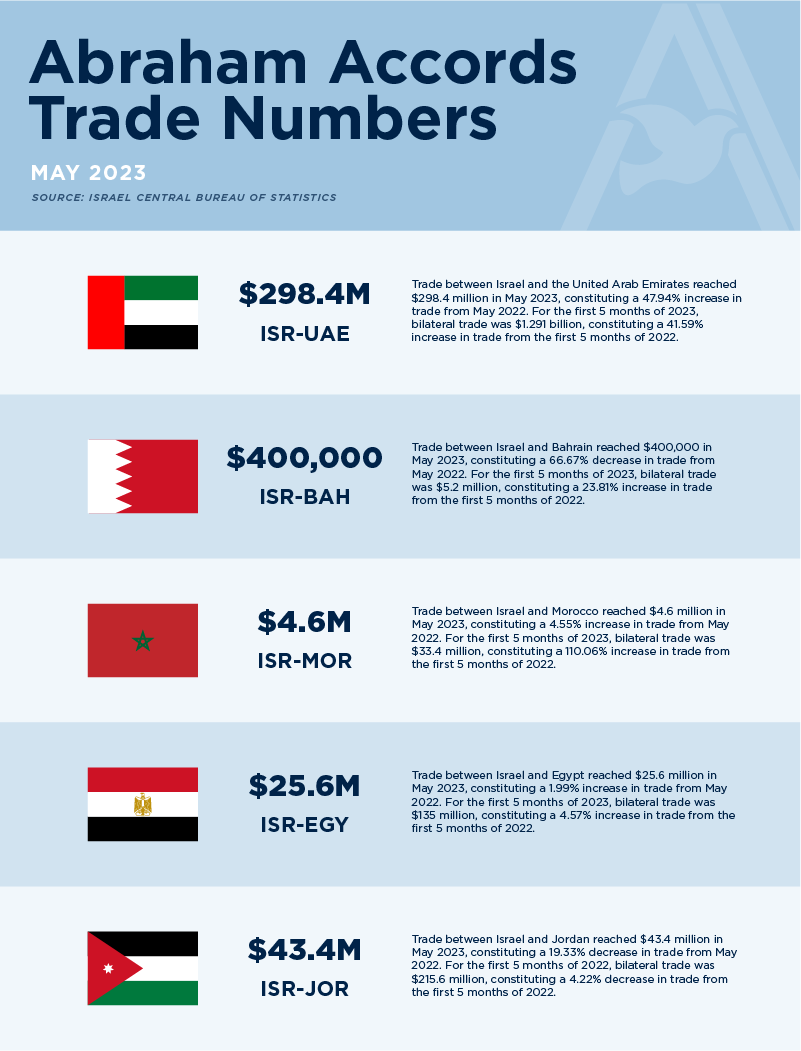
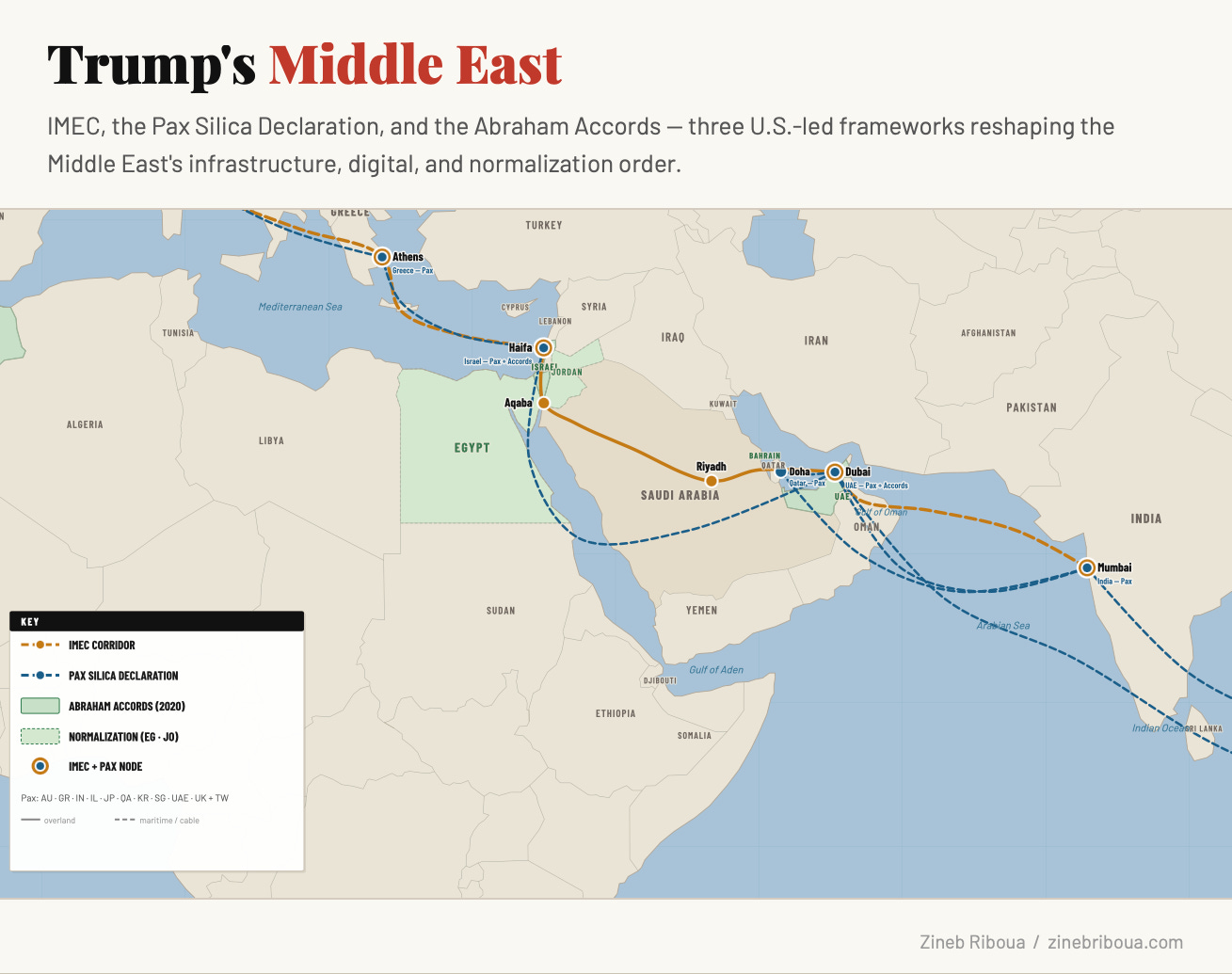
The second objective is the expansion of the Abraham Accords and the consolidation of a regional alignment in which Israel and key Arab states cooperate economically, technologically, and increasingly in matters of security. The pace of that transformation has been notable. Bilateral trade between Israel and its Abraham Accords partners rose from virtually zero in 2020 to roughly $3.4 billion by 2023, an indicator of how quickly political normalization can translate into tangible economic integration.
The third objective concerns the construction of new economic corridors linking India, the Gulf, Israel, and Europe through the India–Middle East–Europe Economic Corridor (IMEC), an infrastructure project designed to move goods across a network of ports, railways, and logistics hubs connecting economies across three continents.
The fourth objective concerns Pax Silica. This framework links technology, capital flows, logistics infrastructure, and security cooperation among states whose interests increasingly converge. The aim is to embed the Middle East within the economic and technological corridors connecting the Indo-Pacific and Europe, producing a form of stability grounded technological integration.
Yet such an order cannot take shape in purely economic terms. It would be wishful and fantasy thinking. For it to endure, it must also be politically intelligible to the societies that inhabit the region.
That is where the fifth objective enters the picture. The stabilization of Gaza under a post-Hamas governing arrangement provides the political condition that makes the other four objectives legible to Arab and Muslim publics.
This is crucial. Since as long as Tehran retains operational control over Palestinian armed factions, it possesses the ability to portray every normalization initiative as a betrayal and to activate its terror proxy network. Breaking that control does not resolve the Palestinian question itself of course, but it removes the mechanism through which Iran transforms Palestinian grievance into a structural veto over the entire regional order.
That mechanism rests on a deep ideological reality because within the political imagination of much of the Muslim world, the Palestinian cause functions simultaneously as a nationalist grievance, a religious obligation, and a civilizational test through which governments and publics measure the “authenticity” of their leaders’ commitments.
Tehran understood this dynamic early on and massively exploited it with exceptional strategic acuity. By positioning itself as the principal armed sponsor of Palestinian resistance through Hamas and Palestinian Islamic Jihad, Shia, non-Arab regime accomplished something that would otherwise have been structurally difficult: it claimed total moral leadership over a cause whose origins and deepest emotional resonance lie within the Sunni Arab world.
The Decision and Its Design
For all these reasons, Operation Epic Fury reflects an attempt to shift the underlying conditions of Middle Eastern politics. It’s a structural solution to a structural problem for Trump. Because if it succeeds, the constraints described above will loosen.
The Abraham Accords offered, I think, an early indication of what such a region might look like:
Several Arab governments signaled their willingness to normalize relations with Israel and move closer to Washington. What held them back was not a lack of political inclination. The obstacle came from the shadow cast by Iran’s network of armed proxies including Hezbollah in Lebanon and the Houthis in Yemen. That network made visible alignment with Israel a potentially dangerous gamble. Trump perhaps understood that incentives alone would not change the region’s calculations. Lowering the costs associated with alignment with the United States was essential.
Seen in this light, the current confrontation carries political and strategic implications, since for Arab nations the choices that once appeared too dangerous to contemplate will start to look far more practical if the operation succeeds.
And it brings Trump closer to the project he has long envisioned: a Middle East no longer constrained by Iran’s disruptive reach, stabilized with a lighter American military footprint and increasingly organized around trade, investment, and large scale infrastructure development.
In other words, Operation Epic Fury is a military campaign that, should it achieve its objectives, may mark the beginning of the end of America’s era of massive military engagement in the region. An attempt for Trump to reorder the strategic landscape of the Middle East in a way no previous administration has attempted, shifting the burden of regional containment toward Israel while freeing American political attention and capital for higher priority theaters.
Absent that outcome, Trump faces the prospect of closing his term with an unbroken Iranian threat, no expansion of Abraham Accords, no IMEC corridor that would benefit U.S. businesses, no Pax Silica that would empower U.S. tech companies, and a legacy indistinguishable from every predecessor who pledged to end American overextension in the Middle East yet never established the strategic conditions that would have made withdrawal possible.
Trump isn’t smart enough to figure all this out! He just wants to prove he is boss and all the Arab states have to kiss his ass? He doesn’t understand that direct war with a nation of 92 Million people and led by hardline clerics who hate Israel is not going to surrender ever! So an air war is not winnable on the ground! His Republican minders in and out of Congress know he can’t win a ground war of this size and not get impeached next January so who the hell knows how he will get out of this? Except declare victory next week and walk away!
This is a great piece and thinking, and I hope it's true that America will be less involved in the Middle East after this war. But I think the main issue I have with this is the lack of psychological analysis. This is brilliant international relations analysis, but Donald has severe ADHD and pathological narcissism: it completely clouds his mind.
Trump doesn't have beliefs (except for beliefs he's had since the 80s like tariffs). Trump has dispositions. And one of his narcissistic dispositions is that he is constantly looking for narcissistic supply. And he gets those through the media and his name in headlines, but also through other people. He humiliated Zelensky in the White House because of his narcissism. There wasn't analytical thinking behind it.
Trump's international relations analysis is based on the person, their power, and the size of their country. Putin has a deft psychological hold on him because Trump sees how powerful Putin is, how many missiles they have, and how big Russia is on a map. And Putin knows when to flatter and when to be cold. And likewise, so does Bibi.
Maybe some sections of the Pentagon think like this piece, but does Pete Hegseth? I think a large part of this war is because of Bibi's influence on Trump. I don't believe Donald has thought anywhere close to this level you are.
Edit: @Vlad Vexler summed it up well
https://www.youtube.com/watch?v=f6fvHOOFYbw