

In 2015, the Joint Comprehensive Plan of Action (JCPOA) was sold to the American public and to the world as the definitive answer to Iran’s nuclear threat. The agreement placed extensive restrictions on uranium enrichment, centrifuge capacity, and stockpile levels, but said almost nothing about the one thing that would actually deliver a nuclear warhead to its target: ballistic missiles. Nothing about cruise missiles either. No limits on the development, testing, production, or deployment of the very weapons systems that transform a nuclear device from a dangerous secret in a bunker into a weapon that can destroy a city. A bomb is only as threatening as your ability to deliver it, and the JCPOA left Iran’s ability to deliver it completely unconstrained.
For Iran, this distinction matters more than it does for almost any other country on earth.
Decades of international sanctions have left Tehran with one of the weakest air forces in the region, an aging fleet incapable of penetrating the air defenses of Israel or any major Gulf state. Iran cannot deliver a nuclear weapon by aircraft. It cannot do so by sea with any reliability. The ballistic missile is the only component that gives the rest of the nuclear program strategic value.
What makes this failure even more consequential is who stepped in to exploit it.
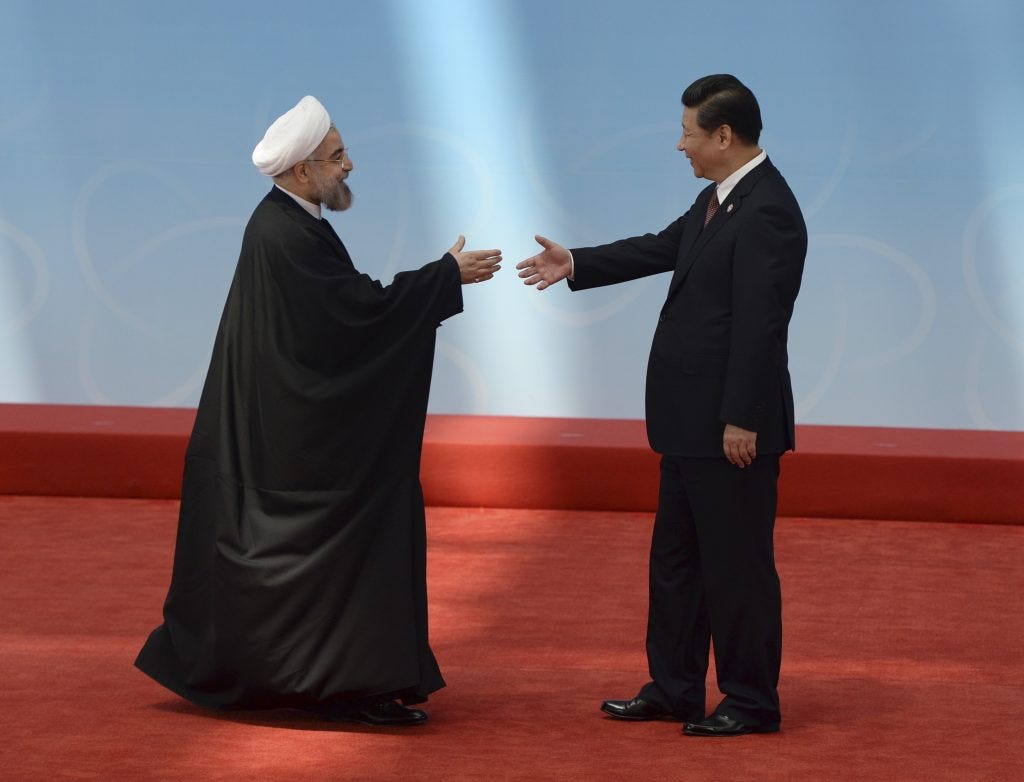
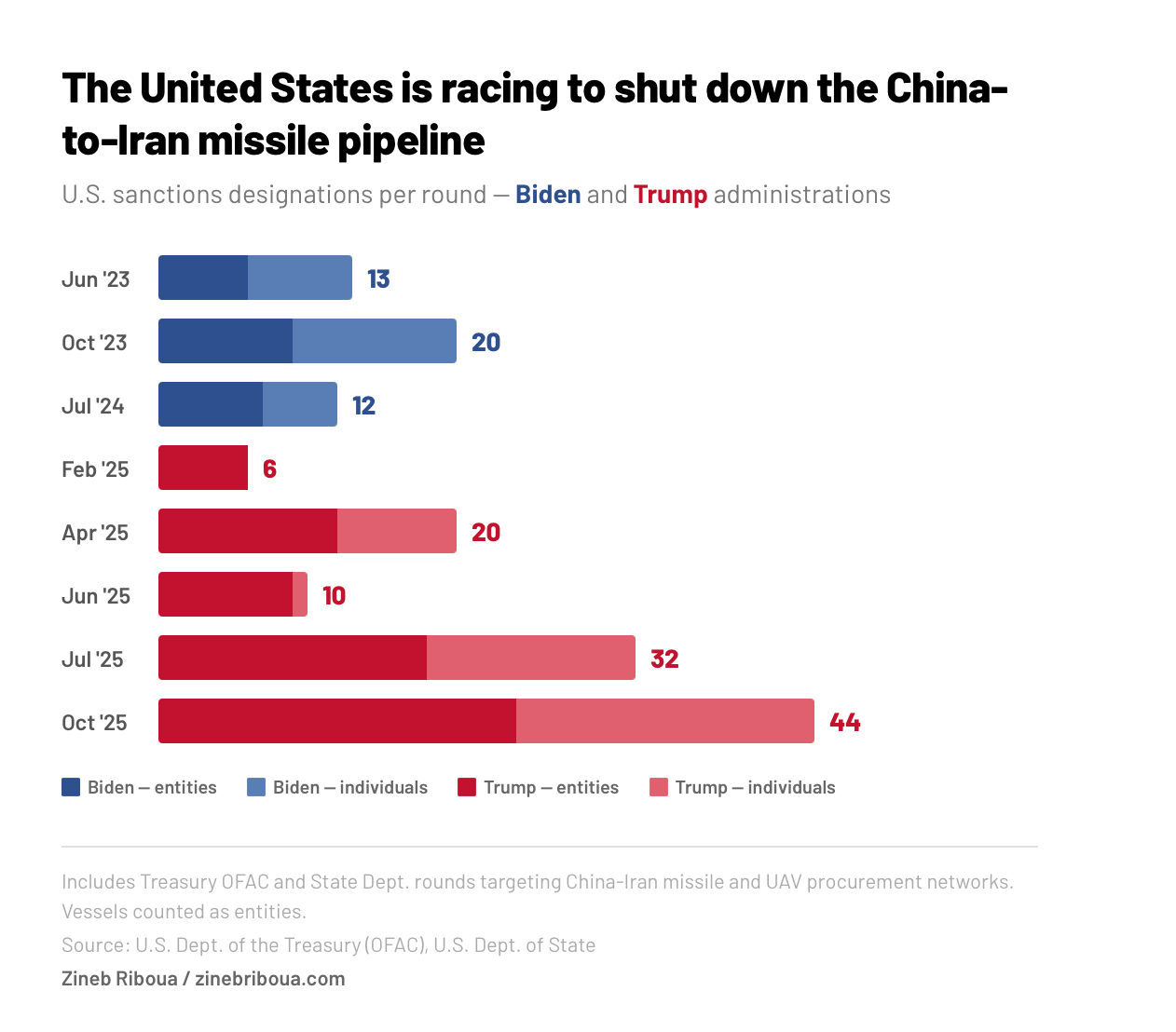
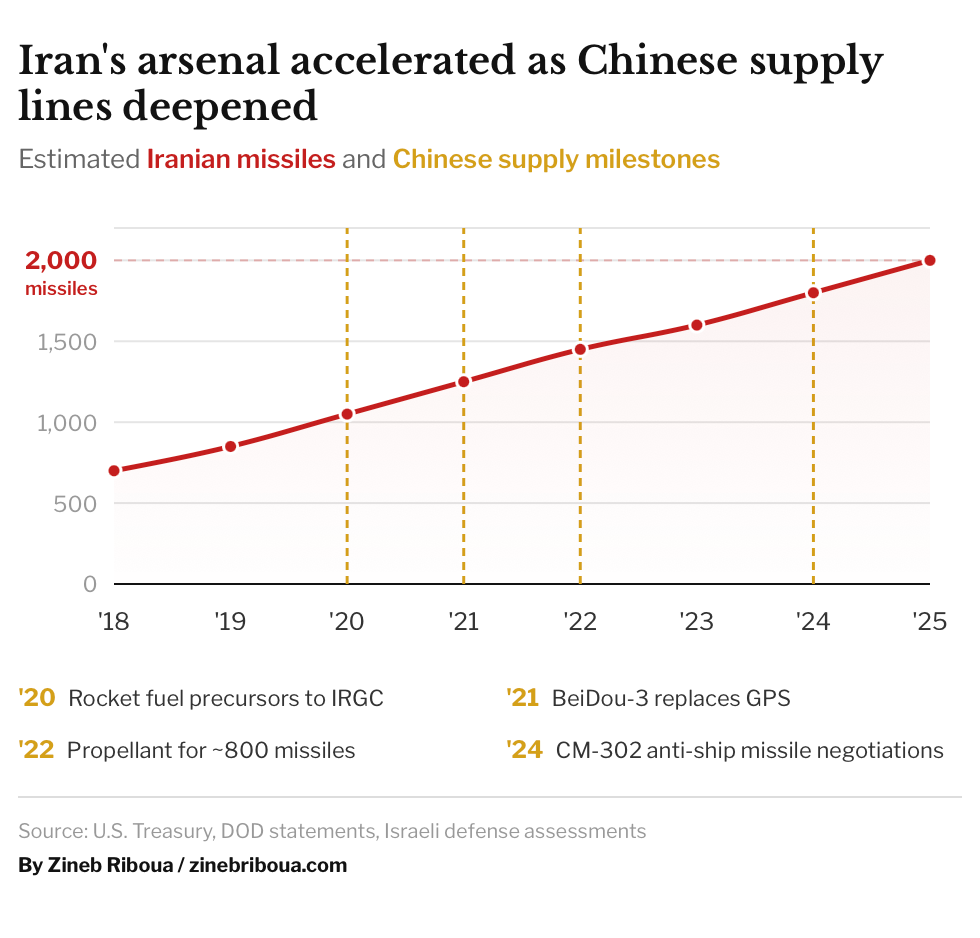
Over the past two years, China has emerged as the principal external supplier of Iran’s ballistic missile program, providing everything from chemical precursors for solid rocket fuel to satellite guidance through its BeiDou-3 navigation network, which replaced American GPS across Iran’s entire military architecture. The U.S. Treasury Department sanctioned several Chinese entities for supplying the IRGC with chemicals used in missile fuel production.
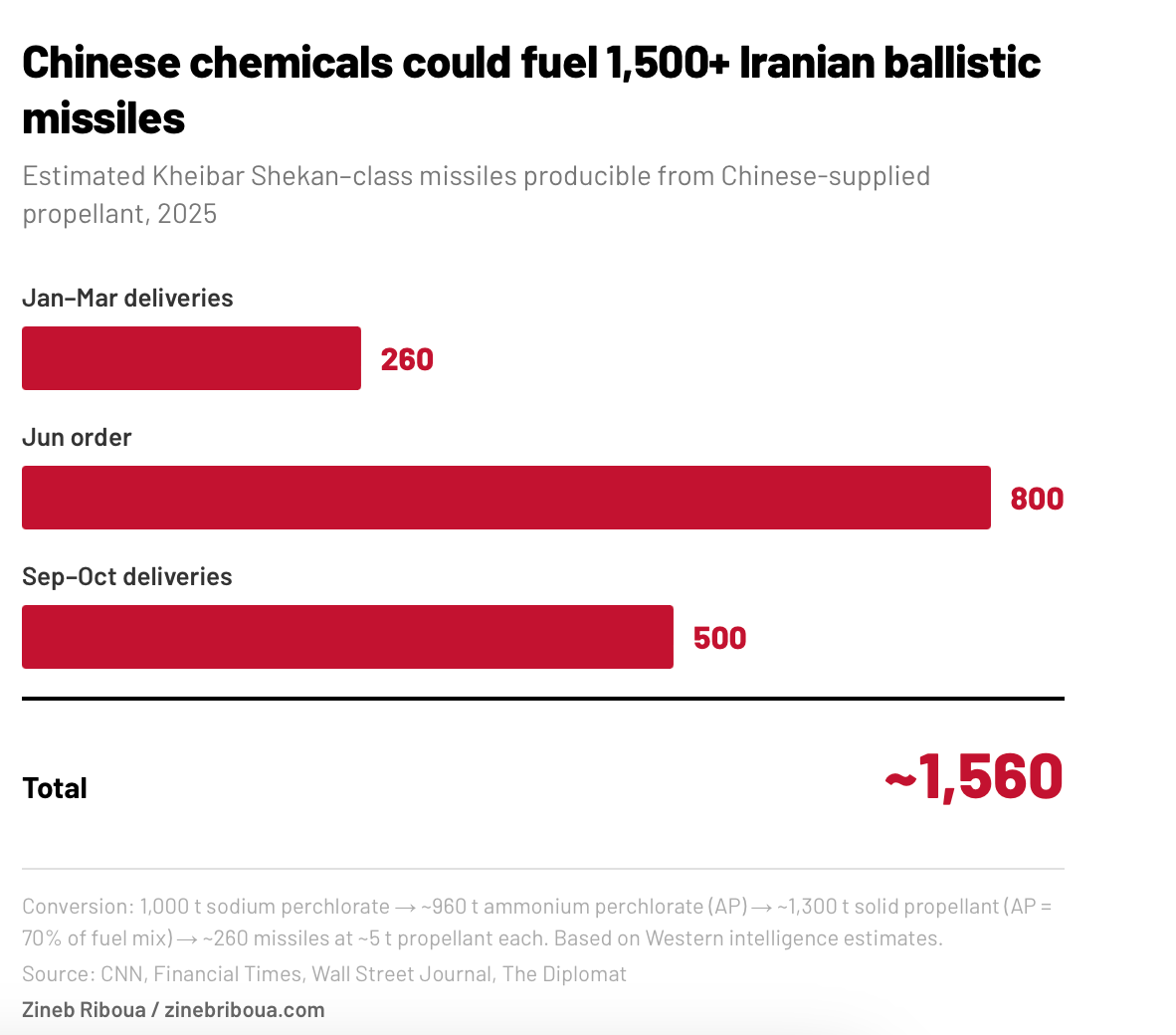
Intelligence revealed Iranian cargo ships unloading shipments of sodium perchlorate at Bandar Abbas, a substance that bypasses existing monitoring mechanisms, in quantities sufficient to produce propellant for approximately 800 new missiles in a single delivery.
Beijing had also been negotiating the sale of CM-302 supersonic anti-ship missiles to Tehran, a system designed to sink aircraft carriers. In December 2025, American special forces raided a merchant vessel in the Indian Ocean carrying Chinese military cargo bound for the Revolutionary Guards.
By the time Operation Epic Fury launched, Iran possessed the largest ballistic missile arsenal in the Middle East, an estimated 2,000 missiles of varying ranges dispersed across hardened underground facilities, rebuilt and resupplied in large part by Chinese industrial networks.
The Deferral
But let’s take a step back and look at what happened:
The Obama administration’s decision to exclude missiles from the 2015 JCPOA agreement represented a calculated concession, and more fundamentally, an act of deliberate deferral. In fact, both China and Russia categorically refused to include missile restrictions in the multilateral negotiations, and Tehran declared its indigenous missile development a non-negotiable sovereign right.
Naturally, the Obama team, determined to secure a landmark diplomatic achievement before leaving office, separated the nuclear file from the missile file entirely, treating them as two distinct problems when they formed two halves of the same threat.
Obama especially framed the deal in aspirational terms, saying it provided “an opportunity to move in a new direction,” but the direction left the missile program entirely unaddressed. In the language of UN Security Council Resolution 2231, the provisions on missiles merely “called upon” Iran not to conduct certain activities, far weaker than the binding prohibition in the prior Resolution 1929, which had explicitly prohibited Iran from pursuing ballistic missile technology capable of delivering nuclear warheads.
The administration even watered down the enforcement language of that earlier resolution to get the deal through, reasoning that missiles could be addressed later. That word, “later,” defined the entire approach. Iran tested ballistic missiles within weeks of the JCPOA entering into force, and no mechanism existed to stop it.
Free from constraint, Iran used the decade that followed to transform its missile program from a crude deterrent into a sophisticated, mass-produced strategic arsenal. It perfected guidance systems, extended ranges to cover all of the Middle East and parts of Europe, transitioned from liquid to solid-fuel propulsion, and constructed hardened underground launch facilities designed to withstand aerial bombardment. The interesting part? None of this violated a single provision of the deal.
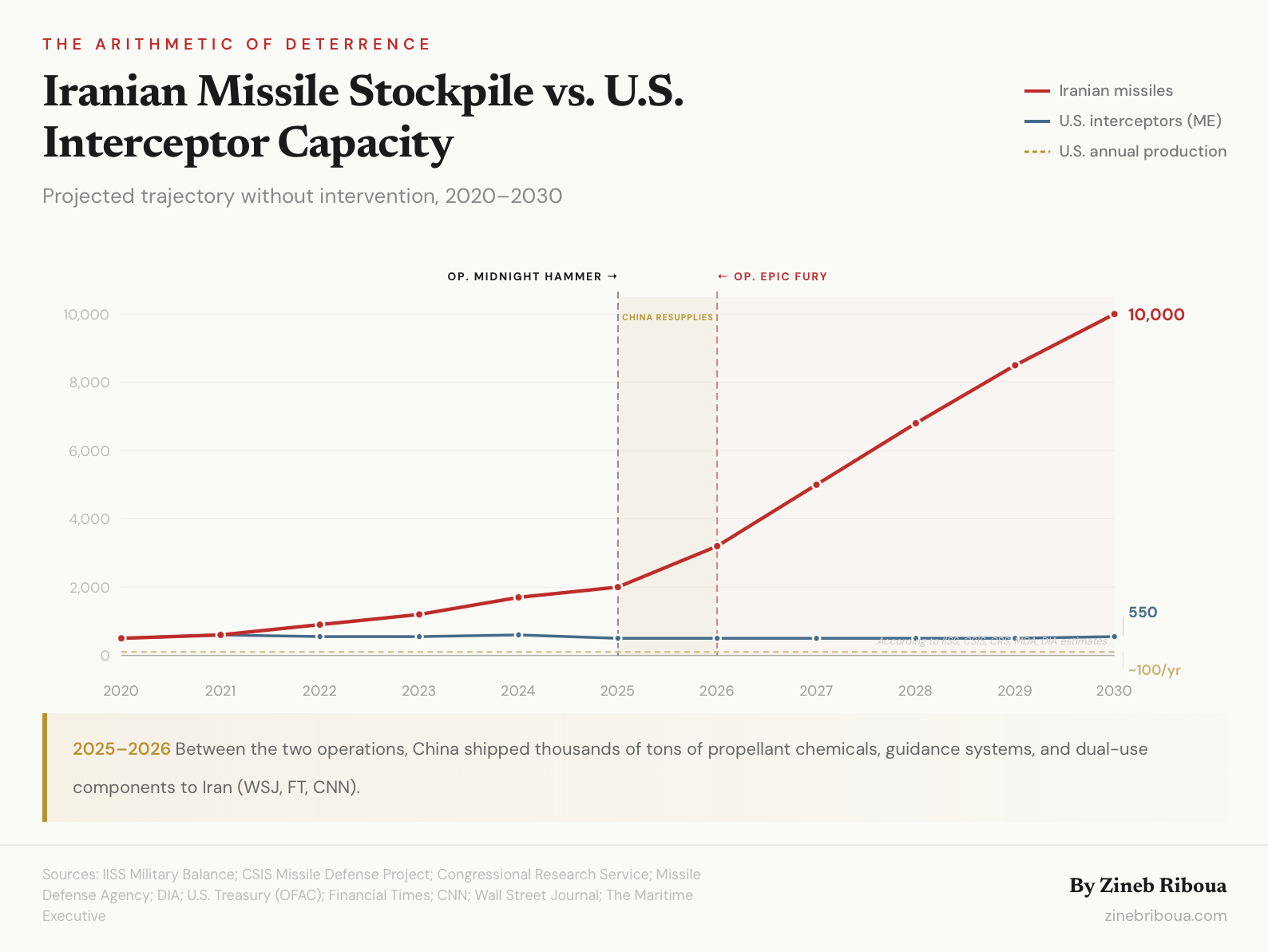
And the missiles served a purpose beyond delivery: Iran aimed to amass such an overwhelming conventional arsenal that military action against its nuclear program would become prohibitively costly. Secretary of State Marco Rubio put today the math in stark terms: “They can build 100 ballistic missiles a month. We build 6 or 7 interceptors a month.” Each interceptor costs between $1 million and $15 million, while each Iranian missile costs between $200,000 and $500,000.
But the missiles did not stop at Israel’s borders. In the opening hours of Operation Epic Fury, Iranian retaliatory strikes slammed into civilian areas across Abu Dhabi, Dubai, and Manama; debris from intercepted projectiles rained near Kuwait International Airport. In the UAE alone, three people were killed and at least 58 wounded. Iran, in this sense, was (and still is) holding Arab capitals hostage, using its missile arsenal as a coercive instrument to punish the Gulf states for daring to deepen their alignment with Washington and/or Jerusalem.
The cruelest irony is that Riyadh and Abu Dhabi saw this coming. Neither was consulted as a stakeholder during the JCPOA negotiations, and both warned — publicly and repeatedly — that any deal leaving Iran’s missile program untouched would one day endanger their populations. They were dismissed as alarmist. Iranian warheads landing on Gulf Arab soil have now settled the argument.
The Reversal
Rubio's articulation of the objectives behind Epic Fury collapsed a distinction that three decades of American diplomacy had fought to preserve. "The objectives of this operation are to destroy their ballistic missile capability and make sure they can't rebuild, and make sure that they can't hide behind that to have a nuclear program," he said. One sentence fused what the JCPOA had deliberately kept apart, the nuclear file and the missile file, and redefined what an acceptable Iran looks like.
The urgency is real. Israeli defense planners had tracked how Chinese components, machine tools, and technical guidance were accelerating Iranian production lines, and their projections pointed toward catastrophe: 5,000 missiles by 2027, potentially 10,000 by the end of the decade. Every warhead carried a Chinese fingerprint, from solid-fuel propellant chemistry to the precision guidance systems that turned inaccurate rockets into weapons capable of striking downtown Abu Dhabi. Beijing was not merely trading with Tehran.
The Chinese government was industrializing Iran’s capacity to hold the Middle East at gunpoint. Whatever Beijing’s full calculus, the military consequences of that investment are legible on at least three levels.
First, every interceptor the United States fires over the Middle East represents one fewer available for the Western Pacific. THAAD batteries, Patriot systems, and SM-3 carrying naval vessels all draw from the same overstretched production lines. By accelerating Iran’s missile output, China imposed a war of attrition on American munitions without deploying a single soldier.
Second, Every Iranian salvo also forces the United States to reveal electronic warfare capabilities, radar signatures, and interceptor performance data in real combat conditions, giving Chinese military intelligence a live laboratory to study American defense systems without ever confronting them directly.
Third, if the United States proved unable to shield its Arab partners from sustained bombardment, every ally watching from Tokyo to Manila to Taipei would draw the same conclusion: Washington’s promises have material limits.
The drain on American readiness had already begun.
During the twelve-day war in 2025, the United States burned through roughly 150 THAAD interceptors, munitions that take years to produce and that feed the same queue supporting Pacific deterrence.
Only a few dozen replacements followed. Iran was rebuilding faster than America could reload. Left unchecked, the math led to a devastating fork: accept Iranian nuclear breakout behind a missile shield too thick to penetrate, or fight a war in the Middle East with stockpiles earmarked for the Taiwan Strait. Beijing had engineered precisely this dilemma. Operation Epic Fury represented the decision to prevent that choice from ever arriving. By destroying the missiles, the United States turned years of Chinese strategic investment and billions in transferred technology to ash.
Thank you for this. I have learned much from your writing, which is by far the clearest and most insightful on the Middle East that I have read.
You seem to be way out in front of other published reports in this important area.