

The situation is obviously dynamic, but from reading today’s statements, here is my takeaway.
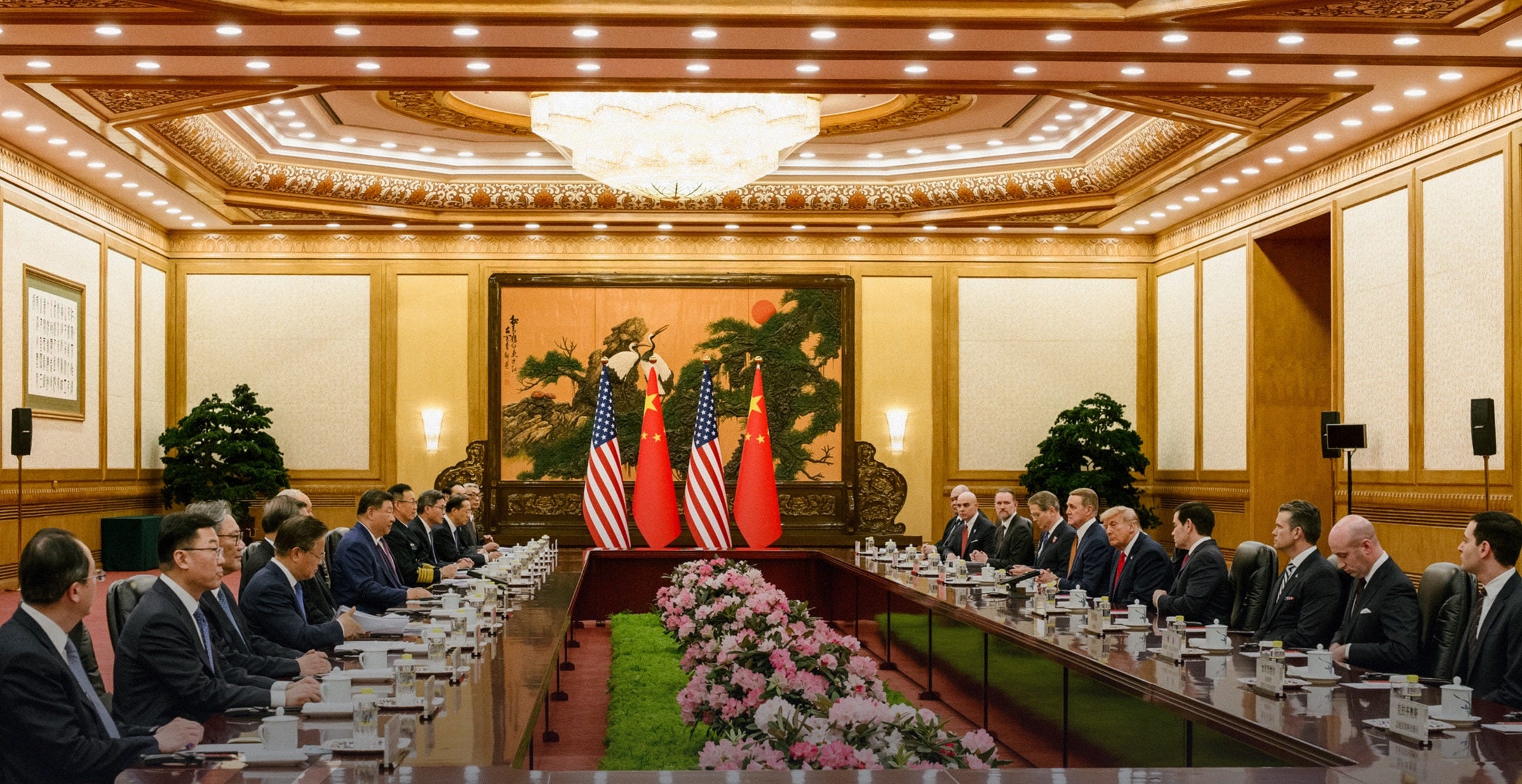
When Iran sealed the Strait of Hormuz, its genius strategists believed they held a winning hand. They expected two things: a global energy shock to force Washington into negotiations and the Gulf states to blame the disruption on US belligerence. Today, as President Trump sat across from Xi Jinping in Beijing, the first statements emerging from that summit began to reveal how thoroughly Tehran had misjudged the situation.
Diplomatic readouts on both sides are written to obscure as much as they reveal, but the White House statement from the meeting is unusually legible. The two leaders agreed that the strait must remain open to support the free flow of energy, and agreed that Iran must not acquire nuclear weapons (or, from China’s side, that Iran should have peaceful nuclear energy). Read at face value, these are bland formulations. Read against the backdrop of the past several months, they represent a significant Chinese repositioning, one Tehran will have noticed immediately.
Reports that Iranian authorities had begun allowing Chinese vessels through the strait coincided almost to the hour with the statement’s release. That synchronicity was not accidental. Tehran's opening passage for Chinese ships is less a concession to Washington than a signal of how much ground it has lost with Beijing.
The deeper story here is what Iran’s gambit cost with its most important patron.
China had extended substantial support to the Islamic Republic through the sanctions years, sustaining Iranian oil exports through teapot refineries, enabling a shadow fleet to move Iranian crude, and providing diplomatic cover at the United Nations. That relationship carried an implicit logic whereby Beijing would absorb some international costs of the Iranian partnership because it served Chinese interests. Weaponizing the Strait of Hormuz broke that arrangement entirely.
Roughly 40-50 percent of China’s crude oil imports pass through the strait, and by threatening the waterway indiscriminately, Tehran was undermining the energy security of the one government still willing to shield it.
When China subsequently blocked a Bahrain-sponsored UN resolution condemning Iran's weaponization of the strait, it exposed the contradiction at the center of its Gulf strategy: defending a partner whose conduct was actively alienating the regional relationships Beijing valued most. Which is why this morning’s statement reads as if Beijing had stopped absorbing that contradiction.
The nuclear language in the summit statement also deserves particular attention, especially given what Tehran was still saying just days earlier.
On May 10, Iran’s ambassador to China, Abdolreza Rahmani Fazli, said Beijing could serve as the guarantor of a future deal between Iran and major world powers, and that any agreement should ultimately be endorsed by the UN Security Council. The statement reflected Tehran’s long-standing preference for multilateral guarantees over bilateral commitments, but more immediately, Iran was still counting on China as its primary diplomatic anchor.
Beijing’s summit statement reaffirmed its longstanding support for Iran’s peaceful nuclear activities, as the IRGC expected, but by endorsing the anti-proliferation standard with Washington, Beijing withdrew diplomatic cover from the IRGC’s weapons ambitions at the precise moment the IRGC most needed that cover.
“Delay and dilution of sanctions rather than outright obstruction seems to be the strategy of Chinese diplomats in dealing with Iran’s nuclear intransigence. China and Russia have balked at certain provisions but have voted for UN Security Council resolutions targeting individuals, companies, and institutions suspected of facilitating Iran’s nuclear and ballistic missile programs.”
China-Iran: A Limited Partnership - Prepared for the USCC by Marybeth Davis, James Lecky, Torrey Froscher, David Chen, Abel Kerevel, Stephen Schlaikjer, CENTRA Technology, Inc.,
The context around Xi Jinping’s interest in purchasing greater quantities of US oil sharpens the picture.
Days before the summit, the U.S. Treasury sanctioned Hengli Petrochemical, one of China’s largest petrochemical refineries and a known processor of Iranian crude subject to sanctions. The interesting part is that Beijing had been enabling Iranian crude exports while simultaneously trying to shield its own companies from U.S. designation, a dual position that Xi’s pre-summit order prohibiting Chinese firms from complying with U.S. sanctions could not sustain once Washington refused to ease the pressure.
This is why Trump’s offer of US energy to China during the summit carries immense consequences.
China has always sought the cheapest available energy to fuel its industrial base, and Iranian crude, heavily discounted under sanctions, served that purpose for years. Cheap U.S. energy offers Beijing an alternative that does not come with Gulf relationships to manage or Chinese companies to protect from U.S. sanctions.
However, reading Beijing's repositioning as a strategic alignment with Washington against Tehran entirely misreads the relationship. What the past several months have demonstrated to China is that enabling the Islamic Republic generates compounding liabilities, and those liabilities now have a price tag attached to specific Chinese firms. A less entangled China is not a hostile China toward Tehran, but a China that can afford to watch Iranian decisions produce their own consequences without intervening to soften them.
More crucially, every future barrel China sources from the Western Hemisphere is a barrel that does not flow through the IRGC’s revenue stream, and that revenue is what sustains the weapons programs, the proxy networks, and the institutional ambitions that have kept the region in a state of managed instability.
Whether the energy arrangement materializes remains to be seen, but the offer is attractive to Beijing, which has watched the US Treasury designate Chinese-linked companies that sustain Iranian crude exports without hesitation. Operation Epic Fury is already compressing the IRGC’s economic base, and these signals, taken together, will not necessarily alter the IRGC’s strategic course. What they will do is amplify the perception of Iranian isolation, which, for a leadership that tracks X posts and meme cycles as proxies for regional sentiment, carries its own weight.
Zineb always brings out more significant factors than appear elsewhere. A breath of fresh air.
Thank you Zineb for your vision!