

On January 5, 1950, in the French daily Le Figaro, Raymond Aron, a prophet of his time, analyzed the causes and consequences of the Communist victory in China.
Source: Le Figaro. Publisher: Pierre Brisson. July 26, 1951. Paris: Le Figaro. “Revolution in Asia,” by Raymond Aron, pp. 1, 10.
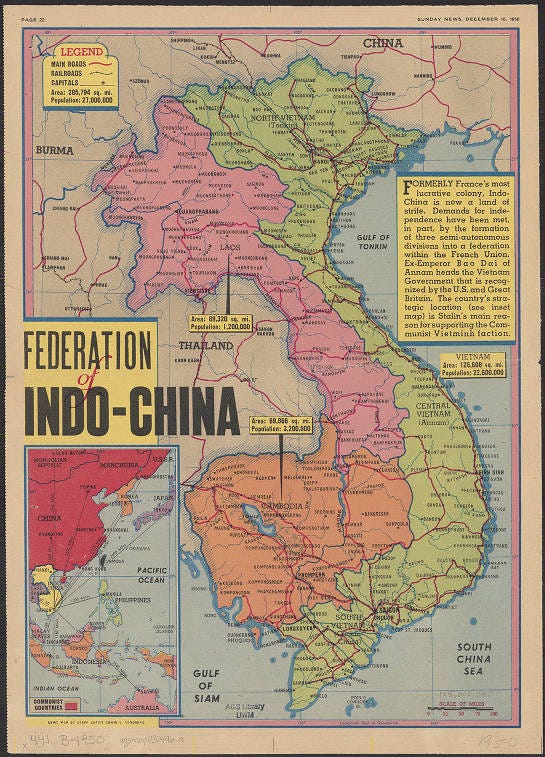
Until now, it seemed that the war in China held little interest for the French public. It took the arrival of Mao Tse-tung’s troops at the border of Indochina to shake this indifference1. And yet, the conquest of the former Middle Kingdom by a revolutionary party, claiming an ideology of Western origin that has become the official religion of a Eurasian empire, constitutes a historical event that is paradoxical in appearance and whose consequences remain unpredictable.
With regard to what is happening in the Far East, two extreme attitudes seem equally misguided to me. Some commentators tend to believe that the problems of Asia are analogous to those of Europe, on the pretext that the same antagonists are found in both. Others, on the contrary, refuse to² link the course of politics in the Far East to the international situation, on the pretext that Mao Tse-tung’s success is explained above all not by Moscow’s influence but by conditions specific to China itself. The entire difficulty lies in the meeting of the Chinese revolution with the global situation.
Chinese Communism
Competent observers agree on a certain number of points that may be taken as established.
The triumph of the Chinese communists more closely resembles that of the Bolshevik party in Russia from 1917 to 1921 than the Sovietization of the Eastern Bloc, which was made possible by the presence of the Soviet army. Chiang Kai-shek received more aid from the United States than Mao Tse-tung did from Russia.
The latter contributed to the arming of the communist troops by handing over the equipment of the Japanese armies and delayed in various ways the arrival of nationalist divisions in Manchuria. But nearly all witnesses, even those with Western sympathies, affirm that in the aftermath of General Marshall’s failed mediation attempt2, the nationalists still enjoyed material superiority, particularly in terms of heavy weaponry. It was from their adversaries that the communists seized the greater part of their tanks.
In China, one finds all the conditions that open the path to power for revolutionary parties, and in particular for the Communist Party: the poverty of the masses, too numerous for too narrow a land; the revolt of peasants against large landowners, against usury, against taxes levied by a hated state; the disintegration of the traditional hierarchy following several decades of unrest and also the guerrilla warfare waged against the Japanese; the weakness and corruption of the former administration; and the moral and political decomposition of the ruling elite.
The example of China, following that of Russia, shows that Marxism, conceived by Marx for post-capitalist societies, has the greatest chance of prevailing in pre-capitalist ones.
The leaders of Chinese communism are not agrarian reformers, contrary to the ambiguity they once suggested to the West. They are loyal Stalinists, and their past is unblemished.
Since the break with the Kuomintang in 1927, they have consistently, in their speeches and it seems also in their actions, followed the directives of the Comintern and later of the Cominform. They denounce Tito with dutiful precision. After their failure in the southern cities and the Long March, they settled in a primitive northwestern province (Yennan) and placed their bet on agrarian revolution. But there is no reason to believe that this, in their eyes, is anything more than a stage. A Soviet-style society remains their ultimate goal. The question is whether they will have the means to build it.
The possibility of a Chinese “Titoism,” so often evoked already, seems for the moment highly unlikely. The Chinese government’s dependence on Moscow’s political bureau is not as tight as that of the satellite governments in Europe. Tito’s rebellion was due in part to the economic exploitation that came with submission to Moscow, and in part to the Soviet authorities’ insistence on maintaining strict control over the military and police apparatus of the people’s democracies. It appears that these mistakes will not be repeated with regard to a government that rules over 400 million people, more nationalist than communist, and inclined toward xenophobia.
On the other hand, no one can predict what form the communist regime in China will take. In the long term, it will probably depend less on a few thousand militants trained in Moscow than on the Chinese people themselves. But a statesman cannot afford to look so far ahead.
American opinion rightly sees the rise of communism as a disaster. Washington's diplomacy has traditionally protected China from the encroachments of European imperialism. During the war, it regarded China as a great power of the future and pressed this view upon its allies.
The result is that tomorrow the Soviet bloc may count a second permanent member on the Security Council. China, whose integrity, strength, and prosperity the United States sincerely sought to defend, now stands as an enemy, repeating with the fervor of a recent convert the denunciations and doctrines of its master.
The disaster is more political than military. The task of transforming China into a modern state is far greater in scale than the one the Bolsheviks undertook. Mao Tse-tung starts from a much lower point. It is not enough to redistribute land to feed the millions of impoverished peasants. Russia’s industrial base had already been established under the imperial regime and had developed rapidly in the twenty years preceding the 1917 revolution. China lacks everything: administrative personnel, engineers, and capital. Without foreign assistance, industrialization funded by domestic savings will lead to hardships even more severe than those experienced by the Soviet Union during the first five-year plans.
No doubt, in the event of a third world war, communist China would most likely align with the Soviet camp and pose a threat to Southeast Asian territories. But that is not, for now, the decisive consideration. Even apart from any strategic calculation, Americans cannot help but regard as a catastrophe the expansion of the zone in which Stalinist orthodoxy prevails and the shrinking of the zone through which goods, people, and ideas circulate freely.
Criticism of the policy adopted by the State Department is easy. The United States supported Chiang Kai-shek enough to earn the enmity of the communists3, and even of many Chinese who were hostile to the Kuomintang, but not sufficient to ensure his success. Yet the State Department's response, as expressed in the White Paper4, has not been refuted. Billions of additional dollars would not have saved the nationalists, unless they had undertaken reforms of which they were incapable. And American public opinion would not have tolerated complete non-intervention. Nevertheless, the solution that was adopted—reluctant support, perhaps inevitable—carried nearly all the disadvantages.
And so the search continues, with no clear path in sight.
In December 1949, Red China’s triumphant Mao Tse-tung reached the IndoChina border, and started ferrying up to 3,000 tons of supplies a month to Comrade Ho. https://time.com/archive/6794840/foreign-news-indochina-the-worlds-oldest-war/
In January 1946, President Truman sent George Marshall to China to unite the U.S.-favored Chinese Nationalist Party, headed by Chiang Kai-shek, and the Chinese Communist Party, headed by Mao Zedong, in order to achieve a ceasefire and prevent a civil war. Marshall gained initial success: both Chiang and Mao seemed favorable to the cease-fire agreement. Marshall's efforts to deal with the two power-corrupted leaders, however, proved futile since the two parties had different political agendas. https://www.tandfonline.com/doi/full/10.1080/1547402X.2020.1788865#:~:text=Abstract,attempt%20to%20achieve%20the%20impossible.
Letter of the Ambassador in China (Stuart) to the Secretary of State: “The United States Government equipped, trained, and transported Kuomintang troops to North China, Central China, and Manchuria to wage internecine war. It has equipped and trained 60 divisions for Chiang Kai-shek dictatorial government of which 20 divisions were equipped just on eve of Japanese surrender.” https://history.state.gov/historicaldocuments/frus1946v10/d220
In August of 1949, the Truman administration published the “China White Paper,” which explained past U.S. policy toward China based upon the principle that only Chinese forces could determine the outcome of their civil war. Unfortunately for Truman, this step failed to protect his administration from charges of having “lost” China. https://history.state.gov/milestones/1945-1952/chinese-rev