

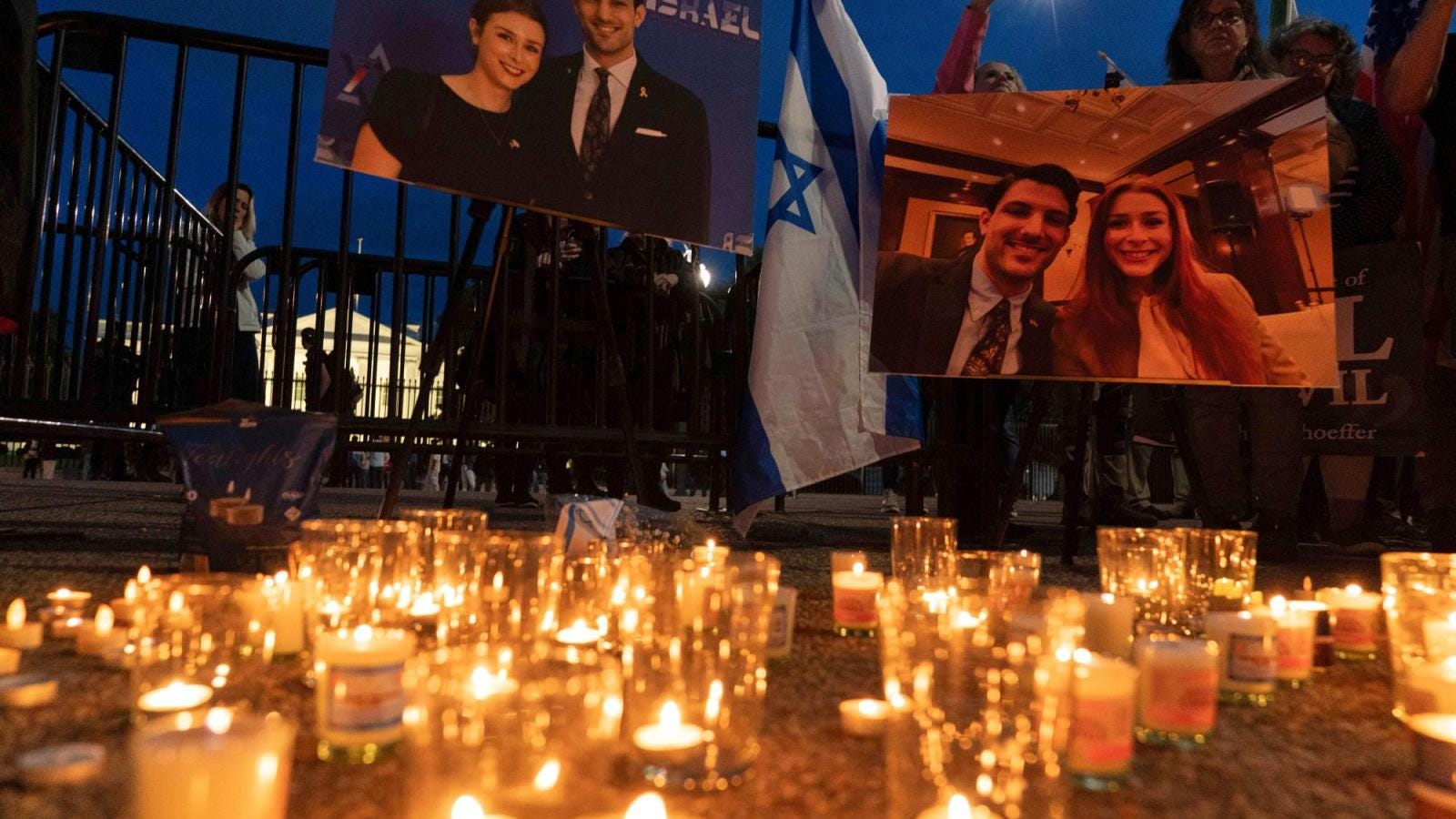
One year ago on a night like this one, a terrorist criminal shot my dear friend Yaron and his fiancée, Sarah.
The next morning, my phone lit with a message from my friend Ethan. He told me “It’s Yaron”. I searched the headlines and found a news report about two Israeli embassy staffers killed in a targeted attack. I got it. I will never forget that moment.
For a few seconds, part of me still believed I was hallucinating. Then I understood it was real. The gunman had walked into the Capital Jewish Museum and killed them both. I sat in the dark early in the morning, cried, dressed, and went to work, because Yaron and Sarah had planned to join me that day for the first conference I had ever organized, and I decided that keeping moving was the only form of honor I had left to offer.
His name was Elias Rodriguez, 31 years old, from Chicago. When event security apprehended him, he pulled out a keffiyeh, said “I did it. I did it for Gaza,” and began chanting “Free, free Palestine.”
Less than an hour after the shooting, a manifesto titled Escalate For Gaza, Bring The War Home appeared on X under his name, defending armed violence against Israel and situating it within an ideological framework of anti-imperialist resistance. The FBI examined the manifesto and found little ambiguity about what it said. Rodriguez was not some feral actor without a history. He had ties to the Party for Socialism and Liberation and arrived at that reception with a real purpose.
Growing up, I absorbed a great deal of propaganda and came away largely immune to ideological capture, though I cannot entirely explain why. That immunity prepared me for nothing when it came to confronting the actual logic of murder. What has become clear to me in the year since is that there are people who loved that Yaron died. They genuinely did.
They announced the murders online, reveled in them, and framed them as justice delivered to an enemy of the people. I had not been prepared for that.
I found comment sections full of ordinary people, many of them educated and professionally credentialed, expressing satisfaction that Yaron was dead. “This is what you get.” That he was a Christian who had dedicated his life to Israeli-Palestinian peace was irrelevant to that judgment. He was an Israeli who worked in America, and that was sufficient. The genocide charge and the Great Satan designation did the rest.
In fact, the newspaper of Ali Khamenei's regime praised the killer, calling him "our dear brother." "Our dear brother Elias Rodriguez, who killed two Israelis in the U.S., has founded the Washington Basij," the paper wrote. Khamenei himself joined the chorus, making clear that the approval was an official endorsement from the top of the Iranian state.
What changed in me was precisely this, the understanding that ideas and policies have logical conclusions, and that I spent too long assuming those conclusions were hypothetical.
When people chanted "globalize the intifada," when they declared “Americans evil” or “the West genocidal”, I processed those slogans from a comfortable analytical remove, as political theater. Yaron's death ended that for me. The slogans had always been instructions. I had simply chosen to read them otherwise.
In the year that followed, I have tried to honor that reckoning by writing more, explaining more, and staying close to what remains. I have met Yaron’s brothers and sister and his parents, and I have stayed in contact with the family. I bury that grief very deep, deeper than I know how to say. Looking at his brother’s face, I see Yaron’s exact smile, and that alone is painful.
I want to thank my family, and every one of you who reached out, who sent a note, an email, or simply checked in. I am deeply grateful, and I apologize to those whose messages I never answered.
I am writing this because I want people to remember that it happened, to remember who did it and under what ideological sanction, and to resist the drift toward forgetting that follows every act of political violence once the news cycle has moved on. I recognize how that sounds. But in the year since Yaron and Sarah were killed, I have watched enough reactions online, from enough people in enough countries, to understand that the forgetting is not always passive. Some people were never troubled by it to begin with.
That is what frightens me, more than the killer himself. The killer was one person. The people who smiled or rejoiced are beyond counting.
Yaron and Sarah deserve to be remembered and the circumstances of their deaths deserve to be named with precision.
His death taught me, among other things, the importance of friendship and what it means to nurture it. I am, by habit and by temperament, someone reserved who works too much and disappears into the work. The burn I carry from his killing has stayed with me, and I expect it will remain, but it has taught me that the people who matter require more than good intentions.
I have also made myself a promise. Whenever I am demoralized, whenever I am mocked or insulted, whenever the work feels useless and the cost of doing it feels too high, I will remember that I am fighting for Yaron and Sarah. That promise has held me, more than once, when nothing else could.
There is so much more I want to say, so much I want to explain, but this is the best I can do. Please don’t forget them.
Below is my tribute, special thanks to Tablet Magazine for publishing it.
Losing Yaron
MAY 26, 2025
The memory of my last hug with Yaron Lischinsky stays with me. It was quick and familiar, as I crossed the street. He smiled, warm and full of life, and said goodbye with a steadiness that made it feel like we’d see each other again the next day. I didn’t know it would be the last time.
Now every detail stands out. The light in his eyes. The way he carried himself. How he made ordinary moments feel meaningful. Yaron was a rare person, thoughtful, kind, and generous. He had a way of making people feel valued.
He was also one of my closest friends.
Though we both held public roles in spaces that demanded constant engagement, we were more reserved by nature. We found comfort in the pauses that didn’t need filling, in the ease of simply being around each other. Where the world pushed for attention, we found meaning in presence, in the steady rhythm of thoughtful conversation.
We met two years ago, and since our first exchange, we never stopped talking. Long lunches between meetings, dinners stretched by ideas, I would find every excuse to invite him to events I was hosting. We spoke about books, belief, politics, and the future. After Oct. 7, when the world shifted in ways that were hard to name, I could see something change in Yaron. His expressions became more focused, his silences heavier. The work he had always taken seriously now carried an added urgency. He spoke less, but when he did, it was with clarity shaped by grief and resolve. The hostages weighed on him. He thought about them and their families constantly.
Yaron’s life was a testament to duty without fanfare: a man who served not for recognition, but because it was who he was. Working with him was a rare kind of partnership. His insights brought steadiness to discussions. I was often the fire in our conversations. I would vent about writings, ideas or opinions that bothered me. Yaron was always calm. He’d listen, lean back, a faint smile tugging at his lips, and say, “Ah, you know ...” Then, thoughtfully, he’d unravel the knot of my anger, helping me carry it without letting it consume me. I left every exchange with a clearer head, more certain of what mattered.
His memory was a gift that held your words long after they were spoken. Days after a conversation, a message would arrive, a quote, an article, a recommendation, always prefaced with, “You’ll find this interesting …” And it always was.
Years earlier, he had pursued an Asia studies minor in college and had studied Japanese, and those interests remained with him. They shaped how he saw global dynamics, how he thought about responsibility, and how seriously he took the inner lives of other nations. He also told me how much he wished there were more academic programs like this, ones that could help Israelis understand Americans more deeply, and Americans come to know Israelis beyond headlines and policy debates, through real conversation and mutual respect.
For Yaron, this kind of understanding required more than policy. It required taking belief seriously. His Christian faith and belief in grace were the pulse of his life. His interest in theology shaped the way he approached everything. He once told me, “People who don’t understand religion should never be in politics.” He believed that without understanding what others hold sacred, leaders fail to grasp what drives loyalty, fear, and hope. For Yaron, religion was part of what made people human.
I never met Sarah, but through Yaron’s words, she became intimately familiar to me. His voice softened when he spoke of her, his eyes glowing with admiration for her strength, her joy, her unwavering commitment to peace. Sarah dedicated her life to building bridges between Israelis and Palestinians, work that mirrored Yaron’s own mission to foster understanding in a region torn by conflict. Together, they carried a shared purpose: a Middle East where coexistence was not just possible but real. He told me she loved my native Morocco, that she and I should get together and think of what we can do for Morocco’s Jewish heritage, he believed we’d get along perfectly. He was ready to propose to her, to weave their lives into a shared future, and I teased him about cooking couscous for their ceremony.
Then came that shattering Thursday. I woke, the air thick with an unplaceable dread. My phone glowed with a friend’s message: “Hey, I don’t want to say this, but it’s Yaron.” My heart stopped. I scoured the news: “Two Israeli embassy staffers killed in targeted attack.” No names. No faces. But I knew.
I wept in the dark willing it to be untrue. It was 4 in the morning. I had to get ready, go to work, keep things moving, at least in his honor, because that day, I knew Yaron and Sarah were supposed to be with me at a conference at the Hudson Institute. I forced myself to smile to trick my brain.
The hatred Yaron confronted, with patience, clarity and grace, had found him. At the conference he helped me plan, his name tag waited: “Yaron Lischinsky,” printed, cut, expectant. He had registered. He had made time, as he always did.
But he was gone. And so was Sarah. Taken not by chance, but targeted. A man looked at them and saw something he could not tolerate, and he pulled the trigger. Yaron had spent his life naming that danger. Sarah had spent hers forging relationships. It was often painful. But they persevered, because they believed that understanding mattered. That the people around them still deserved to be reached.
Yaron Lischinsky and Sarah Milgrim were thoughtful, kind, and full of promise. They should have been able to build a life and grow old together. Instead, their families are left with grief, their friends and colleagues with silence.
But the way they lived still matters. They moved through the world with care, with purpose, and with love that asked nothing in return.
It lives in memory, in absence, and in the responsibility of carrying them forward.
Great remembrance and you are right: too many people rejoiced, never cared or moved on. We can't leave Sarah and Yaron behind. Keep remembering.
Thank you, Zineb for remembering - then reminding the world about that tragedy.