

This piece was originally published in The Free Press
“Iran stands alone, and they are badly losing.”
So said Defense Secretary Pete Hegseth at a Pentagon briefing on Tuesday. The country’s “neighbors, and in some cases former allies in the Gulf,” he added, “have abandoned them, and their proxies, Hezbollah, the Houthis, and Hamas, [are] either broken, ineffective or on the sidelines.”
The assessment deserves more attention than it has received. Hegseth described Iran’s isolation as a military outcome, but it was in fact a structural inevitability — one confirmed when U.S. Representative to the United Nations Mike Waltz announced that Washington stood with its Gulf Arab allies in a unanimous Security Council vote condemning Iran for its attacks on civilians across the region. By accelerating a regional realignment already underway, Operation Epic Fury has handed Washington a rare strategic opportunity: the consolidation of an Abraham Accords 2.0, one that elevates normalized relations between Israel and the Gulf states from diplomatic symbolism into an integrated security architecture.
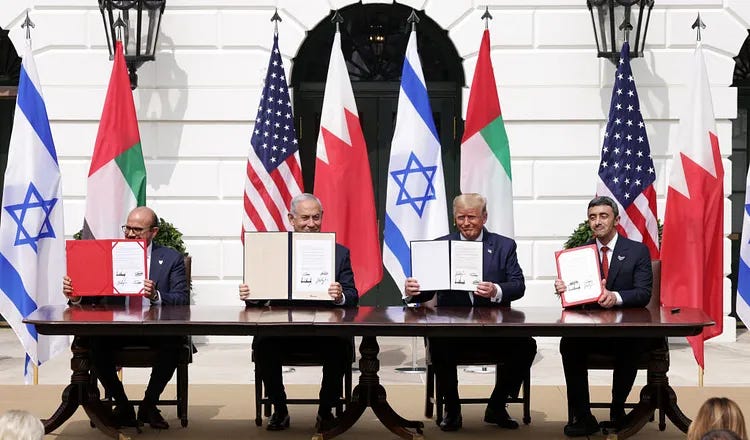
To understand why this moment is so consequential, one must first understand that Iran has spent years trying to combat the regional order established by the 2020 Abraham Accords. Those accords—normalization agreements signed between Israel, the United Arab Emirates, Bahrain, Sudan, and Morocco—set in motion a Washington-anchored system in which Arab states would work economically and strategically with Israel under American sponsorship.
Each new agreement narrowed Tehran’s room to maneuver in a region where it had long enjoyed influence. Which is why, when the UAE and Bahrain normalized relations with Israel in September 2020, Iranian officials described the agreements as a betrayal of the Palestinian cause and a capitulation to Zionist power. The condemnation was designed to shame the signatories and deter others. They were not ideological reactions; they were geopolitical weapons.
Then, in 2023, active negotiations for Saudi-Israeli normalization began. Later that same year, Israeli Prime Minister Benjamin Netanyahu met with Turkish President Tayyip Erdogan after years of rupture between the two countries, confirming that the security architecture was closing in on Tehran from multiple directions.
October 7, 2023, was Iran’s answer to this threat. Hamas was the instrument, and the assault was a strategic decision.
Following the Hamas massacre, Tehran moved with unmistakable ambition to assert a new regional order. It positioned itself as the indispensable patron of Palestinian resistance, and the moral center of a Muslim world awakened to injustice. Through Hezbollah in Lebanon, the Houthis in Yemen, and Iraqi militias, it projected the image of a unified Axis of Resistance operating under a single strategic vision. Iranian Supreme Leader Ali Khamenei terrorized any government contemplating normalization with Israel, declaring that Muslim states pursuing such agreements were “betting on a losing horse,” and that Tehran reserved the authority to determine which nations remained within the fold of the Islamic world and which had surrendered their place in it.
But by taking that posture, Iran blatantly ignored what it had actually been doing to its neighbors for years. The same government presenting itself as the champion of Muslim unity had been arming Houthi forces that had repeatedly struck Saudi oil infrastructure, including the Abqaiq facility in 2019—one of the most consequential attacks on global energy supply in decades. Further, Iranian-backed militias targeted Emirati territory in 2022; Tehran fomented instability in Bahrain in 2011; and Iranian-financed proxies perpetually threatened Gulf governments. Iran has also treated Azerbaijan’s deepening ties with Israel as an existential provocation and worked systematically to frustrate it. Even the China-brokered normalization agreement between Riyadh and Tehran in March 2023 proved to be a diplomatic veneer over deep-seated structural antagonism, rather than a genuine strategic realignment.
In short, prior to the Hamas invasion, Iran had attacked or destabilized every neighbor it now claimed to lead, and destroyed by its own hand the myth of Muslim solidarity it was trying to so carefully construct.
Which is why it’s no surprise that the Gulf states drew their own conclusions about Iran long before the first America and Israel’s strikes began earlier this month. That doesn’t mean they were totally aligned with America, of course; the Obama administration’s 2015 Iran Nuclear Deal, and the Biden administration’s return to nuclear diplomacy in 2021, each signaled to Gulf capitals that Washington’s commitment to their security was negotiable, and that accommodation with Tehran could be pursued at their expense. Several governments responded by cultivating ties with Beijing and attempting to diversify their strategic relationships as insurance against American unreliability. But what they could not escape was Tehran’s fundamental view of them. In Iran’s strategic thinking, Riyadh and Abu Dhabi were American outposts by nature. No amount of hedging, no overture to Beijing, no declaration of strategic autonomy altered that judgment.
The events of recent weeks have vindicated that understanding, for intelligence assessments have confirmed what Gulf planners long suspected: Iranian weapons systems were positioned with Gulf targets specifically in mind. The missile-and-drone architecture Tehran constructed across the region was designed not as a deterrent against Israeli power, but as a mechanism to hold Gulf capitals at perpetual risk, limit their policy options, and extract their deference.
The Abraham Accords, viewed through this lens, were never merely diplomatic gestures toward a distant peace process. They were a security imperative rooted in a hard-eyed recognition that the Gulf states and Israel shared a threat environment that demanded a shared response, and that the pretense of neutrality in the face of sustained Iranian aggression had long since ceased to be a viable posture for any government serious about its own survival.
***
Operation Epic Fury has translated that shared threat perception into functional cooperation. Even as the campaign continues, the conditions for an Abraham Accords 2.0 are already taking shape. Whether we end up with a chastened Islamic Republic that seeks reintegration into the regional order, or a successor government that charts an entirely different course, the strategic reality will be the same: a Middle East in which the case for deeper Arab-Israeli security cooperation has been made more forcefully than any diplomat could have managed at a negotiating table.
Beyond striking Gulf oil infrastructure, Iran had counted on Operation Epic Fury to do what earlier rounds of Israeli-Iranian confrontation had never quite managed: ignite the Muslim street. Tehran calculated that Gulf populations, watching American and Israeli forces dismantle the Islamic Republic, would pour into the streets in condemnation, that the language of Zionism and resistance would once again animate the Arab world into a posture of solidarity with Iran. None of it materialized. The transnational Muslim constituency Tehran believed it commanded simply did not respond, exposing, perhaps more starkly than any military outcome, the degree to which Iran’s ideological capital had already been spent — squandered not only through decades of hollow revolutionary rhetoric, but through the far more concrete offense of having struck the very countries whose populations it now expected to rise in its defense.
That presents an opportunity Washington cannot afford to squander.
At a moment when the United States is drawing down its direct military presence in Syria, Israeli-Arab coordination against common threats has never been more desirable. The Trump administration’s preference for burden-sharing over open-ended commitment finds its most natural expression in precisely this kind of framework.
The Abraham Accords are also a direct answer to China’s Belt and Road Initiative. Beijing has spent the better part of two decades cultivating Middle Eastern influence through infrastructure finance, arms sales, and diplomatic mediation. An expanded and strengthened Accords would construct a competing network rooted in shared security interests and American sponsorship. The India-Middle East-Europe Economic Corridor, an infrastructure network launched in the region in 2023, extends that logic further, offering Gulf governments the option to route resources through allied capitals rather than through Beijing.
Iran’s diminished status as a regional power does not dissolve the underlying competition for influence in the Middle East. If anything, it sharpens the urgency of what comes next, because the window now open will not remain so indefinitely. Every normalization agreement is simultaneously an economic choice and a security arrangement. China has understood this from the beginning, and Washington has too long allowed this vacuum to go uncontested.
America can lock in a strategic advantage by brokering normalization agreements with additional Arab states, granting formal security guarantees and defense cooperation agreements, and integrating Israeli capabilities into a Gulf-anchored deterrence framework. With Iran weaker than ever, the present moment demands a Middle East regional order that reflects American interests, sustains Israeli security, and raises the cost of Chinese and Iranian re-entry far beyond what either can presently afford.
Pete Hegseth was right. Iran stands alone. The question before Washington is whether it will recognize the opening for the most consequential strategic consolidation the region has seen in a generation.
American unreliability in the Gulf is rooted in our ignorance of the history detailed in this article. Our intolerance for short-term loss (higher gas prices/ inflation) drives the countervailing narrative that this war serves only Trump’s ambitions. This drives the conviction that the mid-terms will be a blood bath. Here’s to hoping that Americans can build the institutional memory to see through the fog of this war, and stay the course.
As a side-issue (at least for the moment), whither Gaza? My assumption is that once the fighting ends, the GCC will be much more interested in reconstituting their own countries than pouring additional billions into any Hamas controlled area. Israel could essentially annex the c50% that it currently occupies with relatively little blowback. More important is the strategy of Saudi Arabia-how far will they move towards normalisation with Israel?