

Why Trump Tied Saudi Arabia’s Nuclear Future to Israel
A civilian nuclear deal with Riyadh could reshape the Middle East

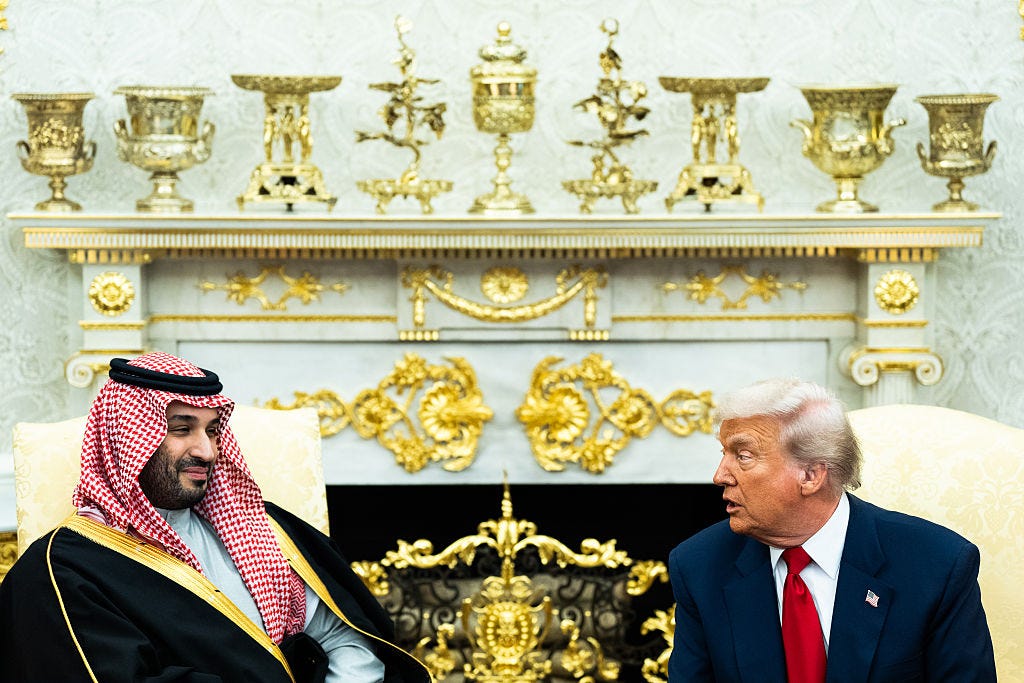
This piece was originally published in The Free Press
On Wednesday evening, the media erupted when the Trump administration announced that it would be signing a 30-year nuclear agreement with Saudi Arabia. Under the terms of the deal, the U.S. would export nuclear materials to the Saudis and support the development of a civilian nuclear power program, prompting alarming headlines about how this might pave the way for Saudi Arabia to pursue uranium enrichment—and potentially develop a nuclear weapon.
Then, on Thursday morning, President Donald Trump revealed that the deal was contingent on Saudi accession to the Abraham Accords. In other words, Saudi Arabia would have to establish diplomatic ties with the state of Israel—an objective long desired by the Trump administration—if it wanted access to U.S. technology and expanded security and economic cooperation.
The possible deal would accelerate the profound reorientation of the Middle East that is already underway. Since the war with Iran began on February 28, Arab countries have learned the hard way where they stand within the U.S.-led security order. As Iranian missiles rained down on their capitals, governments that had invested in military cooperation with Washington and Jerusalem benefited from years of integrated intelligence, early warning, and missile defense. Those that preferred strategic ambiguity discovered the limits of that approach.
The lesson was not lost on Washington. President Trump’s negotiating position over the past few days reflects a broader strategic objective: to build a regional order in which U.S. allies reinforce one another through intelligence sharing, integrated air defense, advanced technology, and energy cooperation such that the system functions even when American attention turns elsewhere. Saudi-Israeli normalization is the missing keystone to that goal.
The prospect of Saudi accession to the Abraham Accords comes not a moment too soon.
America’s main adversaries are racing to build nuclear infrastructure in the Middle East. Russia’s Rosatom, a state-owned nuclear energy corporation, is currently constructing reactors in Egypt and Turkey. Chinese state-owned nuclear firms are pursuing projects across the Gulf, including in Saudi Arabia. Moscow and Beijing understand that exporting nuclear reactors and materials is a strategic investment; a reactor sale entails a relationship of 100 years, drawing in fuel supply, engineering, maintenance, training, and regulation. Whichever power builds the Saudi program will hold the commanding position in Riyadh for the remainder of the century.
That competition gives Trump’s condition its urgency. Before transferring technology that will shape the kingdom’s future for generations, Washington needs to know which geopolitical ecosystem Riyadh intends to join—and normalization is the way to find out.
The United Arab Emirates provides a useful example. Since joining the Abraham Accords in 2020, Abu Dhabi has embedded itself within the intelligence, early warning, and air defense networks linking the United States and Israel. When Iranian missiles flew during Operation Epic Fury, those investments translated into real-time intelligence, coordinated interception, and layered missile defense unavailable to nonmembers.
The UAE has also learned what happens when it wavers in its commitment to the U.S.-aligned network. After Abu Dhabi refused to remove Huawei equipment from its 5G infrastructure in 2021, Washington suspended its sale of F-35s to the country, concluding that Chinese digital systems and America’s most advanced defense technology cannot coexist within the same security ecosystem. American security guarantees and the American technology stack travel together, and governments that embed Chinese infrastructure inside their critical systems weaken the trust on which deeper military cooperation depends.
Saudi Arabia now faces the same choice across civil nuclear energy. And, crucially, its alignment with Trump’s demands is more likely now than at any prior moment, because of the degree to which Saudi and Israeli strategic interests have converged.
Across every active theater in the Middle East, Riyadh and Jerusalem find themselves on the same side of the same conflicts. In Lebanon, the degradation of Hezbollah serves Saudi interests as directly as Israeli ones: A weakened Hezbollah reduces Iranian leverage over Lebanese politics, diminishes the threat to Gulf shipping through the eastern Mediterranean, and removes the most capable element of the missile arsenal Iran could direct against the Arabian Peninsula. In Syria, the collapse of the Assad government and the disruption of the Iranian land corridor running through Damascus toward Beirut closed the weapons pipeline that armed Hezbollah and sustained the Islamic Revolutionary Guard’s forward positions—a strategic gain both capitals pursued through different means.
Against the Houthis, the convergence is most direct. Saudi Arabia has absorbed years of Houthi missile and drone attacks on its territory, while Israel has traded strikes with Houthi forces across the Red Sea. Both face the same Iranian-supplied arsenal and the same imperative to degrade the network sustaining it. Israeli intelligence on Houthi weapons transfers, launch sites, and command infrastructure represents the operational knowledge Riyadh needs and currently accesses only through American intermediation.
It is when it comes to the IRGC itself that the convergence reaches its deepest point. The Revolutionary Guard constitutes the organizational spine of every threat Saudi Arabia faces—arming the Houthis, funding Hezbollah, directing militias in Iraq, and managing the missile programs aimed at Gulf energy infrastructure. Israeli intelligence and cyber capabilities have spent decades mapping that structure with a precision no other service matches. Riyadh and Jerusalem are already targeting the same adversary. The question is whether they will do so through a direct operational relationship or by routing every exchange through Washington.
That question has become structurally unavoidable, because Saudi Arabia already depends on the network established by the Abraham Accords, even if it declines to join it formally.
Throughout Operation Epic Fury, the kingdom has withheld diplomatic recognition from Israel even as Israeli intelligence, routed through U.S. Central Command, contributed to the defense of Saudi airspace and critical energy infrastructure. Formalizing that relationship would allow direct Saudi-Israeli coordination, reducing Washington’s role from indispensable mediator to senior partner within a self-reinforcing system.
Operation Epic Fury has also established the scale of Saudi physical exposure to Iranian threats. Saudi oil facilities, desalination plants, ports, airports, and major population centers have remained within range of Iranian missiles and Houthi drones throughout the conflict. That vulnerability will persist as long as Tehran retains the capability and the intention to threaten Gulf infrastructure. The reactors, industrial zones, logistics hubs, and data centers planned over the next decade as part of Saudi Arabia’s Vision 2030 program will rank among the region’s highest-value targets. Protecting them requires capabilities Israel already has. Over the past few months, we’ve seen Israel’s Arrow system intercepting long-range ballistic missiles, and David’s Sling system engaging medium-range threats under sustained attack. Normalization would allow those systems, together with Israeli radar and early warning networks, to support Saudi defenses directly.
Saudi Arabia already depends on the network established by the Abraham Accords, even if it declines to join it formally.
Meanwhile, in the south, the Houthis continue to threaten shipping through the Bab al-Mandab strait and Saudi infrastructure along the Red Sea. Israel has already recognized Somaliland—a self-declared independent republic in the region—and begun developing intelligence and security cooperation along the Gulf of Aden, because containing the Houthi threat requires a sustained presence near the theater. Formal ties would convert those parallel efforts into a coordinated campaign against Iran’s southern proxy network.
The economic architecture reinforces the security logic.
Saudi-Israeli normalization would activate the India-Middle East-Europe Economic Corridor, establishing a continuous route for energy, trade, and digital infrastructure linking India, the Gulf, and Europe. Secure overland transit through Saudi territory and Israeli ports would reduce exposure to maritime choke points and deepen Gulf integration with U.S.-led supply chains.
Beijing offered Saudi Arabia an alternative path. It brokered the 2023 Saudi-Iran rapprochement and presented itself as the Gulf’s new security broker. But the experiment exposed the limits of Chinese power. Iranian weapons continued flowing to the Houthis, attacks on Gulf shipping persisted, and Chinese refineries continued purchasing the discounted Iranian oil that finances Tehran’s proxy network. Beijing can facilitate diplomacy, but it cannot integrate missile defenses, provide real-time intelligence, or organize a coalition capable of deterring Iran.
Which brings us back to President Trump’s decision to condition the nuclear agreement on Saudi accession to the Abraham Accords.
A reactor agreement would shape Saudi Arabia’s strategic orientation for decades, and Washington has a direct interest in ensuring that its technological future reinforces its security alignment. Saudi Crown Prince Mohammed bin Salman himself anticipated that development in 2022 when he told The Atlantic, “We don’t look at Israel as an enemy, we look to them as a potential ally, with many interests that we can pursue together.” The years since have only strengthened that assessment.
Operation Epic Fury demonstrated that an integrated U.S. regional security architecture works. Washington now has an opportunity to translate that battlefield reality into a lasting political settlement before China and Russia secure a comparable foothold through critical infrastructure and long-term technology partnerships.
Such leverage is unlikely to last. The United States should use it while it still can.
The Flip side of pushing recognition of Israel is it allows us 🇺🇸 distance and flexibility: Strategic Ambiguity in a way
the enemy of my enemy...