

Why am I translating this debate?
(Thanks to ChatGPT, I picked good punches)
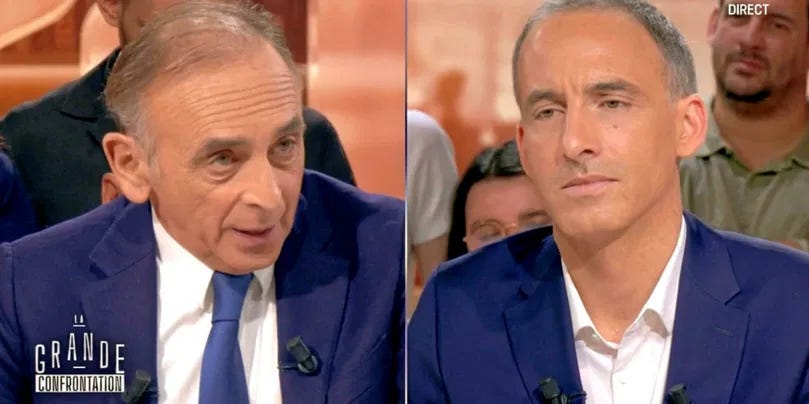
Because it crystallizes the central argument in Europe today. In this exchange, you can see a real tearing of European identity, here in its French form, brought to the surface in a tense and persistent confrontation. Whatever one thinks of Zemmour or Glucksmann, it is essential to read them, to read their arguments and their intentions, in order to understand the scale of the divide that is opening inside Europe.
This moment is especially revealing because Europe is not only dealing with internal fractures but also facing foreign threats that force it to clarify what it stands for. Russia’s invasion of Ukraine has revived old questions about sovereignty, borders and the use of power. It has exposed differences in how Europeans imagine their security, their alliances and their place in the world. This debate therefore takes place at a crossroads where domestic anxieties meet geopolitical pressure. It shows how disagreements over identity, secularism and national cohesion intersect with the challenge of responding to external aggression. It is an important snapshot of a continent struggling to define itself while confronting dangers both within and beyond its borders.
More importantly, this debate stages a clash between two visions of the continent. On the one hand, a civilizational reading of history that sees Christianity, the nation-state, and cultural homogeneity as the last line of defence against decline. On the other side, a progressive reading that treats diversity, individual rights and European integration as the true legacy of the Enlightenment and the French Revolution. Behind the exchanges on secularism, immigration, and security lies a deeper disagreement about sovereignty, universalism, and what Europe should defend in the twenty-first century. Translating this confrontation is a way to make visible that ideological struggle and to follow, word for word, how it is being fought.
David Pujadas (Moderator):
“Éric Zemmour for the political debate. It’s a tradition of this program. So we’re going to tidy up a bit. I hope Thierry won’t mind that we give him back his hazelnuts spoiled by insects.
Éric Zemmour, founder and president of Reconquête, former presidential candidate, and now publishing ‘The Mass Is Not Said: For a Judeo-Christian Revival.’
Good evening, Éric Zemmour. Welcome.
The Church made the kings. The kings made the nation. The nation made the Republic. France without Christianity is no longer France. That is essentially your book. But I believe this has an indirect connection with the subject you want to raise with Raphaël Glucksmann tonight.”
Zemmour:
”Well, when David Pujadas asked me to come debate with you (Raphaël Glucksmann) and when we set the topics—you know how this works—the question of identity imposed itself fairly quickly. And I saw, by listening to your debates, that it kept coming back, even when you tried to avoid it each time. So we’re going to talk about it again.
And when I thought more about it, I remembered a sentence that you certainly know—one of yours: “When I go to New York or Berlin, I feel much more at home culturally…’ Ah, you don’t like that sentence, but it’s from you—‘…than when I go to Picardy.”
And to be fully honest, you later said you regretted it, that it was difficult, etc. I listened to your full sentence because I don’t do to others what was done to me throughout the presidential campaign: taking a sentence and cutting it in half.
Let me tell you: that sentence sums you up. And these 3 hours of programs haven’t changed my mind. What’s amusing is that you talk about Picardy—again tonight, incidentally. I don’t know if you actually know Picardy.”
Glucksmann:
“I do. Very well.”
Zemmour:
“Then you know Picardy is that land close to Belgium where France was more or less born—where the Franks entered. The Vase of Soissons—that’s Picardy. Those innumerable cathedrals: Soissons, Amiens, etc. You know them.
And Picardy, if we go back, is also the Château de Chantilly, where Louis XIV attended that great dinner and where Vatel killed himself because the fish hadn’t arrived.
And Picardy is the Battle of the Somme in 1914: thousands of deaths, the wars with Germany.
Why am I telling you this? Because in a single sentence, you told us: “France does not concern me. The history of France does not concern me. I do not appropriate it.””
Glucksmann:
“I don’t allow you to say that.”
Zemmour:
“I’m saying it anyway. And I’ll tell you something else: I listened to you answering people, and it was pathetic—pathetic in its banality and mediocrity. You’re stuck in the 1980s, Mr. Glucksmann. You haven’t moved since the 1980s while the world has changed.”
Glucksmann:
“Yes, because we lost the war in 1940, right? Crimes against humanity—”
Zemmour:
“Ah, interesting. Usually, my opponents wait a bit before bringing up Vichy because they feel cornered.”
Moderator:
“Please, let him finish.”
Zemmour:
“You are the son of your father, of course—and of your mother too—but above all the spiritual son of Bernard-Henri Lévy. The same person. The identity of peoples only interests you when it’s not French identity.
Ukraine interests you. Georgia interests you.”
Glucksmann:
“Let me answer—”
Zemmour:
“Wait, let me finish my sentence.
Rousseau said something beautiful: “Beware of those cosmopolitans who search for duties toward distant peoples they neglect among their own. Such a philosopher loves the Tartars…” You know the rest. Today, he would have said “the Ukrainians”—”…in order to be excused from loving his neighbors.”
Glucksmann:
“Mr. Zemmour, debating with you is not an honor, because you’re a repeat offender—convicted for racial insult, for inciting religious hatred and racial hatred. My friends asked me why I accepted this debate.
I’ll tell you why: because I want to fight you everywhere—your friends Marine Le Pen, Ciotti, your entire far-right movement—and I want to take the French flag back out of your hands.
That’s the mistake you make about me: France does not belong to you.”
Zemmour:
“Ah no, I belong to France.”
Glucksmann:
“You are not going to conquer this country, because in fact you do not love it. The truth is, you are completely mistaken about me. If there is one patriot at this table, it is not you, it is me. You have—”
Moderator:
“Wait, let him speak, please.”
Glucksmann:
“I want to defend France as it is, not as you fantasize it. You fantasize a France that has, in fact, almost never existed.
You—you cite Joseph de Maistre as an example, for instance. You’re on the side of those who went to Saint Petersburg, like Joseph de Maistre, because France was making the Revolution.
Sir, you are totally disgusted every time France shines.
The latest example: 85% of French people admire the fact that we welcome the whole world to host the Olympic Games, and that we put on an opening ceremony. You find that disgusting, abject.
Each time this France succeeds—because it doesn’t match your fantasies—it disgusts you.
But what you do is rejoice at the success of its adversaries.
You said you wanted to be a mini French Putin, that you admired Vladimir Putin, the man who attacks the strategic interests of our country.
You have boundless admiration for Mr. Orbán because he sets up anti-migrant militias. But Mr. Orbán, now in the service of China, is going to contribute to the destruction of our automobile industry and the closing of our factories.
You have admiration for Mr. Trump, who are hostile to France’s interests and spend their time insulting our country.
The truth, sir, is that you are at the service of a foreign tyranny. You are at the service of an ideology. You are at the service of a far-right international.
But you are absolutely not serving real France.
And I’ll tell you: your strength was built because we, the progressives, the left, we were speechless for too long about what France is.
But now, we are going to talk about France, and we are going to tell the story of France.
A France—you realize, you are even against—because I’ve read Éric Zemmour—you are against the Edict of Nantes. You are—”
Zemmour:
“No, I am not—”
Glucksmann:
“Well, yes, you are for the revocation of the Edict of Nantes.”
Zemmour:
“That’s a bit more subtle than that.”
Glucksmann:
“No, no. You are a theorist of civil war in France, from the real Wars of Religion to the ones you are fantasizing now.
And I’ll tell you what I really think. Deep down, you say words that are unacceptable. You say: “Islamization is like Covid, it is a moral virus.” That’s what you say.
And you know who you made me think of when I read that? Of the Islamist preachers I studied in Algeria.
They said the same thing. They said: “France is a moral virus.”
So you think like them, maybe in reverse.
You are profoundly foreign to everything that made the greatness of France.”
Moderator:
“So, dialogue: Putin, Orbán, Vance… what do you reply, Éric Zemmour?”
Zemmour:
“First, quite simply: you are now one of the incarnations of social democracy, or what remains of it in France. So you can’t ignore that there is also a Socialist International, and that there are socialist parties—French, German, British—which think more or less the same thing, in any case which have the same ideas, the same ideological basis, and which nevertheless defend the interests of their country, the sovereignty of their country.
We even saw French socialists and German socialists go to war against each other in 1914. So having the same ideas, the same ideological substratum as others in the West—I do not have, in my international, people who make war on France.”
Glucksmann:
“I can answer—You, in your international, you have people who are hostile to France”
Zemmour:
“I’m sorry, every country defends its interests.
Mr. Trump defends his interests. Mr. Orbán, whom you mentioned, defends his interests and defends his country against Muslim invasion.
The factories—they’ve been German for 40 years, sir, stop it. He has all his car factories—German industry—for a long time now.”
Glucksmann:
“Can I respond? Does that ring a bell—BYD? Do you know what BYD is?”
Zemmour:
“Tell me.”
Glucksmann:
“It’s the Chinese leader in electric cars. Orbán has just invited them in order to bypass all our—when Renault shuts down its factories—”
Zemmour:
“If Renault shuts down, first it’s because of our social charges—there aren’t many factories left in France—and second, Mr. Glucksmann, because of the ridiculous regulations you supported to impose electric engines everywhere by 2035. That’s what killed—”
Glucksmann:
“I know, but they should have been blocked.”
Zemmour:
“Because the Chinese were ahead, and you didn’t understand that our advantage was in combustion engines, and so we had to block them at the border, not impose electric cars by 2035, sir.”
Moderator:
“On identity, what Raphaël Glucksmann is telling you is that when France shows things it can be proud of, like the Olympic Games, you are unable to rejoice in them.”
Zemmour:
“I did not criticize the Olympic Games.”
Moderator:
“Oh no?”
Zemmour:
“No. I criticized the opening ceremony, which I found vulgar. Do I have the right?”
Moderator:
“Of course.”
Zemmour:
“Well, so much the better for them. Do I have the right not to be among the 85%? Every time—
And secondly, when you say, Excuse me, “the France that I fantasize about”—sir answered you very well earlier: “We are not experiencing an immigration like Italian immigration or others. We are experiencing a migratory invasion. We have a civilization that is replacing us.”
That is the reality. Islam is a civilization. Islam is a religion.”
Glucksmann:
“But would you have said the same about Protestants? Would you have said the same about Italians? You would have said the same thing every time.”
Zemmour:
“What do you know about that?”
Glucksmann:
“Do you—”
Zemmour:
“Are you going to stop attributing things to me? You claim I thought Protestants were German agents to destabilize—”
Glucksmann:
“English and German agents.”
Zemmour:
“Don’t say nonsense. The Protestants were linked to England, and they tried to change the policy—
At least, I do recognize one constant in my reading of French history. I recognize one constant in myself, which is that I try to understand the history of France, and I understand one thing—and you should read, for example, the last book by the great historian Braudel, who died shortly afterward in the 1980s, which is called Identity of France, and which explains that the tragedy of France is precisely excessive diversity. And that this excessive diversity pushed it into religious wars, conflicts, and revolutions.
And you and yours—you and your predecessors—have encouraged this excess diversity with Islamic invasion. And you continue.
You told us earlier—I listened carefully—“We need immigrants to work.”
Do you know—we gave you the figures, I think—out of 430,000 legal immigrants, do you know how many come to work? I don’t know, maybe 50,000. That’s not even 10%.
The others come to get medical treatment, because they are children, grandparents, parents, because they are students, most of them bogus, who take, I don’t know how many years to complete their studies.
So all these people, we don’t need them. They live off us.”
Moderator:
“France—let’s do something: is diversity a problem or a chance?”
Glucksmann:
“You said that the problem of France is that from the beginning it has suffered from too much diversity. Well, you know what made France great, Mr. Zemmour? It is precisely that it was free because it was diverse.
Do you know Le Roman de Renart, that founding moment for France? It was the first time we had a text that was read everywhere, across all the lands. France identified with that fox, who was unclassifiable, neither dog nor wolf, who had a kind of diversity.
You like to classify countries, in the manner of Carl Schmitt, whom you quote—Carl Schmitt, who was a Nazi jurist, for those who don’t know. You like to say: this country is a land power, that country is a sea power.
The huge problem of France for Carl Schmitt—and for you—is that we don’t really know whether it’s a land power or a sea power, since it is both land and sea.
Is France a northern country or a southern country? We don’t know. Its identity is too diverse and multiple.
And you know what? Why we made the Republic, Mr. Zemmour—the Republic that you don’t like? Why? Why? Because we are the heirs of this diversity, because the fact that our identity is not univocal is what made us free.
It’s what allowed us to invent humanism. It’s what gave us—no—it’s what allowed us to be the nation of the Enlightenment. It’s what allowed us to be the nation of the Revolution. It’s what allowed us to abolish privilege. It’s what allowed us to say that all men are born free and equal in rights. It’s what allowed us to shine in the world.”
Zemmour:
“Can I answer—can we talk, because I have not finished?”
Glucksmann:
“Please, it’s this diversity that you condemn that made our country a great nation with a destiny.
But you see, I do not dream for France of a Hungarian or Orbán-style destiny—with that corruption, that nepotism, that closed circle of militias outside any form of legality in the streets.
I dream of a great country for France.”
Zemmour:
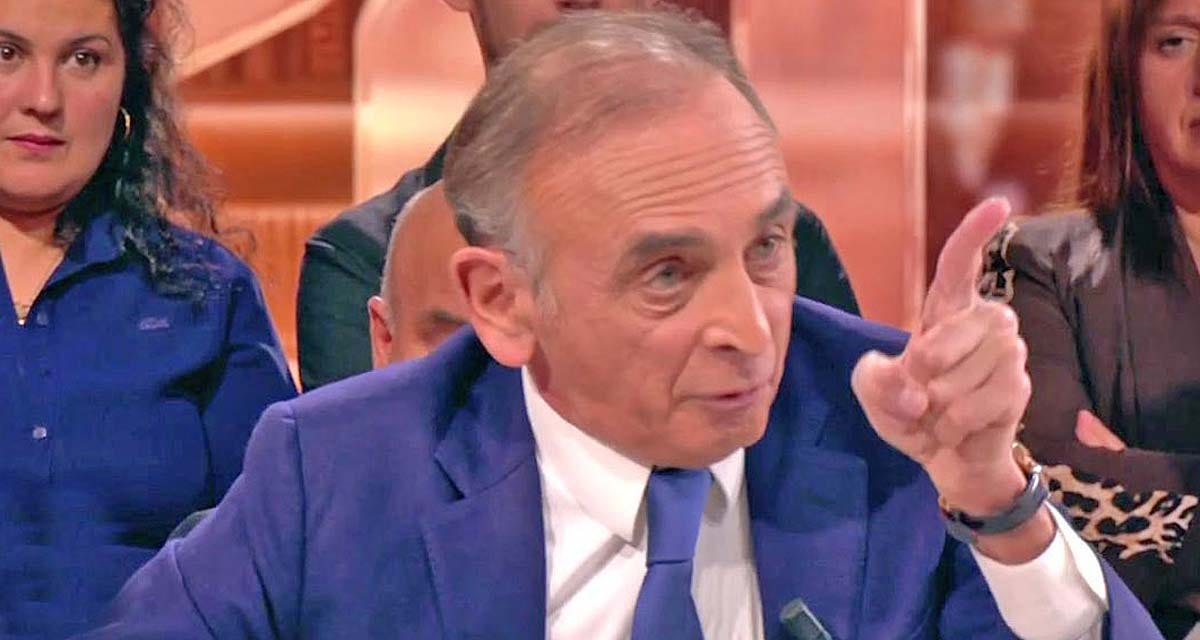
“Mr. Glucksmann, in Hungary there is no little Lola who gets butchered by an Algerian. In Hungary, there is no Thomas who gets killed by a Chechen. In Hungary, there is no Philippine girl who gets raped and massacred by an Algerian or a Tunisian. In Hungary, there is no little Élias who goes out to play soccer and gets killed by an African who—”
Glucksmann:
“I don’t care if your brother would be a billionaire, but I don’t know if your son-in-law were a billionaire, you’d obey Xi Jinping. In Hungary, you’d obey Vladimir—In Hungary you’d suppress free elections—”
Zemmour:
“You don’t care about the people I mentioned, you don’t care at all, and it shows”
Moderator:
“Let him answer, don’t set a bad example. Stop, you’re not setting the right example. Raphaël Glucksmann—Diversity—Is diversity always something good? For diversity, is it a problem, is it a chance?”
Glucksmann:
“Diversity is neither automatically a problem nor automatically a chance. It’s an opportunity, it’s something to build.
A society, like a republican society, sir, is built. It’s not natural. We build it.
But the problem in France is that we have abandoned this construction of the Republic and that we therefore find ourselves in a situation which is a situation of fragmentation into archipelagos.
But what you say, what you promote, is the antithesis of that. It is the antithesis of that integration. It is the antithesis, because in fact you explain that people, not for what they do but for what they are, have no vocation to enter this whole that is France.”
Moderator:
“Mr. Glucksmann—he is answering you, he let you speak—”
Zemmour:
“The Republic, forgive me, is law and assimilation. It is not integration.
In the Republic, under the Third Republic, the woman who was veiled there, with the hijab, who is still there—she is still there—under the Third Republic, this woman would not have had the right to go out with her hijab and would not have had the right to work either.”
Glucksmann:
“Why do you say that?”
Zemmour:
“Because I’m telling you, in the Republic this woman would not have had the right to go out—
The Republic, sir, is assimilation. That means that in the Republic, sir—
Yes, Mr. Glucksmann, excuse me—
In the Republic, religions do not have the right to display themselves in public space, and therefore in the street. That is the Republic. And that is assimilation.
Since you speak of the Republic, and when I spoke to you about diversity—
All powers for 1,000 years, whether the monarchy, the Empire, or the Republic, have been obsessed by this diversity which could destroy the country. And they tried to bring people together and make them resemble one another through assimilation, and often by force.
That is what I’m trying to explain to you.”
Moderator:
“You say that the Republic would not have accepted a veiled woman walking in the street.”
Zemmour:
“Absolutely.”
Glucksmann:
“And on what basis—?”
Moderator:
“And I’ll tell you—
That wasn’t a question. I’m not even asking you a question, actually.
Glucksmann:
“You don’t have the right to say that.”
Zemmour:
“Yes I do, I say it.”
Moderator:
“Let Raphaël Glucksmann answer.”
Glucksmann:
“You explain that under the Third Republic there would have been police to go and remove her—”
Zemmour:
“There wouldn’t have been police. That woman would not even have dared. But there were nuns in the street under the Third Republic. They were professionals of religion—it was Christianity. Christianity, as I say in my book, made France. That is not the case for Islam.”
Glucksmann:
“That’s not the case? I will explain—since you’re talking about the Revolution—”
Zemmour:
“You talk about the French Revolution. Let me tell you: during the French Revolution, a gentleman stood up at the National Assembly in 1789, the Count of Clermont-Tonnerre, and they were talking about—you know this of course, but the people watching don’t necessarily know—Clermont-Tonnerre gave a great speech on the emancipation of the Jews.
And what did he say? He said: “I give everything to the Jews as individuals, and I give nothing to them as a people.”
And then he continued—
He said: “I am told that they don’t want to be citizens—in that case, let them be banished.’”
Glucksmann:
“Yes.”
Zemmour:
“This woman you spoke about, she has not asked for anything as a nation.”
Glucksmann:
“Yes, she has.”
Zemmour:
“No. No. So you’re not letting me speak. She has not asked for anything as a nation. She said herself that she wanted to be a citizen, that she is a citizen. So in fact what you’re saying is nonsense.
And what you’re explaining to us is that essentially the Third Republic would have forbidden a veiled woman to walk down the street—yes—and that, on the other hand, it would have authorized a nun to walk down the street because it’s Christianity.”
Glucksmann:
“Absolutely.”
Zemmour:
“OK. There were even debates about whether priests should be allowed to wear cassocks or not. So you see, there were discussions at the Chamber of Deputies. There were discussions and it almost got banned.
So laïcité—secularism—but I’m not surprised you don’t understand secularism.”
Glucksmann:
“In fact, it’s you who doesn’t understand—”
Zemmour:
“Secularism is the product—
I’ve read your texts on the Wars of Religion where you defend the Catholic League”
Glucksmann:
“I don’t defend the Catholic League.”
Zemmour:
“Yes you do, against the Protestants. And there is a camp you completely forget, which was called the party of the politiques.”
Glucksmann:
“I don’t forget them at all.”
Zemmour:
“Well, Michel de L’Hospital, I’m sorry—”
Glucksmann:
“I don’t forget him at all—”
Zemmour:
“Well, yes. It was that which later gave us laïcité. It is that ability we had—”
Glucksmann:
“Yes, it is the affirmation of the State against definitions of identity that are completely univocal and reductive. It is the definition of the State and gradually of a society that will produce secularism.
And secularism, Mr. Zemmour, is exactly what you don’t understand. Secularism will look at people for what they do, not for what they are. It will set rules.
And in the end, the only thing you do is judge people for what they are, not for what they do. And honestly, I will tell you—you have a massive point in common with Islamist preachers. That is not by chance.
I even have a kind of respect for jihadists, because, well, yes—because in fact they have a relation to the world very close to yours. You only want one thing: generalized confrontation between two identities that you yourself define, without knowing them, as perfectly univocal.
And in the end, you’ll see, France is much stronger than that, and you will not win. And we are going to take back the loom of republican France, and you will be writing books in Saint Petersburg, like your model Joseph de Maistre, in the service of Vladimir Putin, in the service of Donald Trump, of Viktor Orbán, and all the adversaries of democracy, including a Georgian dictator currently in prison.”
Zemmour:
“Well, I am not—I am not at the service of Putin. When you were defending the invasion of Georgia, the invasion of Ukraine, when you defended the invasion of Crimea, you were the one at his service.
I was fighting to help the resistance of the Georgians against Russia—at the service of NATO—and you were at the service of the president [Putin].
Today, I defend European sovereignty, for example. Right? And against—
I am rapporteur on defense issues. I reserve European funds for European production.
And who votes against texts like that, because it annoys the American military-industrial lobby? The far right that you represent, Mr. Zemmour. It’s Mr. Orbán. It’s your MPs in the European Parliament, even though the French are the first beneficiaries of those funds.
The truth is that you are—if we had only your European position, French industry would be dead, because the European Commission—German industry—nobody—
You should be happy: Mr. Zelensky has just bought [weapons] with our money.”
Glucksmann:
“With Russian money—”
Zemmour:
“No, with our money.”
Moderator:
“Alright, back to our discussion. The question, in short, is: Should France give up what it is, and in particular its secularism, acquired at great cost in 1905, in your view?”
Zemmour:
“Not at all, precisely. But I don’t agree with his definition of secularism.
First, Mr. Glucksmann confuses the product of the Wars of Religion, which is not secularism. It is absolute monarchy.
One: I said the party of the politiques.
Two: Yes, that gave rise to absolute monarchy with Henri IV and then Louis XIV.
Second: what is secularism? Secularism is a weapon of war against Christianity.
It’s Gambetta who says: “Clericalism, that’s the enemy.” It’s the socialist deputy Viviani who says: “We have extinguished lights in the sky that will never be lit again.” The Republic made war on Christianity.
That’s the whole problem today: we have a society that is so de-Christianized that it is absolutely defenseless against this Islamic invasion and colonization.
Because when you say ‘the young woman wants to be a citizen’—no, she uses the individual freedom that French society allows her in order to turn it to the service of Islamic colonization.
It’s a strategy developed by the Muslim Brotherhood. They call it, you know, the Islamization of knowledge. But it doesn’t matter, you will read the books of Florence Bergeaud-Blackler and you’ll understand what I’m saying.”
Moderator:
“Can we give her the floor? Because it’s true that we’ve been talking about her in the third person since earlier—”
Veiled woman:
“I absolutely do not allow you to say that I “use” anything at all. You’re mixing everything up.”
Zemmour:
“You also want to forbid me to speak and say what I want.”
Veiled woman:
“I forbid nothing at all—”
Zemmour:
“But that’s normal. In Islam there is no individual freedom.”
Veiled woman:
“That’s what you say, not reality, and certainly not mine.”
Glucksmann:
“It doesn’t matter. She has an individual conscience. She has the right to express herself. And we do not have the right to speak in her name and to include her in a project of Islamization. Stop.”
Zemmour:
“But for me, that’s not even an insult. It’s a word you know very well.”
Glucksmann:
“If there is one person who knows the texts of Islamist ideologues, who has seen the result—it’s me. I was in Bentalha, in Algeria, and I saw the result of Islamist terrorism. I spoke with the victims.
I worked in a newsroom where portraits of journalists murdered by Islamists were hanging on the wall.
And what I saw is that in my newsroom, there were people who risked their lives to denounce Islamism. And you know what? Those people were Muslims.
So in fact, I distinguish between Islam and Islamist ideology. And you—when you see a Muslim, you’re sure that this Muslim is a soldier in the service of a theological-political ideological project.”
Zemmour:
“Well yes, because theological-political, yes. There you spoke in place of a woman who does not feel part of a nation.
You know, Raymond Aron said: ‘Man makes history, but it’s not the history he thinks he’s making.’
Let me finish. Let me finish.
Madam may be acting in good faith. I fully admit that. She may be acting in good faith. But it doesn’t change—yes, she is part of a project of conquest, a project that is written in the Quran, which is the conquest of the lands of the unbelievers by Islam.
And by displaying herself like this with a veil, she is saying to everyone: look, France is becoming Islamic.
It is completely in line with the project of Islam. It’s written in the Quran.”
Moderator:
“When Raphaël Glucksmann tells you, in Algeria, in that newsroom, it was Muslims who fought against Islamists and who died, who gave their lives—”
Zemmour:
“He’s absolutely right—”
Glucksmann:
“I could have done a double tirade in fact, but—”
Zemmour:
“But there have always been wars between Muslims. They themselves call that fitna, because of course there are legitimate conflicts between Muslims.
But then there is what is happening today.
I’ve been announcing for 20 years what you described in your poll: more than 50% of young Muslims who think that sharia is superior to the laws of the Republic. Is that the Republic, Mr. Glucksmann?
50% of veiled women among young girls under 25—is that the Republic?
It’s exactly what I predicted 20 years ago. At the beginning, people told me: ‘That’s crazy, it will never happen.’ And today it’s happening. And in 10 or 20 years, our daughters will have to wear the veil because there will be a Muslim demographic majority and therefore our daughters will have to submit or leave.
It is already happening thanks to people like Raphaël Glucksmann.”
Glucksmann:
“I’ll give you a much more probable scenario—and we’re reaching the end of this debate.
A much more probable scenario: I’m willing to listen to you talk about an invasion, a colonization, an army, that this lady here is about to seize power in our country—but what I’m telling you is that the real risk is that there is a tipping point that indeed occurs in our nation.
The real risk is that our nation stops being faithful to what it has almost always been: a land of freedom, a land of conquest of rights.
Yes, you’re laughing at that because you never believed in it.”
Zemmour:
“Not at all. I explain in my book that freedom is born from the Christian individual. And that it is Islam that is going to kill European freedom.”
Glucksmann:
“Then I no longer authorize you to interrupt me from now on. You interrupted me—”
Moderator:
“Let him speak, please. Raphaël Glucksmann.”
Glucksmann:
“The much more probable scenario, Mr. Zemmour, is that you and your friends may come to power, and that what that would mean is that France would shift very far away from its democratic history. That we would flip into the camp of tyrannies.
Mr. Zemmour, there is a far greater risk that a Russian invasion would force us to send French soldiers to the front than that madam here would take the Élysée, you know.
And I know, Mr. Zemmour, that in that confrontation you are on the wrong side of history. You are against the interests of France.
When Russian hackers attack the hospital in Corbeil-Essonnes, when they attack the hospital in Versailles, when they target our value chain, our industries, our SMEs that produce arms, you, sir, you applaud Vladimir Putin out of ideological conviction.
Because you are, in fact, the stooge—the lackey—of Vladimir Putin. You are the lackey of Putin. You have professed your admiration for him. You are at the service of—”
Moderator:
“This is your last intervention—”
Zemmour:
“I’ll tell you something. For the moment, I see—listen—
I see facts. I will answer exactly what you said.
What I see is that it’s not Russian soldiers who are killing our children. It is not a Russian soldier who killed Philippine. It is not a Russian soldier who killed Thomas.
Those who are dying today are young French people killed by Islamist thugs. That’s all I see. For the moment, that is the threat.
The threat is that poll—”
“Yes, of course, Islamist thugs. They kill in the name of Allah, excuse me. They shout ‘Allahu akbar’ and they kill in Crépol. In Crépol they say, “We’re going to kill some whites, we’re going to kill French.” It’s the same thing. It’s jihad. It’s exactly the same.
And if—you don’t understand that in Islam, religion is a nation. In truth, the whole problem is there. Islam is a country. That’s why I quoted Clermont-Tonnerre earlier.
And that’s the whole problem, moreover, for Muslims. I fully admit it. The tragedy is that, and we are paying for it today.
We see this poll, we see an entire Muslim youth who, unlike their parents and grandparents, no longer make any effort to try to understand French society because, in general, they hate it and retreat into a religion that is, in truth, a country.”
Moderator:
“Sorry to interrupt you, but Erin, we can think what we like about her veil, but earlier she told us, “I would like to work at school, I would like to work in a hospital.”
She does not have the right because of secularism, and that was clearly restated. But she is not showing a desire to separate. She is showing a desire to take her place in French society.”
Zemmour:
“But if she wants to take her place in French society, she can remove her veil. There’s no problem and she will be welcomed with open arms.”
Glucksmann:
“Well, I find that she is a person, who is here, who is someone who can speak, who spoke, with whom we had an exchange. To treat her like an object—an object, there—”
Zemmour:
“I am ready—I’m not going to take your speaking time to debate with the young lady, but I am ready to debate with her. I have no problem with that, Mr. Zemmour.”
Glucksmann:
“I have no weakness towards Islamism, towards Islamist ideology. But it is not the same thing—
That’s the whole difference. Your obsession with Islam—your obsession with Islam is such that you think that’s your only problem.”
Zemmour:
“Not at all.”
Glucksmann:
“Oh yes. Because in the name of your fight against Islam, despite your similarities with Islamist preachers—you have the same vision of identity, of course—
Yes, I hope people will compare everyone’s words.
In the name of that obsession, you are ready to ignore all the other problems of society and you are ready to ally yourself with Xi Jinping’s China, with Viktor Orbán, with Vladimir Putin, with Donald Trump. You are ready to sacrifice everything.
In fact, you do not love France. You love your own obsession. You love your fantasy of what France should have been and what, unfortunately for you, it never was. It has never resembled what you want it to be.”
Zemmour:
“It was like that in the 1960s. Were you there, Mr. Glucksmann? You weren’t even born.”
Glucksmann:
“I admit, I’m younger than you.”
Zemmour:
“Yes. So don’t talk about what you haven’t known. I knew a France that was not like today, whether you like it or not.”
Glucksmann:
“Mr. Zemmour, France has always changed, and people of your kind have always condemned the era they live in.
I, on the other hand, will tell you something: I want the France that exists today to succeed. I want the France that exists today to produce its own destiny. I want the France that exists today to be autonomous, to be able to choose its destiny and to have a great destiny.
Mr. Zemmour—”
Zemmour:
“Those are just words.”
Glucksmann:
“No, they are not just words. They are not just words, Mr. Zemmour. They are political decisions: to revitalize schools, to invest in public services, to ensure that we have trade policies that favor our own production.
It’s not words—it’s factories opening or closing.”
Zemmour:
“Go say that to your friends at the European Commission and your friends on the left.”
Glucksmann:
“But I’ve been fighting for years for European industrial sovereignty. And I’ll tell you something: we’re not far from agreeing on that. At least we end—”
Zemmour:
“We have no point of agreement whatsoever. Because in the European Parliament, you refuse even that. You refuse that each time, because you don’t want to give more power to Europe.
Because your anti-European obsession leads you to sacrifice French industry.
Mr. Zemmour, you are so blinded that you make decisions each time according to your obsessions and against French interests.
It was in the interests of France and its industry to vote for the European Defence Fund—you were against it.
It was in the interests of France and its industry to set up protective trade policies, to give European preference, to build a European industrial strategy. But no, because that would give more power to the European level, and you are against it.
So what you defend is a sort of little Hungarian France that will be on its knees in front of the great empires.”
Moderator:
“Thank you for this debate. We tried—please, please, please. Raphaël, thank you in any case for this debate. Thank you, Zemmour, for having debated with him.
Even if we can’t say that the rules of, how shall I put it, great respect for each other’s speaking time have always been respected on both sides, we tried. Sometimes you stepped on each other’s toes a bit, but we clearly heard your disagreements.
That is France, and that is democracy in France.”
End —
That's not the best debate, but they were surprisingly polite for how much venom they seemed to have for each other. The translation wasn't great (especially for chatgpt who can smooth over those irregularities pretty easily), but I agree with Gluksmann's definition of secularism, but I think he misses his own point by his definition. If secularism doesn't look at who you are then how can it support any of his points about diversity and humanism being the core of French identity. It, by itself, affirms Mr Zemmour's criticisms and contradicts Mr Glucksmann's points. I would've hammered on that more. The appeals to sensational anecdotes don't really work in a debate like that, but I appreciated both sides and the moderator. I appreciate the debates and discussions. Thank you for posting.
Aïe aïe aïe pauv’ petit Éric… petit Éric Zemmour (زمّور - “klaxon” en arabe libanais) dont les grands-parents (berbères juifs arabophones) ont été arraché de leur terres ancestrales millénaires en Algérie par les tours de passe-passe anti-juif de Crémieux et Vichy.
Comme son homologue anglais Melanie Phillips, il croit à une France (Angleterre) mythique fondée sur un soi-disant patrimoine « judéo-chrétien » qui n’a jamais existé (le christianisme a cherché à détruire les juifs et le judéité pendant 2000 ans). Quant à elle, Phillips a même affirmé que le christianisme est la « foi fondatrice » de l’Angleterre. MDR, comme ils disent.
Heureusement, personne ne prend leurs clowneries au sérieux, ni en France ni en Angleterre, surtout Zemmour qui a été condamné pour haine raciale à plusieurs reprises (Phillips le sera bientôt).
(No ChatGPT was harmed in writing in this comment)