

This piece was originally published in City Journal
Published in 1996, Samuel Huntington’s Clash of Civilizations predicted that, with the end of the Cold War, global conflict would center on the divide between Islamic and Western civilizations. Thirty years later, however, and a quarter-century after 9/11, the principal fault line runs through Islam itself, separating two ideological worlds.
Within Western diaspora communities, Islam has become intertwined with Third-Worldism and postcolonial theory, both of which see Western imperialism as the great evil of the modern era. Meantime, much of the Middle East and Asia has turned toward pragmatism, normalization, and acceptance of Western predominance as a geopolitical reality. The gap between these rival outlooks now exceeds the divide between Islam and the West that Huntington anticipated when his book first appeared.
After 9/11, American strategy focused on political Islam. Al-Qaeda and its eventual Islamic State offshoot, the Taliban, the Muslim Brotherhood, Hamas, Hezbollah, and Iran’s Islamic Republic differed sharply in theology and tactics but shared a revolutionary ambition to overturn the Western led order. Today, that Islamist challenge has fragmented. Al-Qaeda has splintered, the Islamic State has lost its caliphate, Egypt has outlawed the Muslim Brotherhood, and the Gulf monarchies increasingly treat Islamist movements as threats.
Iran remains the principal revolutionary holdout. The Islamic Republic defines itself through opposition to the United States and Israel while sustaining a regional network of armed proxies. Yet the foundations of that project have weakened. Hezbollah has suffered major battlefield losses, Iranian influence in Syria has contracted, nationwide protests in 2019 and 2022 exposed deep domestic disillusionment, and the ideals of the 1979 Iranian Revolution command little enthusiasm among younger generations. Tehran still exports its revolutionary ideology, but its influence across the broader Middle East continues to wane.
Much of the Middle East has chosen a different course. The Abraham Accords institutionalized security cooperation and trade with Israel. Morocco expanded ties with Jerusalem to strengthen diplomacy, defense, and economic growth. The United Arab Emirates built partnerships spanning artificial intelligence, aviation, finance, and defense. Saudi Arabia evaluates normalization through the lens of security guarantees, advanced technology, its Vision 2030 modernization program, and regional stability. Across the region, partnerships are judged less by ideology than by the capabilities they deliver.
This transformation reflects a broader shift in how Arab and Muslim states understand statecraft. Scientific discovery, industrialization, and institutional innovation have long rewarded societies that adopt the world’s most advanced technologies, regardless of their origin. Middle Eastern governments have embraced the same logic after experiencing the costs of resisting Western innovations—most notably, the Ottoman Empire’s centuries-long restriction on printing in Arabic script until 1727, which left the region lagging in the spread of knowledge long after Europe had surged ahead.
That historical stagnation gave rise to a century of Arab intellectual discourse centered on the crisis of modernity: the painful question of why Islamic societies had fallen behind the West. Thinkers such as Shakib Arslan, in works like Our Decline: Its Causes and Remedies, diagnosed cultural isolation and technological backwardness as the root of the problem and urged selective emulation of Western advances. Leading-edge technologies have become strategic assets because they determine military capability, economic competitiveness, and geopolitical influence. Leaders once legitimized through anti-Western resistance now measure success through modernization.
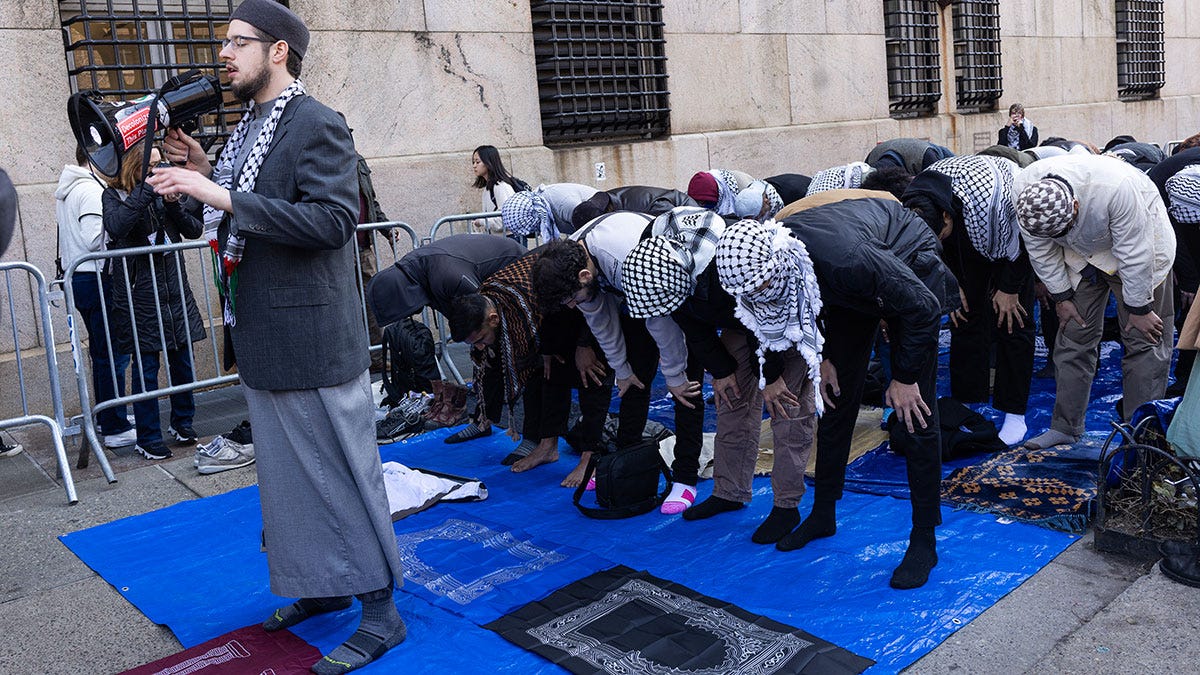
Western intellectual life has followed a different trajectory. Universities interpret the Middle East through postcolonial theory, with Edward Said’s Orientalism becoming one of the field’s canonical texts. Within that framework, the Israeli–Palestinian conflict serves as the paradigmatic story of settler colonialism and resistance. After October 7, these ideas spread beyond academia into campus protests, divestment campaigns, professional associations, philanthropic organizations, and elections. Palestine became the organizing symbol for broader critiques of American influence, capitalism, and the liberal international order. Muslim identity merged with narratives of dispossession and resistance.
The consequences extend well beyond the campus. Anti-Israel activism once largely confined to Islamist organizations now operates comfortably within progressive politics. Zohran Mamdani’s appointment of Ramzi Kassem—who represented Ahmed al-Darbi after his conviction for the al-Qaeda-linked MV Limburg bombing—as New York City’s chief counsel illustrates that institutional migration. University encampments, municipal resolutions invoking “from the river to the sea,” and coalitions organized around decolonization reflect the same evolution. Revolutionary Islam now finds expression through postcolonial theory rather than religious doctrine. Iranian-aligned clerical networks in places such as Dearborn, Michigan, frame public life around opposition to American influence and solidarity with Tehran.
The same rift has hardened in Europe, where diaspora activism contrasts with the pragmatism of Middle Eastern governments. Universities and progressive institutions have embraced postcolonialism, entrenching narratives of permanent resistance and contributing to a sharp rise in anti-Semitism, particularly on British campuses, where incidents increased more than fourfold after October 7. Gulf states view these environments as incubators of radicalization. The UAE, for example, removed British universities from its state scholarship program—even though nearly 9,000 Emirati students had studied in the U.K. in recent years—while still funding study in Israel.
These trajectories suggest sustained confrontation. The version of Islam that has emerged within Western universities, activist groups, and progressive politics clashes with both the Western societies in which it operates and the Middle Eastern governments now abandoning revolutionary politics.
Three forces drive this collision. First, the opposing sides draw political legitimacy from different sources. Much diaspora activism is rooted in historical grievance, anticolonial struggle, and opposition to Western influence, producing an anti-system worldview in which cooperation with the U.S.-led order can itself signify submission or betrayal. Pragmatic Middle Eastern governments increasingly see cooperation with the United States and Israel as a means to strengthen security, attract investment, acquire technology, and accelerate economic growth. This divide now plays out across Western democracies, where boycotts, campus protests, municipal resolutions, and electoral campaigns target both Arab governments pursuing these partnerships and the Western institutions that support them.
Second, priorities have diverged between governments in the Middle East and North Africa and some of their diasporas in the West. Regional governments increasingly prioritize investment, technology, military strength, and economic growth. Saudi Arabia and the UAE, for example, are investing heavily in AI and data centers. Meantime, several pro-Palestinian movements in the West have expanded their campaigns from opposition to Israeli technology contracts to opposition to the data centers and cloud infrastructure supporting them. The divide increasingly places diaspora activism at odds with the economic and technological priorities of regional governments and complicates relations with the United States.
Third, Western institutions amplify the diaspora vision far beyond its demographic weight. Universities, philanthropic foundations, professional associations, media organizations, and segments of electoral politics have absorbed postcolonial ideas that recast Middle Eastern affairs through the lens of decolonization and racial justice. By contrast, Gulf restrictions on Islamist financing and expanding cooperation with Israel reflect a deliberate effort to contain the same ideological currents sweeping across Western public life. The United States and Europe thus face pressure from two directions: an ideological movement extending its institutional reach at home; and regional allies that regard that same movement as a direct threat.
Huntington was right that culture would matter after the Cold War, but he misidentified the principal fault line. Political evolution within civilizations matters more than the boundaries between them.
The United States will continue to confront Islamism in the twenty-first century. But the principal challenge will not come from Huntington’s civilizational Islam, but instead from the version the West has itself helped cultivate: a diaspora Islam molded by Third-Worldism, postcolonial grievance, and a politics of permanent resistance.
this NAILED/NAILS it, however I have to warn Ms. Riboua that even cosmopolitan, highly educated Muslims in the Middle East are still at least somewhat drawn to anti colonialist ideas and slogans, ESPECIALLY whenever it pertains to the "Zionist Entity". So when they attend US re=education faciltiies. err. universities , they readily find and identify with the diaspora (much of which is Palestinian AND from lower socio economic strata) on especially THAT topic. (even though they love taking shopping trips to Dubai) How do I know this? taught in Middle East in Saudi and Egypt for 7 years .
Excellent analysis, as always, but I do pause on one assertion:
"After 9/11, American strategy focused on political Islam. Al-Qaeda and its eventual Islamic State offshoot, the Taliban, the Muslim Brotherhood, Hamas, Hezbollah, and Iran’s Islamic Republic differed sharply in theology and tactics but shared a revolutionary ambition to overturn the Western led order."
But did American strategy truly focus on political Islam? In retrospect, it appears to have targeted the violent extremist branches of political Islam while ignoring, downplaying and sometimes even partnering with articulate mainstream figures and organizations that have presented themselves as moderate but serve as strategic conduits for advancing an underlying Islamist agenda through Western liberal language, public relations and institutions. It seems to me that it is the tolerance of Islamism in the West, and the sharp distinction drawn between it and movements that engage in violence, that allowed the hijacking of Western liberal elites, academia and other societal institutions you describe to take place.