

This piece was originally published in Mosaic Magazine
The Islamic Republic’s anti-Western posture gave China the ideological atmosphere it needed to present itself as a neutral arbiter in a region hungry for alternatives to American stewardship. Beijing gained tangible diplomatic capital from this situation in 2023 when it brokered a Saudi-Iranian normalization agreement, positioning itself as the indispensable dealmaker in a region the U.S. had long treated as its exclusive domain.
The Islamic Republic was, therefore, not merely a regional power pursuing its own ambitions but a key participant in a broader coalition assembled to erode the American-led order, with Israel being the prime target. But, although Tehran was tasked with holding a great deal of the alliance’s strategic weight on its shoulders, Operation Epic Fury has exposed Iran as weak and unsteady.
What made that exposure so striking was how thoroughly Washington had refused to see what was being assembled around it. Chinese firms have over the past few years rebuilt the Islamic Republic’s surveillance infrastructure, transferring the tools of population control that Beijing had refined at home into the hands of a government that needed them to manage its own people. Chinese suppliers furnished the components and precursor chemicals that kept Iran’s weapons programs viable despite years of Western pressure. Tehran’s defiance ran on a Chinese subsidy, and Washington’s permissiveness toward one compounded its tolerance of the other. While Washington is now paying a price for that permissiveness, the price Iran is paying for its defiance is much higher.
Now that the bill has come due for Iran, the logic of its empire by proxy is starting to collapse. Tehran’s regional strategy drew on grievances too local, too accumulated, and too genuine to be manufactured from outside. What it contributed was not the grievance but the apparatus around it. The Islamic Republic’s genius lay not in creating reactionary movements so much as finding them.
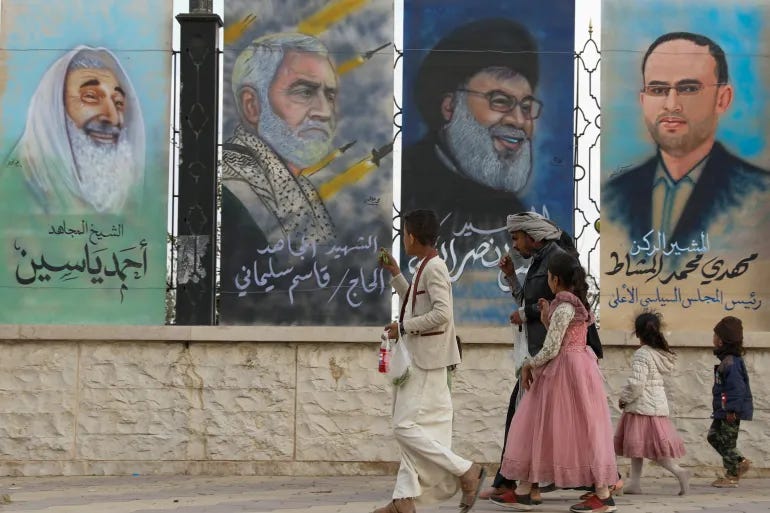
The Houthis, the Popular Mobilization Forces in Iraq, and Hizballah in its earliest form all arrived with their own grievances, their own tribal memory, and their own theological fury. Tehran did not manufacture that energy, but directed it. Khamenei grasped that movements of that kind need a sponsor, a strategic horizon, and above all a narrative capable of converting local resentment into something that looks, from a distance, like a coherent cause. He identified these movements, nurtured them, and brought them under the mantle of “resistance.” For decades, that narrative coalesced around a central idea: that the Palestinian question is the only question that matters in the Middle East, overriding every other calculation and folding every other grievance into itself.
The ideology of resistance relied on a program of information warfare, sustained through satellite networks, religious institutions, and a proxy apparatus designed to keep the region’s attention fixed on the confrontation with Israel. For a generation, it worked. What broke it was not a countervailing argument but the IRGC’s own conduct in Syria, where Arab publics watched the resistance proposition applied to Arab populations in Arab cities. The Iranian narrative did not survive contact with its own practice. Wanting investment, mobility, and a future their children can inhabit, people across the region have seen clearly what Tehran means by resistance. The audiences Iran spent decades cultivating are now the ones looking elsewhere.
The outbreak of war on October 7, 2023, might have reversed this pattern, refocusing attention away from the plight of Syrians and toward the plight of Gazans. Instead, it had the opposite effect. Israel’s display of technological superiority over Hizballah and the Iranian military has hastened a long-awaited reckoning. Every advance in Israeli aerospace, intelligence, medicine, and computing had widened a gap that revolutionary Islamism preferred to explain as the product of a Western conspiracy. The moral verdict Islamism issued against modernity proved more comfortable than the practical reckoning it displaced. In an ironic reversal, the civilization that produced Averroes and Avicenna, whose scholars carried ancient knowledge across continents, found itself organized around the proposition that engagement with the West represented a form of defeat.
But more importantly, Operation Epic Fury is also preparing the ground for a realignment that the resistance spent decades trying to prevent. The rapprochement between Washington and the Gulf states, whose alliance had been fraying under years of American ambivalence and strategic distraction, is finding new impetus in the wreckage of Khamenei’s regional order.
The lesson Gulf governments are drawing from this campaign is one Iran taught them directly. Every country that moved toward normalization with Israel has found itself targeted by a Tehran willing to threaten oil infrastructure, destabilize neighbors, and deploy missiles against capitals that had chosen a different future. Rather than demonstrate—as some Western commentators have predicted a little too eagerly—that an alliance with Israel was a risk not worth taking, the experience clarified, with considerable force, where Gulf security actually comes from and who is willing to provide it. Operation Epic Fury has been proof of concept for the strategic and economic calculations behind the Abraham Accords, and the Gulf is drawing the appropriate conclusions.
As Mansour himself acknowledges, revolutionary Islamism will not disappear from the Middle East. The movements Tehran found and sponsored will persist, rooted in grievances that no military campaign can resolve. What will be different is the proposition those movements carry. The era in which defiance of American power functioned as a self-sufficient political program, requiring neither a positive vision of governance nor an account of consequences, has closed. Whatever emerges next in the region will inherit a different calculus: defiance of American power is no longer a cost-free foundation for political ambition.
The question of where the ideology of resistance goes from here is not really a question about the Middle East alone. The most fervent support for Khamenei’s doctrine during Operation Epic Fury came not from Cairo, Amman, or Casablanca but from London, Paris, and Berlin. European cities produced the protests, the vigils, and the political pressure that Tehran had wagered the Arab street would generate.
That displacement is significant. The resistance doctrine is losing its audience in the Middle East and finding a different kind of host in the West, among populations with their own grievances against the Western order, their own suspicions of American power, and institutions sufficiently open to make the resistance proposition feel like dissent. The next phase of this confrontation may unfold less in the streets of Tehran or Sanaa than in the parliamentary debates and cultural institutions of Europe, where the ideas that the Middle East is already moving past are still gaining ground. While that shift bodes ill for Europe and for the West, it nonetheless is a sign of resounding defeat for the ideology of the Islamic Revolution.
"Every country that moved toward normalization with Israel has found itself targeted by Tehran, which has been willing to threaten oil infrastructure, destabilize neighbors, and deploy missiles against capitals that chose a different future."
Excellent analysis, as usual. I think it may also be fair to say that not only countries that moved toward normalization have been targeted and “taught a lesson.” Iran has gone after Qatar, Oman, and Saudi Arabia as well, yet none is formally part of the Abraham Accords. Do they feel particularly rewarded for holding back?
Here in Londinistan we can confirm it is well underway.