

The Logic of Trump’s Neutralization Strategy
A New Middle East Equation

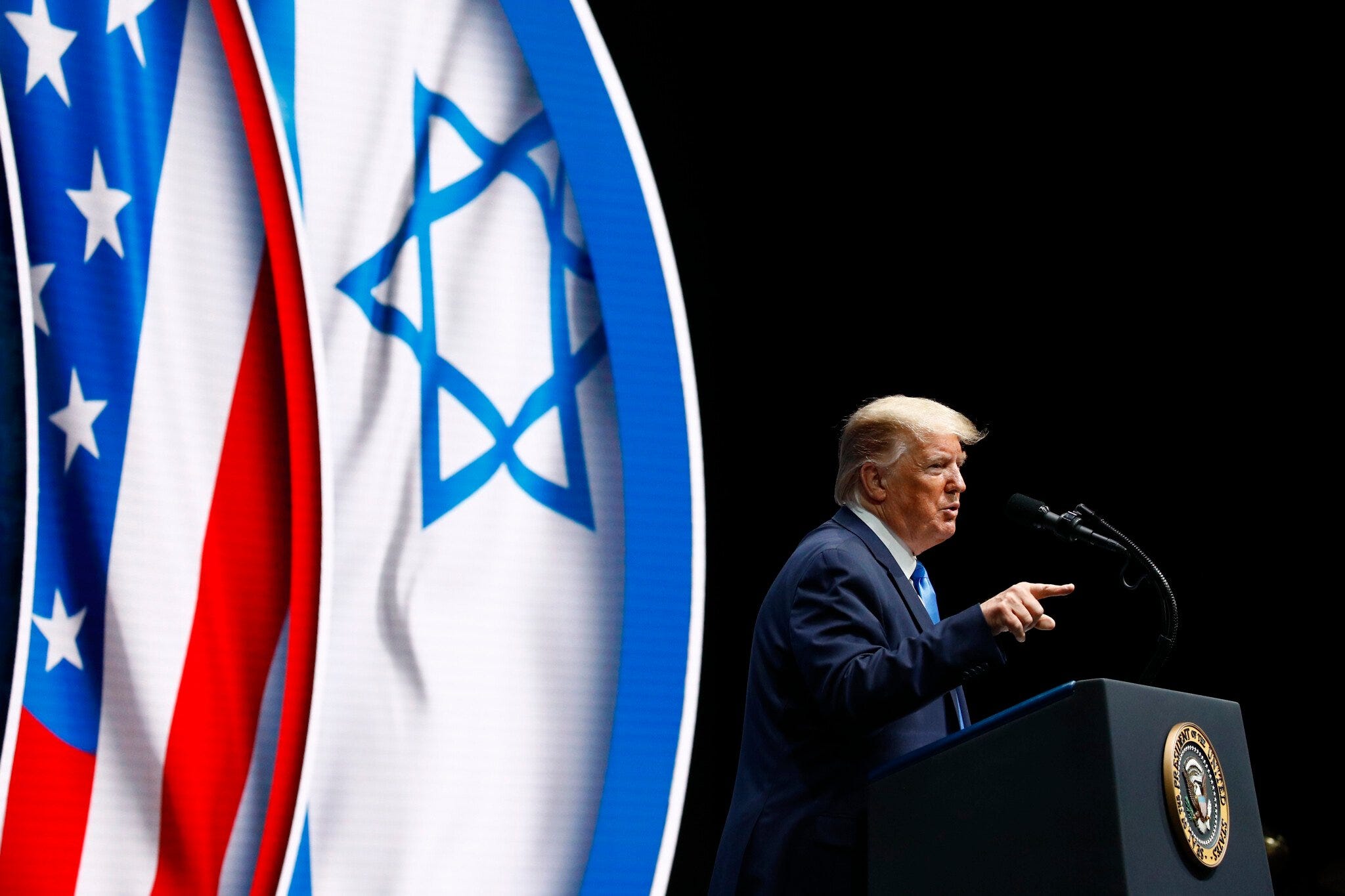
“Men will not look at things as they really are, but as they wish them to be— and are ruined.”
― Niccolò Machiavelli, The Prince
For half a century, American policy toward Israel remained stagnant. Successive administrations spoke of peace, but treated Israel’s strength as a diplomatic problem to be managed rather than a foundation for regional stability. The vocabulary of diplomacy shifted from one administration to another, but the substance remained unchanged. Washington pressed Israel to yield, comforted Arab leaders with gestures, and preserved a peace process that produced neither peace nor progress.
The modern framework of U.S. policy toward Israel began under President Jimmy Carter in 1978 with the Camp David Accords. The peace between Egypt and Israel was an extraordinary achievement; however, it also established a pattern that would define American diplomacy. From that moment, Washington began to view itself less as Israel’s strategic partner and more as a neutral intermediary, pressing Jerusalem to make concessions in pursuit of regional stability.
In fact, under President George H. W. Bush, this mindset became policy. In 1991, his administration withheld ten billion dollars in loan guarantees to pressure Israel over settlements. What started as a posture of neutrality gradually turned into a policy of pressure, with Washington using its influence not to deter Israel’s enemies but to restrain Israel itself.
President Bill Clinton revived the same old formula in the optimistic language of the Oslo Accords. The 1993 accords promised a new beginning, granting the Palestinian Authority international legitimacy and financial support while demanding little in return. The agreement reflected a recurring belief that negotiations alone could overcome rejection. When the Second Intifada erupted only a few years later, that belief collapsed, but the diplomatic structure behind it remained intact and unchallenged.
Years later, President George W. Bush inherited the very same framework and tried to modernize it with new slogans such as the “Roadmap to Peace” and the “two-state solution.” But behind the new, catchy terminology stood the same conviction that Israeli concessions would reduce hostility and that the process itself was progress. By the time President Barack Obama entered office, neutrality had hardened into distance. His 2015 nuclear deal with Iran rewarded a regime that armed and financed Israel’s enemies, while his 2016 abstention at the United Nations allowed a resolution branding Israel’s historic heartland “illegally occupied.” What had begun decades earlier as mediation had turned into total strategic estrangement.
Across these decades, the pattern endures. Every administration speaks of peace while maintaining a framework that treats Israeli restraint as the cost of regional stability. Diplomacy becomes routine, a cycle of meetings and statements where negotiation replaces strategy and process stands in for purpose.
Trump, in this sense, breaks that pattern. He refuses to manage a process that no longer delivers outcomes. He probably also essentially despises it. He sees the Middle East not as a diplomatic puzzle but as a contest of strength, and within that contest, he sees Israel as an anchor of stability rather than a source of friction. To him, Israel represents the qualities that command respect in the region with a capable military, advanced intelligence, and a culture of innovation that mirrors the self-reliant spirit he values in America. This conviction shapes every major decision that follows.
When Israeli Prime Minister Benjamin Netanyahu calls Trump “the greatest friend Israel has ever had,” it is not a matter of sentiment but of results. Trump recognized Jerusalem as Israel’s capital, moved the U.S. embassy there despite international pressure, and recognized Israel’s sovereignty over the Golan Heights. He understood that symbolic clarity is itself a form of deterrence.
That principle extends to his current approach. The success of the Peace Summit itself does not measure the success of any deal or agreement. As long as Hamas remains armed and committed to confrontation, Israel will continue to face a persistent threat. No agreement changes that fundamental reality. What matters, however, is that Trump understands the conflict not as something to solve but as something to neutralize.
By forcing Hamas to release hostages, by rallying both allies and adversaries around a single objective, and by stripping away the moral and political leverage that the “Gaza question” has long provided, he is making the issue politically unviable. In effect, it becomes less exploitable, less weaponizable, and less useful as a platform for anti-Israel or anti-American politics.
Let’s not forget that Trump’s regional agenda is ambitious. He aims to advance the India–Middle East–Europe Corridor, achieve full normalization between Israel and Saudi Arabia, expand economic partnerships across the region, and bring Turkey back into a cooperative framework. None of this is possible while Gaza dominates the political landscape.
The conflict consumes diplomatic attention, divides partners, and gives every actor in the Middle East a pretext to postpone engagement. It is noticeable that in acting to force the release of hostages and to push both allies and rivals toward resolution, he is doing something larger than seeking a deal, he is creating the conditions for these broader projects to move forward, making Gaza less useful as a political instrument and less central to the region’s agenda.
What he is doing is a form of political neutralization. Since October 7, the Gaza conflict has dominated the regional agenda, giving every actor a pretext to posture, delay normalization, and extract concessions without consequence. Trump’s approach seeks to strip the issue of that strategic utility. By pushing for the release of hostages and tying every discussion to tangible outcomes, he turns Gaza from a center of diplomatic gravity into a secondary front. The goal, clearly, is not resolution but reordering, reducing the conflict’s ability to dictate the tempo of regional politics.
In a way, his method echoes Kissinger’s handling of the Vietnam War. Faced with a war that could not be won outright, Kissinger sought to neutralize its strategic weight rather than resolve it. Through a mix of negotiation, withdrawal, and linkage with larger powers, he turned a liability into a platform for broader realignment. Trump is doing something similar on a different stage, reducing Gaza’s centrality so that the United States can reclaim the initiative and redirect regional dynamics toward integration and power balance.
This recalibration generates tangible political gains. It weakens the leverage of actors who depend on perpetual crisis and restores initiative to those seeking integration. China and Russia profit from a Middle East trapped in a cycle of reaction. By accelerating projects such as the India–Middle East–Europe Corridor, advancing U.S.–Israel–Saudi normalization, and engaging Turkey within a broader security and trade framework, Trump shifts the region toward a more U.S.-anchored architecture. Even with Hamas still in place, the conflict no longer dictates U.S. priorities. The adjustment strengthens Israel’s political weight, consolidates U.S. leverage, and constrains outside powers that thrive on a fragmented Middle East.
In terms of domestic political gains, Trump’s strategic play projects control at a time when voters associate the Middle East with failure and fatigue. By casting American support for Israel as a matter of strategy rather than ideology, Trump makes it harder to treat it as controversial. Linking Israel to regional stability, technological strength, and the containment of China and Iran deprives critics of moral leverage and strips the issue of political weight. In neutralizing the Gaza question abroad, he narrows its divisive power at home and turns what was once a source of contention into an assertion of American confidence.
Will he succeed? It is uncertain. Iran remains untouched by full pressure, China stays entrenched in regional trade, and Hamas still threatens Israel’s security. Even so, Trump has shifted the balance. By neutralizing the conflict within his political window, he gives Israel room to emerge as a stabilizing force and key partner in regional growth. Cooperation with Israel now signals an advantage, while opposition carries a cost. For now, Trump turns Israel from a contested actor into a central partner in America’s regional strategy.
The analogy with Vietnam is a bit flimsy, to be honest. That really was a war the US couldn’t win.
If Trump had wanted to neutralise the Gaza problem he could have done it two years ago with one phone call. But that it is not the aim here. It is the US that gains from permanent instability in the Middle East by preventing the oil-rich Arab countries from achieving social and economic autonomy and maturity in the way that, inter alia, Indonesia and Malaysia have (I cite two Muslim countries to defuse the usual “it’s Islam” claims). The best way to do that is to keep Israel psychically on edge and in permanent conflict with everyone.
Mission accomplished for another 30 years.
How Dare You Absolve yourself!
How dare you wash your hands
in the shallow water of distance—
each death in Gaza
a name erased from the census of dawn,
a breath that once fogged a window,
now ash on the wind.
*Not a statistic.*
A child who knew the alphabet of rubble:
*A* for ambulance that never arrived,
*B* for bread buried with the baker,
*C* for cradle crushed mid-lullaby.
You speak of "complexity,"
build barricades of bureaucracy,
while mothers dig graves with bare hands
and fathers hold silence like a shrapnel-shredded flag.
This is not collateral.
This is a world unmade,
one stolen heartbeat at a time—
and you dare call it *war*?
When the soil itself weeps,
and the olive trees bear witness,
what court absolves indifference?
What god forgives turned backs?
Look and take it ALL in:
every phantom wail is an indictment.
Every unmourned body
a covenant broken.
*No absolution.*
Only the reckoning
of every gaze that refused to see,
every voice that chose the comfort
of silence.
—-
This isn’t politics—it’s *pain demanding witness*. When a life is erased, whether in Gaza, Mariupol, or Sudan, our humanity contracts. Poetry like this refuses to let grief be buried beneath headlines.
**Look. Acknowledge. Do not look away.**
Because there is blood 🩸 on your hands!