

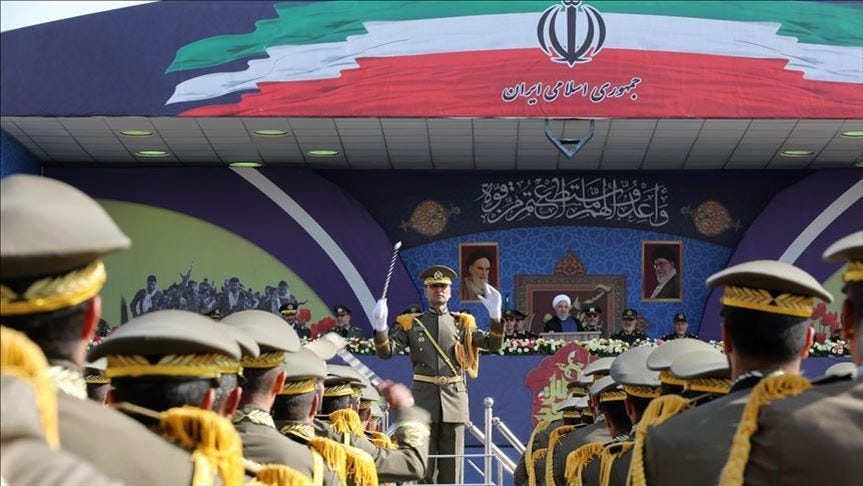
Something unprecedented is stirring in the Arab world. Beyond the expected discussion of the war and of Iran’s long record as an aggressor, one now hears a different register altogether, a growing conviction that the regime itself may actually fall because its revolutionary aim is being exhausted.
I believe this shift has no precedent in living memory.
Before turning to the two interviews, it is worth dwelling on the theological dimension in which the IRGC operates. Most American observers remain unfamiliar with how the Revolutionary Guard sees itself and the world, and that unfamiliarity matters, because it is the only lens through which Trump's threats, erratic and occasionally frightening to Western ears, can be properly understood from the inside.
The Eschatological Machine
Whatever clerics and Revolutionary Guards commanders remain standing in Iran are actually men who have spent their entire lives inside an edifice that explicitly defined this moment for them, and that has nevertheless failed to prepare them for Trump’s modus operandi.
To grasp how they read it, one must first understand what they believe the world fundamentally to be.
In 2006, Bernard Lewis, writing in a piece titled “August 22,” identified the roots of Iran’s pursuit of nuclear weapons with considerable precision.
“There is a radical difference between the Islamic Republic of Iran and other governments with nuclear weapons. This difference is expressed in what can only be described as the apocalyptic worldview of Iran’s present rulers. This worldview and expectation, vividly expressed in speeches, articles, and even schoolbooks, clearly shape the perception and therefore the policies of Ahmadinejad and his disciples.”
Lewis wrote those words nearly two decades ago, and the worldview he described has never required updating. It remains what it has always been, the foundation upon which an entire revolutionary state gets built. In a certain sense, the Islamic Republic runs an eschatological project that happens to possess a government. What it actually builds toward, always, is Qiyamah, the Day of Judgment.
That project rests on a specific theological architecture, one that begins with Twelver Shia Islam’s singular orientation toward the end of history. The entire tradition converges on Akhir az-Zaman, when the hidden Twelfth Imam, Muhammad al-Mahdi, emerges from his divine occultation. He remains in concealment, awaiting the appointed hour.
When that hour arrives, the Mahdi emerges to confront and defeat the Dajjal (The False Messiah) and the Sufyani, a tyrant from the Levant whose wars and massacres figure among the major signs of Qiyamah. The tradition holds something considerably more nuanced, for the Mahdi arrives at the lowest point of the human condition, summoned by the world’s complete exhaustion of its capacity for suffering.
Obviously, no eschatological matrix, however elaborate, suspends itself in abstraction. It requires an originary wound, a historical moment so charged with injustice that it ruptures the boundary between the temporal and the sacred, and becomes, permanently, both. For Shia Islam, that moment is the Battle of Karbala.
In 680 A.D., Husayn ibn Ali, grandson of the Prophet, was surrounded and killed on the plains of southern Iraq, abandoned by a passive world. The event underwent an immense metaphysical transfiguration, becoming the prism par excellence through which all subsequent suffering gets refracted.
There is an almost cyclical quality to this arrangement since every generation re-enacts Karbala. For Khomeini, Karbala and Qiyamah formed a single continuous arc, a battlefield that time never closed, still accumulating its martyrs, still moving toward its predetermined conclusion.
The evil genius of Khomeini lies precisely in this, in his grasp of this horizon’s governing potential. In his fatwas, he addressed Iranians during the revolution in the register of a man for whom the plain of Qiyamah had already begun to fill. “O nation, wake up! O government, wake up! Everybody wake up! You are all in the Presence of God. Tomorrow, you will be called to account. Do not ignore the blood of our martyrs, and do not quarrel over position or status.”
What the Arab World Sees
One must pause here and reckon with what this kind of certitude actually does inside a revolutionary and militaristic state, because its function rarely gets understood from the outside.
In ideologies centered on the end of the world, believers discover a profound certainty that removes all doubt about the future. This conviction serves as a divine promise. History does not remain truly open-ended, since God has already determined its final outcome.
A normal Western politician carefully weighs risks and adapts to changing circumstances. But the true committed IRGC revolutionary, driven by this unshakable faith, inhabits an entirely different relationship with time. For him, the final victory is already secured. The present does not create the future, and merely confirms what was always destined to occur.
Raymond Aron once observed that “foreknowledge of the future makes it possible to manipulate both enemies and supporters.” The IRGC not only believes in its eschatological vision, but it also uses it, and the difference matters enormously.
Indeed, eschatological certainty possesses the capacity to mobilize populations; it’s almost a hypnotic force and grants its believers an enormous power to erode political constraints and manufacture sacrificial commitment on a vast scale. Which is why what distinguishes the IRGC from the ordinary zealot is their simultaneous mastery of genuine belief and its calculated instrumentalization, a combination that renders them considerably more formidable.
But this orientation collides at every point with the mainstream Sunni worldview, which treats Judgment Day as a matter of divine concealment rather than political schedule. Sunni tradition forbids the forcing of providence and regards any state organized around accelerating the end of history as a deviation from Islam rather than its fulfillment. The Arab world reads the IRGC through this very lens, and what it sees is not a pious republic being tested, but a heterodox project masquerading as the fulfillment of faith, structurally incapable of assessing its strategic failures.
As a matter of fact, Arab media today surfaces an ideological skepticism toward the Islamic Republic that years of resistance mythology had long kept buried. That skepticism coalesces around two core claims:
First, Saudi Arabia and the UAE are executing generational modernization projects anchored in post-hydrocarbon economies oriented toward the future. Iran’s governing vision moves in the opposite direction entirely, organizing state power around an apocalyptic theology that treats modernity as a Dajjalic corruption and positions regional destabilization as a sacred instrument for hastening the end of history. For Arab capitals investing hundreds of billions into the next century, a neighbor whose ideological horizon terminates at the Mahdi's return represents a civilizational incompatibility, one that IRGC strikes on Gulf territory have now made impossible to manage through diplomacy alone.
Second, Iran's revolutionary theology teaches that adversity confirms the righteousness of believers and that enemies validate prophecy, which means eschatological conviction has entirely consumed the space where strategic analysis would otherwise operate. Arabs are watching a regime facing institutional collapse before the promised fulfillment arrives, one that has no doctrinal mechanism to absorb that failure and no capacity to assess it, because in Iranian doctrinal terms, the United States was never a potential negotiating partner but a Dajjalic force of deception and corruption. What Arab observers find most damning is precisely this, that a regime organizing an entire region around its prophetic vision cannot explain, even to itself, why the prophecy is unraveling.
The theological and revolutionary mindset described above may seem dense to the uninitiated, but it is precisely the background in which the Arab world is now processing Iran's institutional and religious disintegration.
The two interviews below, one with Iraqi researcher Ghaith al-Tamimi, a former Shia cleric, and one a panel debate between Arab intellectuals and analysts, speak directly to that moment.
Ghaith al-Tamimi: Iran Lost the War, and This Is What Awaits Iraq
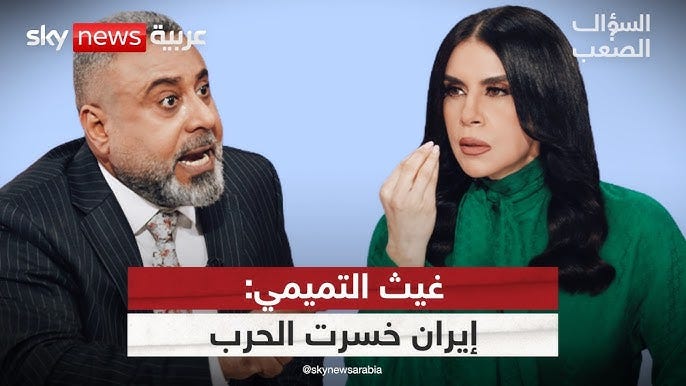
Host: You were criticizing then, and you still criticize Iran today. Khamenei was killed. How did you feel when Khamenei was killed by American and Israeli hands last February?
Tamimi: Oh my God, what a question, Your Eminence. Look, I faced this feeling when Saddam was executed. I faced this feeling on the ninth of April when the American army entered Baghdad as occupiers and liberators. I faced this question when Zarqawi was killed, when Bin Laden was killed, when Baghdadi, Sinwar, and Nasrallah were killed, all the way to Khamenei.
A complex ladder of personalities that I am influenced by, whose thought I engage with, whose ideology I engage with. This is the environment I breathe. Each one of these personalities is a deep narrative. I see before me a stage, and his death is the death of a scene in this play. We are facing a real and grand scene of ideology.
That is why I wrote about Khamenei’s death before his assassination. I wrote about the death of narratives, the death of a person.
Host: Why did you feel this way? You still have not described to me the exact state you were in.
Tamimi: The feeling is that this man chose this path, so he died an ideal death according to his methodology. As an opponent of Khamenei, it is not fitting for him to die less than al-Baghdadi, less than Saddam, less than Guevara, less than any of the great leaders who lead liberation revolutions, even if they are insane. They say that a person often resembles the way he dies.
I met Khamenei three times in my life. He is a charismatic man, an educated man, fluent in Arabic, a skilled translator of Sayyid Qutb’s In the Shade of the Qur’an. He is a man fluent in the language, deeply immersed in Arab and Islamic culture, the Muslim Brotherhood, Qutb, literature, and a religious scholar.
You are facing a man who has been a judge for fifty years, a politician who has ruled Iran as president and as Supreme Leader. He is a man who is historically, physically, and in substance, the Shia religious scholar who wears a black turban and delivers his speech. His name is Ali, his tribe is Husseini, and his approach. You will notice all of this is rooted in the charisma of this person.
His death was precisely the kind of death that Sunnis who sympathized with the concept of the caliphate at the expense of the modern nation-state, or the way Baghdadi and Bin Laden were killed, this narrative needs. This is the ideal death for them. Sinwar is the same.
But on the other hand, in order for a state society to be established, in order to raise a generation whose culture is the culture of the state, when you tell them about the Islamic caliphate or the Islamic state with the rule of the jurist, they know that Islam is beliefs, behavior, and faith, not a system of states in life. The state needs a system built on laws, citizenship, investment, development, international relations, and interests.
This generation needs a great symbol to be raised, but Khamenei, whoever he is, is against everything you tell him about. Against citizenship, against the culture of coexistence and tolerance.
Host: He hates Arabs, right?
Tamimi: Look, to be clear, Khamenei does not hate Arabs. Yes, the Iranian regime is hostile to Arab regimes, but Khamenei, as an individual, is accused by Persians of being Arabized in Iranian culture and Persian in language. He is the most Arabized of them, unlike Khomeini.
Khomeini did not have a single instance of teaching in Arabic, not even in his classes in Najaf. Our teacher, Sayyid al-Sadr, may God have mercy on him, said, “I studied with Sayyid Khomeini in Najaf. He gave the lessons in Persian, and I wrote the report in Arabic.” Meanwhile Khamenei, in his Friday sermons in Tehran, addresses Arabs in Arabic, recites Iraqi and Arabic poetry, and is well-versed in Arabic.
He is like Erdogan, but he supports an expansionist ideological project. The proof is that as soon as he was killed, the Iranian war began against countries that have no connection to this war.
Host: For you, it has no connection to Khamenei’s project.
Tamimi: He says it many times, my dear lady. Khamenei clearly says, “We aspire to Islamic unity in this region that will expel the United States and its Western allies.” They slaughter the Jews, liberate Jerusalem, and overthrow the Arab regimes, which they consider infidel and tyrannical in terms of the religious doctrine of the Revolutionary Guard.
The political and military doctrine of the Revolutionary Guard and those associated with them considers these regimes pagan, infidel, and polytheistic. Therefore, they are like al-Qaeda and ISIS in this respect.
Host: Khamenei is gone for good. Where is his son?
Tamimi: He is under suspicion. In my opinion, I do not have tangible evidence, and if I did, I would have sent it to Trump. But my opinion is based on data and personal observation, considering that I am a religious man and that I have relationships with the Iranians, specifically the system of Sayyid Khamenei.
In my opinion, Sayyid Mojtaba Khamenei was present at the incident when his father was killed. He and his mother were taken to the hospital. His condition was critical. He was admitted to the hospital, and there he disappeared. He disappeared, meaning he was in a severe coma, severely injured, and hidden for the benefit of the Revolutionary Guard.
Perhaps he died. I believe he died, or he is in a coma with his hands cut off, or disfigured to the point that he is unfit for anything and cannot write or give his opinion on anything. It is not even appropriate to photograph him or record his voice. The theory that he is still alive is completely out of the question.
Host: Why is there another jurist who is the Supreme Leader now in Iran?
Tamimi: Apart from who I believe is Ayatollah Arafi.
Host: Who is Ayatollah Arafi? Who is this person?
Tamimi: Ayatollah Arafi is close to Sayyid Khamenei, a Shia jurist, a religious authority within the system of the Guardianship of the Islamic Jurist, close to the Revolutionary Guard. I believe Ayatollah Arafi or someone like him is the real Supreme Leader. Because the Revolutionary Guard is at war, and deception in war is necessary, they have fabricated a story about a dead man to mislead the United States, Israel, and international public opinion, and to save the life of the real Supreme Leader.
All that is required of us is to give legitimacy to the Guard in the war. Nothing else is required.
Host: Do you think this information is widespread among American intelligence, Mossad, and others?
Tamimi: Honestly, I have not read a detailed analysis of this. Let me say that I am personally interested in this topic. As a researcher, I am interested in the marja’iyya, the religious authority. Khamenei, who comes after him, Sistani, who comes after him. This is my work, and I have been interested in it for years. I am involved in managing such matters.
I believe, according to the theory of the “righteous believers” and considering that they are in a state of war, they chose Ayatollah Arafi as the Supreme Leader and obtained his religious authorization to lead the war.
You might ask, “Is Sheikh Tamimi more extreme than Mojtaba Khamenei and Ali Khamenei?” The issue is not extremism. It is the ability to lead, influence, and shape events. These extremists can sometimes be useful because they are foolish. Arafi possesses this ability. I believe Ayatollah Arafi will only provide the religious cover.
You need to understand this. I am using a religious and jurisprudential term that those connected to this system understand. They need a virtuous figure. They need religious cover to lead. They are the “righteous believers” according to their jurisprudential system. They need a marja’ who says it is permissible to do so, that is all they need. Like Khamenei, he does not get into details.
Even with the killing of Ali Khamenei, the Supreme Leader’s regime did not kill the Revolutionary Guard, which carries the Khomeini and Khamenei doctrine and the ideology of General Qassem Soleimani. They have been mobilized and trained for forty years, and they are still mobilized with everything you can and cannot imagine.
They cannot give it up so easily. The Iranians have a religious principle that says preserving order is the most important duty. What order? I am talking about the Revolutionary Guard’s system, not the state. They do not believe in the state.
Host: Okay, Sheikh Ghaith al-Tamimi, please excuse me. You said about two weeks ago that the Iranian regime had lost the war militarily and politically. What is your proof? Iran and the Revolutionary Guard are still capable of responding and influencing, still attacking Arab capitals and cities, still striking deep inside Israel. How can a regime that is finished and has lost the war politically and militarily continue to influence and respond?
Tamimi: It is very simple, Your Eminence, without complicating things. Any foolish teenage boy in any upscale neighborhood could break the windows of ten of the most beautiful houses. The fact that someone in the area might start a fire, might take a knife and kill children or commit an assault, does not mean they are strong, does not mean they are victorious, and does not even mean they exist.
The Iranians, the Revolutionary Guard, are committing suicide without any vision. Can you imagine them attacking Iraq? I cannot understand this. The Revolutionary Guard is attacking oil in Majnoon, meaning in Qurna, Basra. This is the strategic depth of the Shia who are linked to the Guardianship of the Islamic Jurist, who have been smuggling oil to Khamenei for twenty years and funding the Revolutionary Guard.
They go and attack Amarah, Basra, and Nasiriyah, attacking Iraqi army bases that Abu Fadak and the Popular Mobilization Forces use daily for movement and operations. Do you see such a thing? Imagine them attacking Camp Victoria in Baghdad, the one the Prime Minister, the Chiefs of Staff, the Popular Mobilization Forces, and the militia leaders use daily, and they call it an American base.
My friend, what is happening? And yet the Popular Mobilization Forces still support them, still take orders from them.
Host: Will the war end with the fall of this regime?
Tamimi: Yes, but they will continue to strike and weaken it until it disintegrates. It will not just fall in a normal way. It will disintegrate, meaning it will begin to fade away, fragment, and split internally over money, interests, and decision-making.
Host: What will happen after the cessation of operations, in your opinion, or during the coming weeks?
Tamimi: Before now, they are focusing on three types of targets. The Israelis are killing people, targeting individuals and command centers. The Americans have been striking strategic infrastructure and facilities. What they have in common is operations against camps, locations, and sites.
If we study this, they are dismantling command and control centers, and whenever they see them being reactivated somewhere or in some way, they eliminate them. Trump and Israel are working to rid Iran of weapons that affect the security of the region for a long period.
Host: You heard Trump, and even the Secretary of Defense, have always talked about a new regime. Do you really feel that there is a new regime in Iran, or is it a kind of counting of gains?
Tamimi: Trump is trying to say that this war ultimately produced a new regime. The problem is that we think ultimately. Who said that the American mind believes that there is an end, or that there should be an end? America is not going to disappear, and the region is not going to disappear.
Host: I am talking about military operations.
Tamimi: Military operations, my friend. What America and Israel are practically doing is destroying major strategic infrastructure that has had forty years spent on it. What good will the Revolutionary Guard do if it remains? It will remain, it will not matter. This is an illusion, an illusion of the left and the leftist media, who have been dreaming the same dream since October 7th. They do not want to wake up.
This war will not end except with a new Middle East. Let me tell you about Iran. Iran will enter a coma, just like Iraq entered a twenty-year coma. Iran will enter a coma like Libya is in a coma now, just like Yemen is in a coma.
Host: The difference, if you will allow me, is that when Iraq entered a coma, it was satisfied, meaning it withdrew into itself. Iran, with its missiles, you saw what it is doing.
Tamimi: My friend, give it two weeks, and everything will be finished. Missile farms, missile platforms, missile depots, missile production facilities, and missile carriers. All of this will be destroyed.
Panel on Iran Negotiations
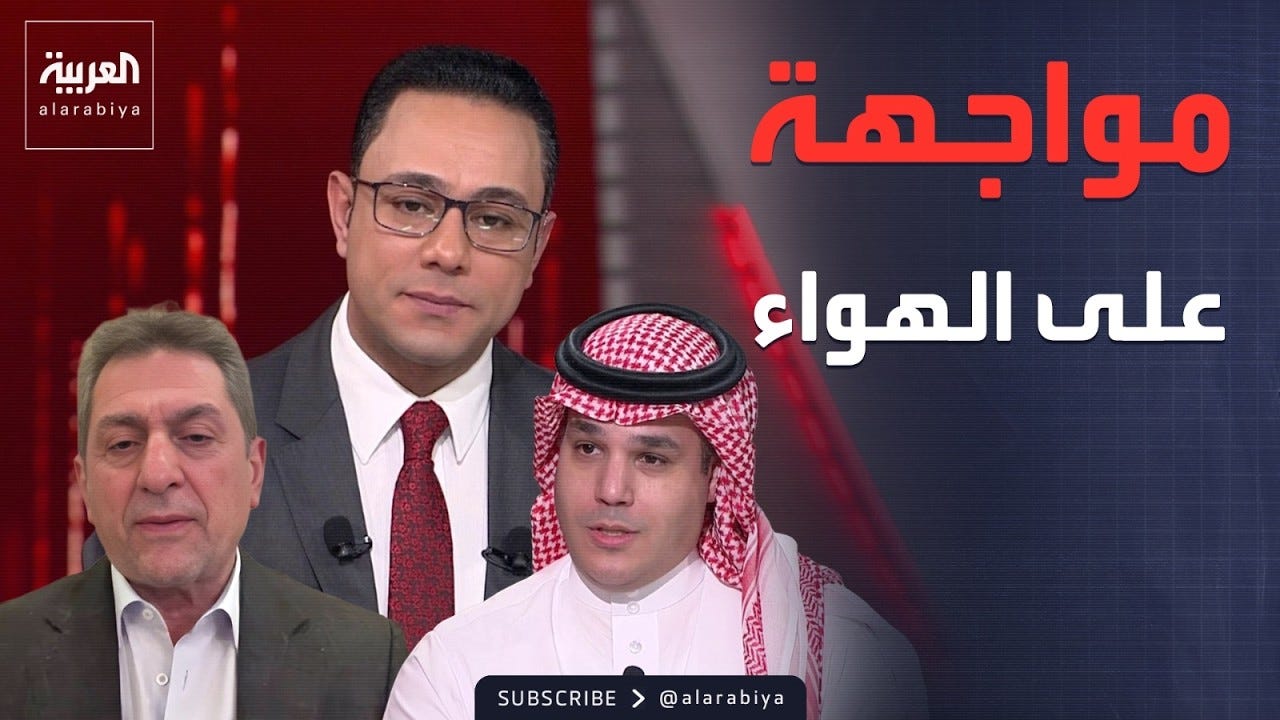
Al-Ahmari on the Gulf’s Security Concerns and the Militia Question
Al-Ahmari: Thank you, and thank you to Al Arabiya again. Yes, I believe they are, and the proof is the question of the militias and the proxies, the abandonment of the proxies. This is the most important point, and it is the real security concern, not the targeting that has occurred during this war. The strikes have a separate legal discussion regarding compensation and regarding the conversation with the Chinese guarantor, who had been the guarantor of the agreement between Saudi Arabia and Iran, among others.
The reality is that the Gulf states’ demands reflected in these negotiations concern the abandonment of the militias and the proxies.
The strange coincidence is that the militias and proxies had their real expansion in the region under former President Obama during the negotiations of 2013, 2014, and 2015. Those negotiations expanded Iran’s footprint, tied to their famous statements about controlling the four Arab capitals. You can trace this back to statements by American officials of that period, including former US ambassador to Syria Robert Ford, who said that there were semi-direct or indirect instructions not to confront Qassem Soleimani and the IRGC, because of the fear.
Host: Look at the deception. There was a fear in Obama’s mind that the Iranians would withdraw from the nuclear negotiations.
Al-Ahmari: Let them expand however they wish, but let us finish this agreement. Today, the militias and the proxies are one of the essential conditions in the negotiations, not just uranium enrichment. President Trump says we will not give up on any condition. One of the American items is the abandonment of the proxies. I believe this is a very clear Gulf concern, whether it involves support for the Houthis in Yemen, the Popular Mobilization Forces in Iraq, and we have seen the missiles and drones launched which prompted the Saudi Foreign Ministry over the past two days to summon the Iraqi ambassador and issue a strongly worded statement condemning the aggressions that were launched from Iraq.
Where did these drones and missiles come from? From Iran, to the proxies in Iraq and the armed factions. Of the four militia networks that existed across the Arab world, the one in Syria has fallen. The Houthis today are in a truce and a security agreement with the legitimate government in Yemen, and they are respecting previous agreements. Nothing has been launched at the Gulf states by the Houthis, and they have not entered this battle.
Host: We have also seen Hezbollah today, with Lebanon in Washington, Lebanese officials in Washington. The unity of the fronts that Iran clung to no longer exists. Syria is out of the fold. Today Lebanon is negotiating directly with Israel.
Al-Ahmari: Iran itself, they say, has abandoned this principle when it went to negotiate with the Americans, regardless of what is happening on the ground.
Host: Iran uses these militias as a card.
Al-Ahmari: And abandons them at the right moment.
Host: Dr. Sadeqian, according to the latest from the Americans, there may be a new round of negotiations in the coming two days. What will the Iranians offer in your view to move the negotiations forward and avoid the deadlock we saw in Islamabad a few days ago?
Sadeqian: Greetings to you, your guest, and your viewers. When the Islamabad negotiations ended and the two delegations, the Iranian and the American, returned to their countries, there was initial information from the Iranian side that they had reached about seventy percent of a resolution, or had managed to resolve seventy percent of the pending problems and files between the two sides.
It appears there was a phone call with JD Vance, and based on that call he left Islamabad, despite the fact that the Pakistani Prime Minister tried to salvage the failure of the negotiations and proposed extending them to Sunday. The negotiations were on Saturday, and the American side accepted, as did the Iranian side, to continue the discussions on Sunday. It appears there was a decision for a press conference by Vance, in which he said the negotiations had failed, and there was a document given to the Pakistani side on a “take it or leave it” basis.
He boarded the plane, and that was that. We heard notable statements, especially yesterday, from JD Vance, who said the negotiations had been good to a large extent and that there are issues that can be addressed. The American tone differs from what it was in Islamabad. The Iranian side now says it is ready to address the remaining problems, but it seems there is a very deteriorated trust, a lost trust, if I may use that expression, between Tehran and Washington, and that is casting a shadow over everything.
Host: Addressing files like what, Dr. Sadeqian? Which files will be addressed in your view, and from which angle?
Sadeqian: There are clearly pending issues. The files that have been addressed are, first, the nuclear file, second, the sanctions file, and third, the file of Iran’s relations with its friends or allies in the region. This covers the Iranian regional role.
It seems to me there were many initiatives and proposals from the Iranian side and the Pakistani side, but it appears JD Vance came to deliver a document. He said we will not negotiate on it. Either you accept this document or you do not. The Iranian side does not accept such things.
This document came against the backdrop of the ten points submitted by the Iranians, and there was great confusion about them, and the American side disavowed them, according to the information available.
Host: The American side disavowed them after having accepted the ten points?
Sadeqian: When Vance came to Islamabad, he said no, he was not negotiating on the ten points. He had these points that must be discussed. Either you accept them or leave them.
Al-Ahmari Pushes Back on the Ten Points Narrative
Host: Let me give space to Mr. Adwan al-Ahmari, because it seems he has things he wants to respond to. Mr. Adwan, it appears the Iranians want to say that what is being disputed and agreed upon are the ten points they originally presented.
Al-Ahmari: No, that is not correct. If you are facing the President of the United States who spoke clearly and frankly and said there are two essential points, the first being that they said, “Give us five years only for Iranian enrichment, not twenty.”
Host: He even said twenty years, not even twenty years, he would not accept.
Al-Ahmari: You are facing a president who sees himself as victorious, and the reality says that the losses and missiles fired by cars are on the Gulf states, not on Iran, not on Israel, and not on the United States. I also believe that President Donald Trump is coming from a position of strength. If we go back in time, the Iranians did not agree to go to Islamabad except after the famous statement, “We will wipe out an entire civilization tonight.”
They agreed immediately afterward. If Iran had negotiating solutions, it would not have agreed immediately after that threat, because there was genuine intent to target energy, water, and electricity facilities in Iran.
Let us move to the other point. When did Iran agree to go to Islamabad? Immediately after Trump announced the naval blockade. If you go back to the news timeline, you will find that four or five hours after the announcement of the naval blockade, Trump said he received calls that the Iranians were open to a second round of negotiations.
Each of these parties is making the other believe it has the posture of the victor, but the reality by the numbers on the ground says Iran today will suffocate economically. It will not be able to support what Dr. Sadeqian calls its allies and friends in the region. Iran does not have state alliances.
The truth is, if you asked Dr. Sadeqian who the allies are, is it the Lebanese government of Prime Minister Nawaf Salam or Hezbollah, he would tell you Hezbollah. If you asked him who the real ally in Iraq is, is it the Iraqi government or the Popular Mobilization Forces, he would tell you the Popular Mobilization Forces. He is talking about proxies, not real regional allies. Syria is out of this equation. Yemen will be out of this equation.
This is what Iran must think about. How can it, let us say, win everyone over? We saw the contact between the Iranian foreign minister and the Saudi foreign minister. We also saw the welcome by the Gulf states and the states of the region for the negotiations in Islamabad, and the welcome of their outcome, the truce and the ceasefire. I believe that today after the naval blockade, things are not as they were before the naval blockade.
I believe the Arab viewer, and Dr. Sadeqian from Tehran among them, will see in the coming days that Iran’s tone will abandon much of the arrogance on the matter of the negotiations, which made everyone believe it was victorious.
Iran has suffered enormous destruction. The casualties are in the thousands, if not tens of thousands. Today the losses are between 290 and 400 million dollars per day, not per month, in oil exports and the closure of the ports. You are talking about a state that planted mines along the Gulf of Oman and in the Omani maritime borders, which is an ally of Iran, to force ships to pass through its waters so that it could then impose fees and make a show of saying it will impose fees. This cannot be enforced.
The whole world sees such rhetorical theater, and it is Iran’s right, of course, to do all this to sell to the Iranian interior, which has not yet come out against the government, out of fear of repression, because there is activation of the emergency law. At any moment, Iran may be strangled economically, and it will surrender and meet all the demands, just give us at least 100 million dollars so we can breathe daily.
The exaggerations that deluded Iran into thinking it was able, I believe they thought that JD Vance was John Kerry. They thought Obama was Trump. They stalled in the negotiations. Vance gave them a clear request, left the plane, and said we gave them a “take it or leave it” offer. This is what will actually happen. Take it or leave it. After that, the naval blockade began, which Iran did not think would be implemented.
This is a smart move by the United States, the least costly for them. The ships are there, the warships are there. I simply inspect and prevent instead of firing missiles and shells daily and launching sorties. I am out at sea. If Iran were able to win and truly able to make the world and its regional allies believe, as Dr. Sadeqian says, that it is a strong state, it should launch missiles and drones at the American warships and the ships that are there.
“…..The strange coincidence is that the militias and proxies had their real expansion in the region under former President Obama during the negotiations of 2013, 2014, and 2015….”
Nothing to do with being able to finance that expansion with the $15 Billion appeasement bounty that Obama gave to Iran then?
Thank you for a very insightful discussion. The theological motivation of the IRGC is rarely reported in the mainstream western media. I believe it is because nearly every reporter and editor is either ignorant or uninformed.
It is important to understand this to fully understand the actions of the IRGC.