

Iran is most often discussed as a nonproliferation problem, a sponsor of terrorism, a regional spoiler. Each of these framings captures a real problem, but none captures what matters most. The nuclear file, the militia archipelago stretching from Lebanon to Yemen, the question of Gulf security architecture: these only acquire their full meaning when read against the backdrop of Chinese grand strategy.
In fact, Beijing has spent years and billions of dollars building Iran into a structural asset. Everything that follows in the Middle East flows from this fact. Which is why Operation Epic Fury is the first American military campaign that threatens to sever that asset. By striking Iran directly, the Trump administration is dismantling, whether by design or by consequence, a pillar of China’s regional architecture.
The urgency of saying so plainly has never been greater. In June 2025, Israel launched Operation Rising Lion, a 12-day campaign of precision strikes that destroyed Iranian enrichment facilities, killed over 30 senior commanders and a dozen nuclear scientists, and drew the United States into direct strikes on 3 nuclear sites. The Islamic Republic’s deterrent mythology, cultivated over four decades, collapsed within a fortnight. In late December, the largest protests since 1979 erupted across all 31 provinces, fueled by economic freefall and a population that no longer believed in the regime’s strength. The government responded in January 2026 with massacres that killed thousands, prompting the European Union to designate the IRGC as a terrorist organization and further increasing the isolation of the regime.
By any conventional measure, the Islamic Republic is weaker than at any point in its history. Yet China was moving to put it back together. This week, it was reported that Tehran was close to finalizing a deal for Chinese-madesupersonic anti-ship cruise missiles, weapons capable of threatening American carriers now massing in the Persian Gulf. Earlier, Chinese suppliers shipped over 1,000 tons of sodium perchlorate, a key missile propellant ingredient, to the Iranian port of Bandar Abbas, enough to rebuild a substantial portion of the ballistic missile stockpile that Israel had just spent 12 days destroying. Understanding why Beijing would do this and what it means for the United States requires looking beyond Iran and toward the broader contest in which Iran plays a role.
The Energy Lifeline
Start with oil, because oil is where the entire relationship begins. China buys around 90% of Iran’s crude exports at steep discounts. The shipments travel on a ghost fleet of tankers that switch off their transponders and relabel their cargo as Malaysian or Indonesian crude to circumvent American sanctions. Since 2021, the cumulative value of these purchases has exceeded $140 billion. This makes China the main reason the Islamic Republic has not gone bankrupt.
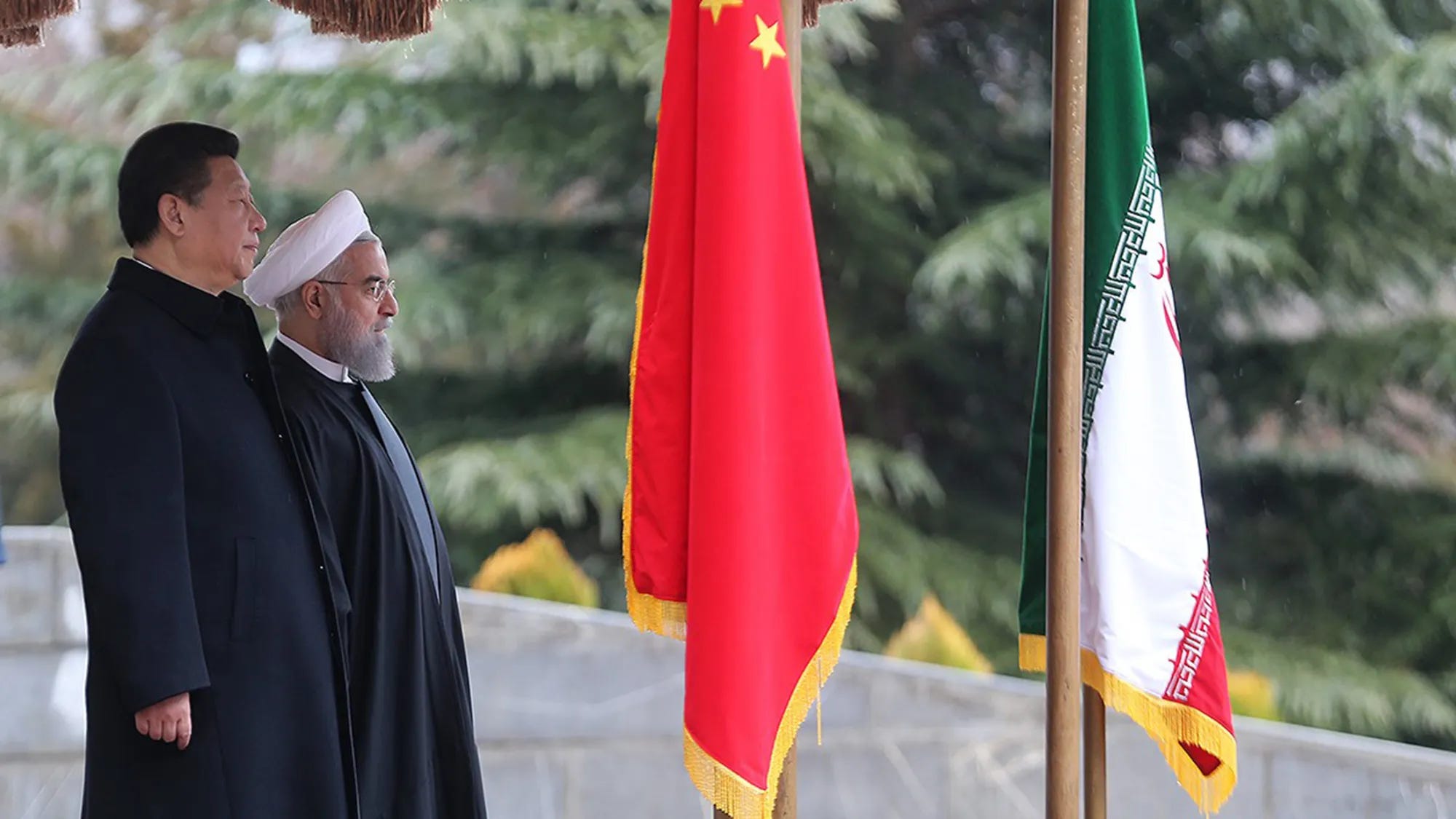
The arrangement works beautifully for Beijing. It gets cheap oil for its industrial base, saving billions annually compared to market-rate suppliers. And in exchange for what amounts to a discount at the pump, China acquiresdurable influence over a nation of 90 million people sitting astride the world’s most consequential energy corridor. Tehran, increasingly cut off from every other major economy, has nowhere else to turn. When Ayatollah Khamenei received Xi Jinping in 2016, he praised the 25-year strategic partnership as “totally correct and endowed with wisdom,” adding pointedly that “Western governments have never been able to win the Iranian nation’s trust.” The supreme leader was not merely flattering a guest. He was describing a structural reality: Iran’s economy now runs on Chinese money, and both capitals know it.
The 25-year Comprehensive Strategic Partnership signed in 2021, committing China to invest an estimated $400 billion across Iran’s energy, banking, telecommunications, and infrastructure sectors, formalized what was already underway. A freight rail corridor now connects the Iranian city of Qom to Yiwu, China. The deeper this integration runs, the less leverage anyone else has over Tehran, and the more leverage Beijing accumulates.
The Digital Leash
The technology dimension of this compact is less discussed than the oil trade, but arguably more revealing of its true character. Huawei and ZTE have built significant portions of Iran’s telecommunications infrastructure. As far back as 2010, ZTE signed a $130 million contract to overlay a surveillance system onto Iran’s state-managed telephone and internet networks. Huawei became the country’s largest telecommunications equipment provider, supplying location-tracking services to mobile carriers and pitching Iranian officials on content-censorship tools by emphasizing that, as a Chinese company, it had the relevant expertise.
Since then, the cooperation has expanded to include AI-enabled facial-recognition cameras from firms such as Tiandy and Hikvision, deep packet inspection tools, and centralized traffic management systems. Iran’s National Information Network, a state-controlled domestic intranet that progressively severs citizens’ access to the open internet, was modeled on the Great Firewall of China and built with Chinese technical assistance.
The practical consequences came into focus during the January 2026 massacres. When the regime imposed a near-total internet shutdown to prevent footage of the killings from reaching the outside world, it did so on infrastructure that Chinese firms had years helping to construct. The surveillance technology that enables the IRGC to track, identify, and suppress dissidents was supplied by the same companies that perform identical functionsfor the Chinese Communist Party in Xinjiang. Beijing is providing the Islamic Republic with the tools to survive its own population’s rejection and is doing so for the same reason it buys the oil: a dependent Iran is a useful Iran.
The Red Sea and the Logic of Attrition
Iran’s value to China extends beyond energy and technology into the domain of proxy warfare. Consider the Red Sea. When Iran’s Houthis began attacking commercial shipping in the Bab el-Mandeb Strait in late 2023, the consequences rippled across the global economy. Container traffic through the Red Sea fell by 90% within 3 months. Goods worth roughly $1 trillion were disrupted in the first 7 months. The rerouting of ships around Africa’s Cape of Good Hope added nearly 2 weeks and about $1 million in fuel costs to every voyage, driving freight rates between Asia and Europe.
The United States bore the heaviest burden of response. Carrier strike groups were deployed, air campaigns were sustained for months, and precision munitions costing between $1 million and $4 million per interceptor were expended at a rate that, by mid-2025, had consumed roughly a quarter of America’s high-end missile interceptor inventory. China, throughout all of this, did nothing.
Chinese-flagged ships sailed through with less interference. Beijing contributed no vessels to the multinational protection force and issued no condemnation of the attacks. Even more so, Chinese satellite companies were providing the Houthis with intelligence to enable their targeting of commercial vessels.
The logic here requires no conspiracy theory to explain. Every dollar the United States spends defending Red Sea shipping lanes is a dollar unavailable for submarine production, Pacific basing, or Taiwan contingency planning. Every carrier group stationed in the Gulf of Aden is a carrier group absent from the Western Pacific. Iran’s proxies, armed with Iranian weapons and supported by Iranian intelligence, function as a mechanism of American strategic attrition, and the costs fall entirely on Washington while Beijing accumulates strategic gains.
Courting America’s Gulf Allies
There is also a further dimension to this picture that receives too little attention. China benefits from the Iranian threat in a second, less obvious way: it uses the anxiety that Iran generates among Gulf Arab states to deepen its own relationships with those states, which happen to be America’s most important regional partners.
The Gulf monarchies have lived for decades under the shadow of Iranian aggression. They managed this historically through close alignment with the United States. But confidence in American reliability has eroded, a process that began with the Obama administration’s pursuit of the nuclear deal with Tehran, deepened after the muted response to the 2019 Aramco attacks, and accelerated after the withdrawal from Afghanistan. Gulf leaders increasingly believe they cannot rely solely on Washington.
China has stepped into this uncertainty with commercial patience and diplomatic ambition. Saudi Arabia now sells more oil to China than to any other country. The UAE has woven Huawei technology into its critical tech infrastructure. Chinese firms are building ports, railways, 5G networks, and smart cities across the Gulf. And in March 2023, Beijing brokered the Saudi-Iranian normalization agreement, a diplomatic achievement that announced China’s arrival as a Middle Eastern power broker. That same year, Saudi Investment Minister Khalid Al-Falih declared publicly that a multipolar world had emerged and that cooperation between the Gulf states and China would be “a significant part of the new order.”
The pattern should be legible by now: Iran's threat pushes Gulf states to diversify their partnerships, and this very diversification increases Chinese leverage. And the more leverage China holds over Gulf capitals, the less likely those capitals are to side with Washington on the questions Beijing cares about most: Taiwan, semiconductor export controls, sanctions enforcement, and the future of the dollar-based financial order.
Why This Is Really About Taiwan
All of which brings us to the central problem. Trump didn't launch Operation Epic Fury to only punish Khamenei for his massacres. He launched it because every year Washington spends managing Tehran is another year Beijing buys in the Pacific, and the administration has decided the trade isn't worth it anymore. The orientation of the Middle East will determine whether the United States can prevail in the defining confrontation of this century: a Chinese move against Taiwan.
First, consider energy. China imports roughly 70% of its oil, most of it transiting the Strait of Malacca. In a Taiwan contingency, those sea lanes become contested. Beijing will need alternative energy sources and will look westward to Iran, Russia, and any Gulf state willing to sell outside the dollar system. If the Middle East has already drifted into Beijing’s economic orbit by the time that crisis arrives, China begins the confrontation with a strategic energy reserve that American planners cannot disrupt.
Second, consider force posture. The United States cannot fight a two-theater war. The Red Sea campaign demonstrated this concretely: a regional militia armed with Iranian weapons consumed a quarter of America’s interceptor stockpile in a matter of months. A Middle East that demands permanent crisis management bleeds the American military of the ships, aircraft, and munitions it needs for Pacific deterrence. A Middle East restructured toward stability, where Iran’s proxy architecture has been degraded, and Gulf partners are aligned, can be managed with a lighter footprint, freeing decisive combat power for the theater that will define the century.
Third, consider coalitions. If a Taiwan crisis comes, the United States will need allied nations to impose punishing costs on China through sanctions, financial exclusion, and technology denial. The effectiveness of that coalition depends on whether energy-producing states participate. If Saudi Arabia, the UAE, and others are so deeply engaged in the Chinese economic system that they refuse to curtail oil sales to Beijing during a Pacific war, the entire sanctions architecture collapses at the moment it is needed most.
The Choice
For all these reasons, the Islamic Republic has been the central pillar of a regional order that Beijing assembled, and Operation Epic Fury is now cracking that pillar. But the strikes should not be understood as an end in themselves. They are the opening act in the larger contest against China, because Iran is where Beijing’s Middle East architecture is most concentrated and most vulnerable. Collapse the Islamic Republic and you remove the single greatest drain on American strategic bandwidth, expose the fragility of every client relationship Beijing has built from Tehran outward, and free the United States to concentrate on the Pacific with a credibility that twenty years of pivot talk never produced.
That outcome, however, requires following through.
The administration has already rejected the negotiated settlement that would leave the clandestine arsenal operational and the Chinese-built surveillance state in place. What remains is to use the convergence of military pressure, regime fragility, and allied momentum to finish what the opening act began. The Venezuela playbook offers a template. Recognize a legitimate transitional authority, marshal international support around the transition, and let the regime’s own fragility do most of the work while American pressure forecloses Beijing’s ability to reconstitute what has been broken.
The nature of the threat makes the harder course not just preferable but necessary. Tehran’s deterrent has never rested solely on its nuclear program. In January 2024, the IRGC launched ballistic missiles from shipping containers aboard a converted cargo vessel purchased for less than 20 million dollars—a fraction of what a warship costs, yet merchant hulls are far harder to sink than frigates, as decades of naval experience have shown. Iran now possesses a mobile, survivable, and largely undetectable strike platform that can operate from any port or shipping lane, hitting from vectors no existing defense plan anticipates. A state that can threaten American carriers from unmarked hulls in any ocean cannot be managed through arms control. Its total removal from the board changes the geometry of great-power competition entirely.
None of this would be possible without the groundwork already laid. What much of the Western conversation has missed, consumed as it has been by debates over proportionality and narratives of supposedly Israeli aggression, is that Israel has been the actor most consistently performing the strategic work that American interests require. Israel broke the Iranian-led axis, dismantled Hezbollah's command structure, and proved that the entire edifice could be shattered by force.
The fashionable framework that reduces the Middle East to a morality tale of Israeli excess has been strategically blind, obscuring the fact that the most consequential campaign against Chinese regional infrastructure in this century was fought not by the United States but by its closest Middle Eastern ally, acting largely alone and under relentless international censure. In this sense, Operation Epic Fury picks up where Israel left off, escalating from proxy destruction to direct confrontation with the hub itself.
Beijing’s response confirms the diagnosis. Chinese satellites provided Tehran with real-time intelligence on American force deployments, including detection of F-35A, F-15E, A-10C, and THAAD system arrivals at Muwaffaq Salti Air Base in Jordan.
And the desperation runs in both directions. At the SCO summit, Pezeshkian begged Xi to treat Iran as “a friendly and determined ally.” Beijing is obliging, because the collapse of the Islamic Republic under American pressure would sever China’s corridors.
No comparable opportunity to inflict this kind of strategic damage on Chinese positioning has presented itself since the end of the Cold War.
It bears repeating: the Iran question was never about Iran. Remove the Islamic Republic from the equation and China loses its pawns for a Taiwan contingency. Leave it in place and the Middle East remains what Beijing designed it to be: a second front that Washington can never afford to leave and can never afford to stay in. Trump's strikes are the first move by an American president who appears to understand that the road to the Pacific runs through Tehran.
Excellent piece. Your ability to explain the bigger picture, overlooked elsewhere, is much appreciated. Looking forward to your coverage of these epic events.
Great piece! I think you're right: it's eventually all about China ... but in the meantime, to eliminate Iran as a threat and enemy in order to achieve an anti-Islamist, enforced peace is paramount. What a relief! Let's hope ...