

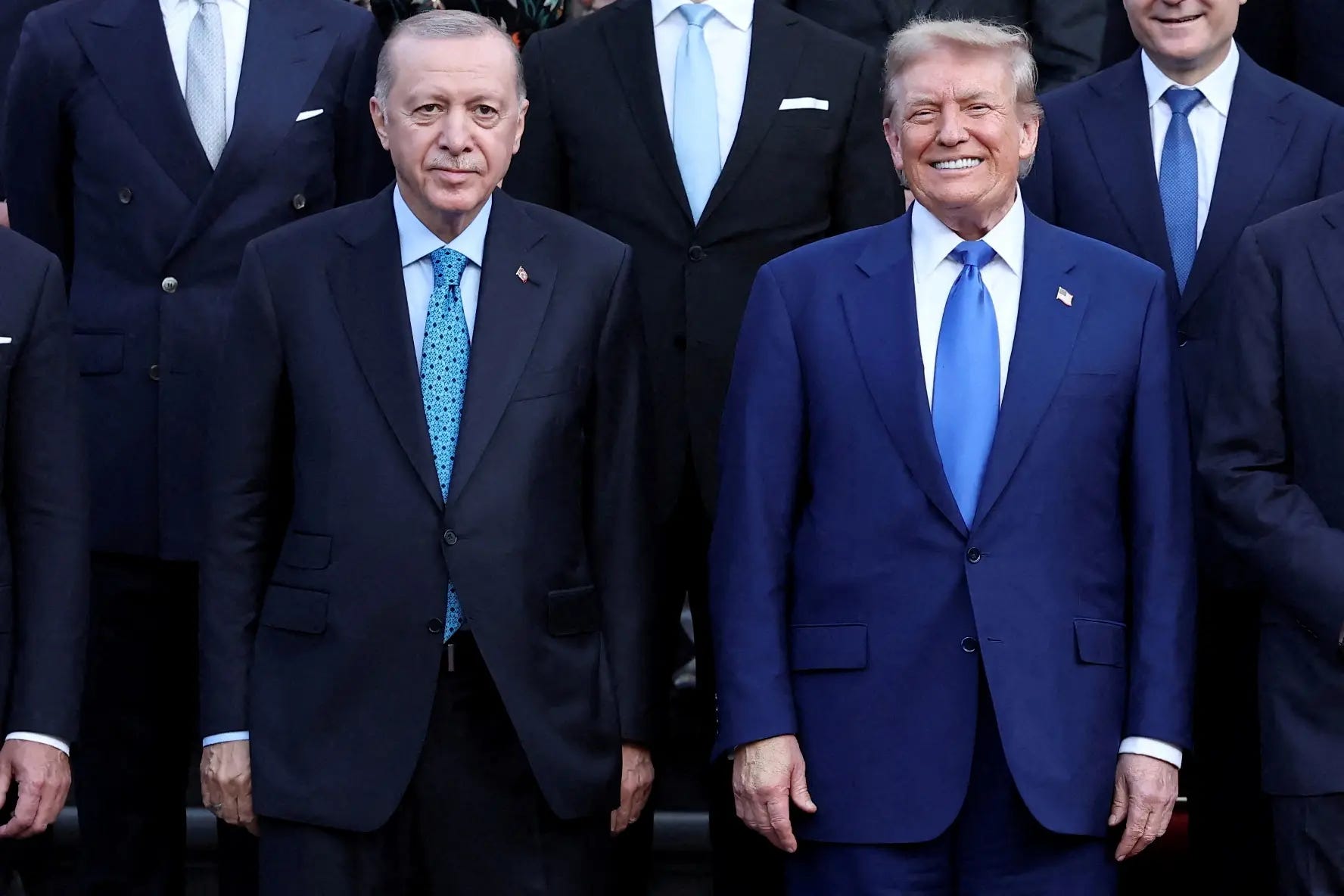
Operation Epic Fury is already destroying one of the central pillars upon which the entire architecture of Middle Eastern geopolitics rested for four decades. The joint American-Israeli strikes eliminated Supreme Leader Khamenei, dismantled Iranian command-and-control infrastructure, and degraded Tehran's missile and nuclear programs. This was the most consequential use of American military force in the region since the 2003 invasion of Iraq.
And the second-order effects will prove far more significant than the kinetic operation itself. Ankara now occupies a position of extraordinary strategic consequence. Iran's incapacitation opens space across every theatre where Turkey projects influence:
The Levant,
The Turkic world,
The African continent,
And the broader competition between Washington and its rivals.
Erdogan's initial response to the strikes was characteristically calibrated. He condemned the American-Israeli operation as a violation of Iranian sovereignty, attributed the escalation to Netanyahu's provocations, and called upon the Islamic world to prevent a wider conflagration. In the same breath, he denounced Iran's retaliatory strikes against Gulf states as unacceptable and dispatched his Foreign Minister, intelligence chief, and Interior Minister into intensive coordination with counterparts across the region. Turkey rejected claims that it provided airspace or logistical support for the operation. The dual posture—deploring all parties while positioning to inherit the aftermath—is typical Erdogan. What distinguishes this moment is the sheer scale of the opportunity now available to him.
Filling the Vacuum
Iran’s degradation accelerates a transformation already well underway.
Since the fall of the Assad regime in December 2024 and the ascent of Ahmed al-Sharaa’s government in Damascus, Turkey functions de facto as Syria’s principal external patron. Approximately 10,000 Turkish troops remain deployed in northern Syria. Ankara shaped the January 2026 ceasefire arrangements that consolidated Damascus’s authority over key territories and oil fields east of the Euphrates. And Turkey’s Defense Minister stated in February that Ankara intends no withdrawal from Syrian or Iraqi territory. The decision, he made clear, belongs to the Republic of Turkey alone.
The removal of Iranian influence completes a process that began with Hezbollah's degradation in Lebanon and accelerated with Assad's ouster. Tehran's network of Shia militias in Iraq—Kataib Hezbollah, which threatened to attack American bases in Babil province following the strikes, and the broader Popular Mobilization Forces apparatus—now faces an existential leadership vacuum. The command-and-control links to Tehran that sustained these organizations for two decades are severed.
Naturally, Ankara sees an opening to deepen engagement with Iraqi factions already gravitating toward Turkish influence, particularly the Kurdistan Democratic Party and an array of Sunni Arab groups disillusioned with Iranian patronage. Turkey's growing influence in Syria already emboldens these Iraqi constituencies, and the Syria file now functions as a strategic multiplier for Ankara's position in Baghdad.
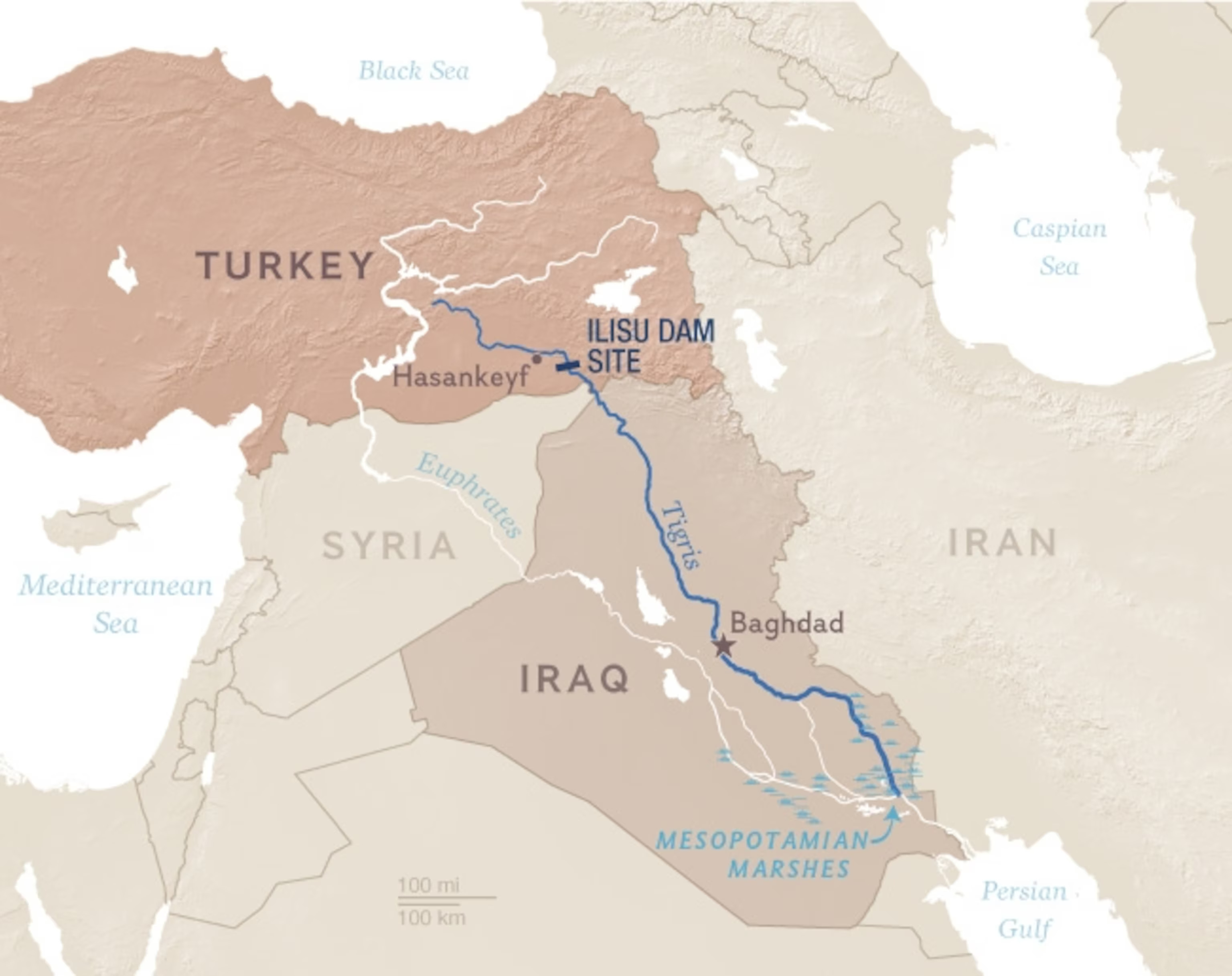
But more importantly, Turkey's leverage over Iraq extends into the most fundamental resource of all. As the upstream power on both the Tigris and the Euphrates, Ankara possesses decisive control over Iraq's water supply—a reality that constrains Baghdad regardless of political dynamics or of Iran’s state of affairs.
Turkey also recently expanded road construction in the Kurdistan Region's western Duhok province and deepened cooperation with the Kurdistan Regional Government on the Development Road Project which is a $17 billion corridor designed to link the Grand Faw Port on the Persian Gulf to Turkey through Iraqi territory. Qatar and the UAE signed a quadrilateral memorandum of understanding with Ankara and Baghdad to serve as the project's strategic financiers, creating a coalition that binds Gulf capital to Turkish logistical reach through Iraqi geography.
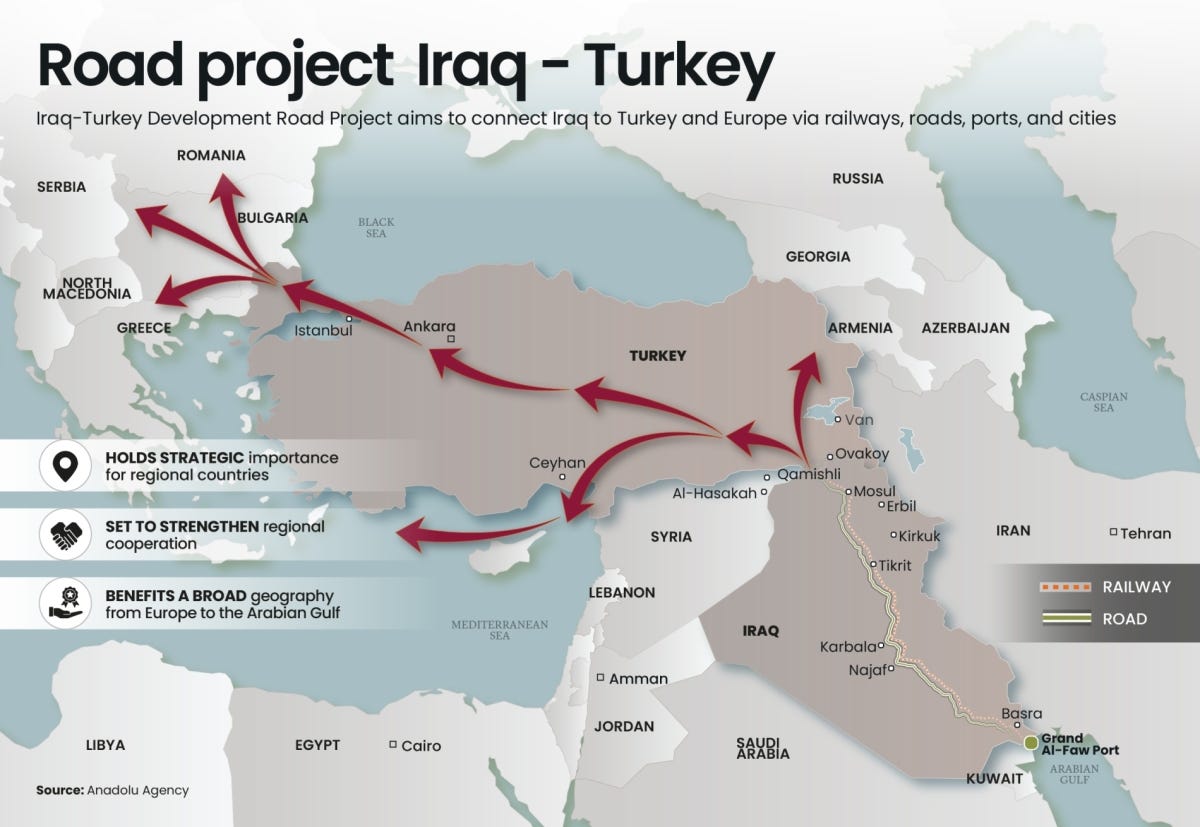
Iran viewed the Development Road with undisguised unease, recognizing it as a direct threat to its own ports and transit leverage. Tehran's incapacitation now removes the principal external actor that counterbalanced Turkish influence over both Baghdad and Erbil.
Putin: The Widening Asymmetry
The other important player for Erdogan is Putin.
Russia’s position in the Middle East collapsed over the past year, and Operation Epic Fury will accelerate the process to its logical conclusion. Moscow lost its Syrian foothold when Assad fell. Russian bases at Tartus and Khmeimim remain nominally operational, but Russia’s strategic influence in the Levant evaporated.
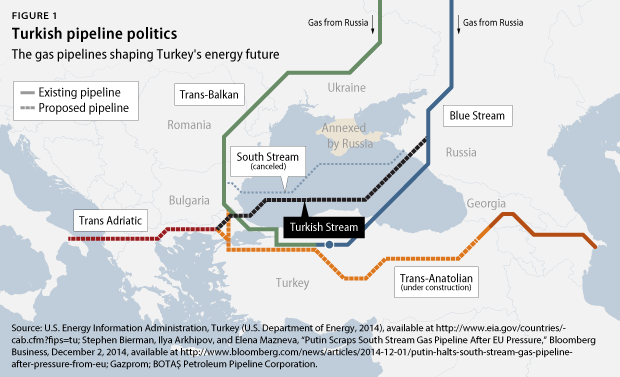
The Turkey-Russia relationship was always one of mutual opportunism held together by the hard logic of energy (although there are obviously numerous other factors at play, but energy/water these are extremely important). Turkey relies on Russian natural gas. The Akkuyu nuclear power plant, under construction by Rosatom, binds the two economies in a multi-billion dollar commitment that neither side can easily unwind. Moreover, bilateral trade reached $55 billion in recent years, a volume large enough to give both capitals a material stake in managing their disagreements.
And the economic entanglement is reinforced by genuine personal chemistry: Putin and Erdogan share parallel trajectories, both were born in the 1950s, both governed for more than two decades, both are nostalgic for imperial grandeur and skeptical of Western institutional frameworks, and both prefer to settle matters between themselves rather than through multilateral machinery.
But Russia's weakening already tilted this relationship decisively in Ankara's favor. Turkey supplied Bayraktar drones to Ukraine, facilitated prisoner exchanges, humiliated Moscow over the return of Azov commanders, and cultivated Central Asian states in Russia's near abroad, all of this without meaningful Russian retaliation.
Why? Well, Putin needs Turkey more than Erdogan needs Putin.
Ankara offers a diplomatic channel to NATO and a partner whose acquiescence Moscow cannot afford to lose in the Caucasus and Central Asia. Operation Epic Fury deepens this asymmetry further. With Iran destroyed and Russia consumed by Ukraine, Putin's capacity to constrain Turkish ambitions is diminished to the point of irrelevance in every theatre except energy supply.
It bears remembering that Erdogan positioned Turkey as a mediator on the Russia-Ukraine conflict, offering to host peace talks and proposing limited ceasefires targeting energy infrastructure. This mediator role enhances Turkey's strategic autonomy rather than tethering it to Moscow.
The dynamic is not whether Turkey will abandon Russia—it will not, as long as energy dependence persists—but that Ankara accumulates leverage at a rate that allows Erdogan to dictate terms rather than negotiate them.
The Turkic World
Iran's degradation carries consequences that extend far beyond the Middle East, and nowhere more so than in the Turkic world.
The Organization of Turkic States (OTS), comprising Turkey, Azerbaijan, Kazakhstan, Kyrgyzstan, and Uzbekistan, underwent a transformation from a cultural identity platform into an increasingly substantive geopolitical grouping. Intra-OTS trade reached an estimated $58 billion in 2024, and Turkey's cumulative trade with member states over five years exceeded $62 billion. At the October 2025 Gabala summit in Azerbaijan, the organization placed security cooperation on its agenda for the first time, with Baku proposing the first-ever OTS military exercise for 2026. It is safe to bet that group will only grow stronger.
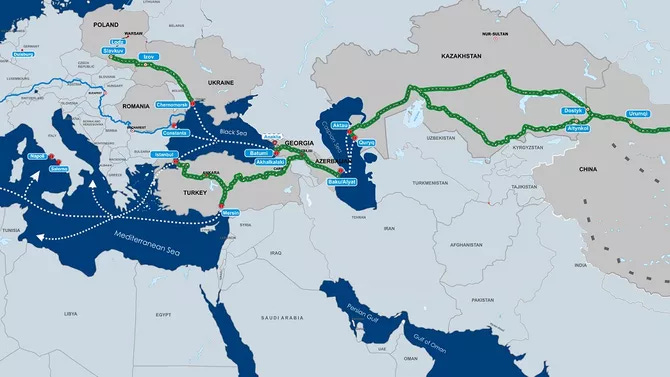
The physical infrastructure to match this political consolidation is already taking shape. Iran's paralysis opens new possibilities for the Middle Corridor, the trade and transport route linking China to Europe through Central Asia and Turkey. The corridor bypasses both Russia and Iran, and gains strategic viability as Iranian disruption potential diminishes. A Polish logistics company already completed the first full round trip through Iraq's new TIR corridors in June 2025, reducing transit time from 24 days to 10. The route now functions. Iran can no longer threaten it.
Turkey's soft power reinforces the institutional gains. Turkish television dramas reach hundreds of millions of viewers, Turkish Airlines connects Istanbul to dozens of Central Asian cities, Ankara launched social media platforms in 2025 aimed specifically at Turkic populations, and Turkish defense exports now penetrate markets that were once exclusively Russian.
The African Expansion
Turkey’s growth across the African continent stands as one of the most significant and least appreciated geopolitical developments of the past decade.
Trade between Turkey and African countries exceeded $37 billion in 2024.
Defense exports surpassed $10.56 billion in 2025, a historic record, with Turkish military hardware now deployed across the Horn of Africa, the Sahel, and North Africa.
Turkish Airlines serves 64 African destinations which is a soft-power enabler for Ankara’s broader strategic agenda.
Iran’s degradation matters here too. Tehran cultivated African relationships for decades, using embassy networks, Shia community ties, and arms transfers to maintain footholds from West Africa to the Horn. That infrastructure is now in disarray.
Turkey moves into the space with a model that combines large-scale infrastructure, defense cooperation, and a distinctly Ottoman sensibility about civilizational ties to the Islamic world. Turkish religious foundations, educational scholarships, and humanitarian organizations laid the groundwork long before the state apparatus followed.
The approach is transactional and unencumbered by the conditionality that constrains Western engagement. Ankara, like Beijing for that matter, does not make defense cooperation conditional on governance or human rights commitments. For instance, Turkey backed the Government of National Accord in Libya’s civil war, deploying drones and Syrian fighters that reversed Haftar’s advance on Tripoli and secured Ankara a lasting foothold in North Africa. In Sudan, Turkey cultivated ties with both the military establishment and civilian factions, positioning itself as a mediator while expanding commercial and defense relationships. This gives Turkey access to partners and markets that Western capitals forfeited, and that Tehran can no longer contest.
The Calculation
Erdogan's Turkey stands at a moment of extraordinary possibility. Iran's destruction removed the most significant regional check on Turkish ambitions. Russia's preoccupation with Ukraine neutralized the second. The Kurdish question is closer to a political settlement than at any point in four decades. Turkey's influence extends from the Balkans to the Horn of Africa, from the Levant to the steppes of Central Asia. No other middle power in the international system operates across so many theaters with such a combination of military, diplomatic, economic, and cultural instruments.
Erdogan's genius always lay in his capacity to maintain contradictory positions simultaneously. He condemned Israel while preserving deconfliction channels, armed Ukraine while purchasing Russian energy, championed the Islamic world while expanding NATO engagements. Operation Epic Fury does not end this hedging. It raises the stakes. The post-Iranian Middle East offers Turkey more room to maneuver, but also more pressure to choose. Choices that could be deferred when Iran absorbed the attention of every regional actor will now demand resolution.
For Washington, the strategic imperative is to treat Turkey as what it is: not an easy partner, not a submissive ally, but an indispensable one.
Erdogan’s relationships with Trump, with al-Sharaa, with Putin, and with the leaders of the Turkic world give him a connective capacity that no other leader in the region possesses. The United States should use the post-Epic Fury environment to press for a Turkey-Israel settlement on Syria, positioning Ankara as a stabilizer rather than a spoiler in the Levant. It should engage the Organization of Turkic States as a serious element of Central Asian strategy. And it should coordinate with Turkey on African engagement where interests converge, especially in countering terrorism and stabilizing the Horn.
The alternative is neglecting Turkey’s potential while Erdogan hedges between competing poles, squandering the most significant realignment of Middle Eastern power since the end of the Cold War.
Erdogan will, as always, calculate. The question is whether Washington will calculate with equal precision.
Great article as always Zineb!
But currently Iran is not much of a counterweight to Turkey, with a GDP 1/3 of Turkey, isolated by sanctions and faced with internal dissent.
In the longer term, if the Islamic Republic is replaced by a pro Western regime like the Shah's, then Iran will become a much more powerful counterweight to Turkey than the Ayatollahs ever were. Iran will once again have massive oil revenues, access to the best US and Israeli technology and a better educated population.