

Ahead of the U.S. midterm elections, one might have expected President Donald Trump to lower the temperature with Iran. Instead, Washington has continued applying economic and military pressure while Tehran has concentrated on convincing Americans that the confrontation is costing the United States more than Iran.
Mohammad Bagher Ghalibaf, speaker of Iran’s parliament, has made that case through U.S. economic indicators. When the 10-year Treasury yield reached 5.1 percent on September 24, he wrote in a post on X, “Happy 5.1% 10Y America,” and warned of “high gas prices” and “diesel shortages.” Three days later, Ghalibaf cited the premium in oil prices to challenge Washington’s claim that Iran had lost control over the Strait of Hormuz, writing that “either the market’s dumb or the US narrative-laundromat is faking it.” On September 30, he projected growing U.S. financial stress through November and into 2027.
In many ways, this is the core of Tehran’s information campaign. Rather than answer questions about the damage the IRGC is absorbing, Iranian officials point Americans toward the costs they can see at home and argue that continued confrontation will only make them worse. The timing, weeks before the midterms, is hardly incidental. Ghalibaf’s message is that Washington may pressure Iran, but Americans will eventually decide the price is too high. That argument, however, tells us little about Iran’s ability to sustain the confrontation or preserve the regional system Tehran spent decades building.
In fact, Washington appears to be pursuing a broader objective. The current approach is better understood as what I would call “strategic asphyxiation,” and it has an interesting Cold War precedent. On January 17, 1983, President Ronald Reagan signed National Security Decision Directive 75, or NSDD-75, which laid out U.S. strategy toward the Soviet Union. Washington would seek “to contain and over time reverse Soviet expansionism” by “competing effectively on a sustained basis with the Soviet Union in all international arenas.”
NSDD-75 reflected a broader strategic principle: containing Soviet expansion required Washington to weaken the foundations of Soviet power and challenge its influence abroad. Economic pressure, technology restrictions, military competition, and support for forces resisting Soviet influence worked together to raise the cost of Moscow’s ambitions. As these pressures mounted, the Soviet Union would find it increasingly difficult to sustain its commitments abroad on an already strained economic and technological base.
Iran is a very different adversary, but its character as a revolutionary state makes this approach particularly relevant. Over several decades, Tehran has built a regional power system centered on the IRGC, linking the regime’s financial resources, military industries, procurement networks, and allied armed movements. Through this system, Iran converts revenues into weapons, technology, training, and logistical support that sustain its influence across the Middle East. The Houthis in Yemen and Iran-aligned militias in Iraq operate within this broader structure, relying to varying degrees on the resources and capabilities Tehran provides. Pressure on these groups can weaken Iran’s regional reach, but its effects will remain limited so long as the regime retains the financial and industrial capacity to replenish their losses. A sustained strategy must reach the Iranian system that makes their operations possible.
In this sense, the strategic asphyxiation strategy has four defining features:
Economic constriction: Reduce the revenues and access to foreign currency that finance the wider system. Operation Economic Outcast targets this layer through oil exports, trade, financial intermediaries, and sanctions-evasion mechanisms.
Network disruption: Target the IRGC financial, procurement, shipping, and logistical networks that convert money into technology, components, weapons, and support abroad. Economic pressure has a limited effect if Tehran can still move resources through alternative channels.
Industrial degradation: Damage the military infrastructure that converts technology and materiel into missiles, drones, and other weapons. Strikes on production facilities make losses harder and more expensive to replace.
Regional attrition: Increase the cost of Iran’s external commitments by weakening the armed groups and supply networks through which Tehran projects power. Pressure in Iraq, Yemen, Lebanon, and elsewhere forces Iran to spend increasingly constrained resources defending investments accumulated over decades.
The campaign also works on morale. Clausewitz placed “moral forces” alongside physical ones because military power depends partly on confidence. For decades, Tehran cultivated the expectation that Iranian support would remain available despite losses or sanctions. Once that expectation weakens, the effect reaches beyond the weapons or money Iran has actually lost.
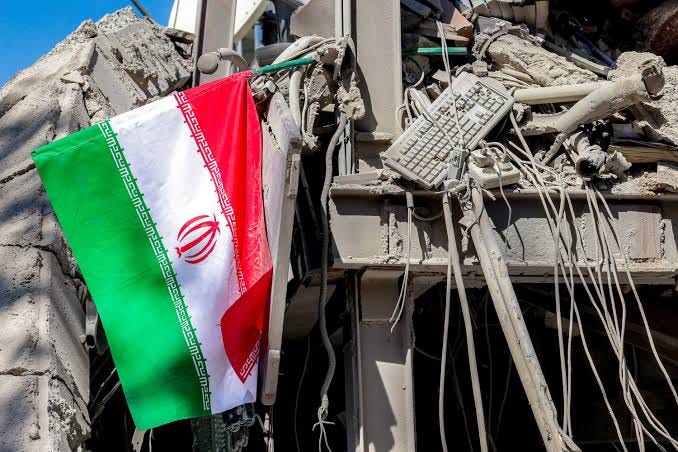
The results are already visible. The rial has lost more than half its value over the past year, falling to roughly 2.7 million to the dollar, while inflation has climbed above 70 percent. Tehran has also acknowledged a sharp contraction in trade. But these figures are only the most visible signs of a broader weakening. Iran spent decades converting economic strength into regional influence, and the strain is increasingly visible in Iraq, Yemen, and Lebanon.
As a matter of fact, the Houthis face growing challenges, Baghdad is pressing Iran-aligned militias to bring their weapons under state control, and Lebanon has entered negotiations with Israel as Hezbollah’s position weakens. The talks may lead nowhere, but their very existence speaks to how much the regional balance has shifted. Iran’s mounting economic troubles and the growing vulnerability of its regional network reinforce each other, leaving Tehran with fewer resources to sustain its allies and fewer allies capable of defending its interests.
Washington still has work to do, but sustained strategic asphyxiation will sooner or later force the Islamic Republic to confront a fundamental choice: abandon the revolutionary ambitions that have cost Iran and its people billions of dollars, or pursue them at an increasingly unbearable price until the revolution itself consumes what remains of the regime.
It’s always illuminating to hear your perspective.
Curtis Yarvin:
“Power is habitual obedience; Regime change is a structured discontinuity in the habits of obedience. It must never be forgotten that regime change is a change to obeying something else.”
When will Iran stop being a revolution. They have squandered enough generations of their people on their stupid ideology. Really, Shia Islam is who’s future; Nice turbines though.