


“If tolerance is born of doubt, let us teach everyone to doubt all the models and utopias, to challenge all the prophets of redemption and the heralds of catastrophe.
If they can abolish fanaticism, let us pray for the advent of the skeptics.”
Raymond Aron, The Opium of the Intellectuals
It’s official. Secretary of State Marco Rubio and Under Secretary of State Sarah B. Rogers agree with me that Third-Worldism is one of the biggest challenges that the United States is confronting, and I’m obviously very glad the notion is gaining traction.
For some reason, it has slipped out of the standard encyclopedia of ideologies even though intellectuals like Raymond Aron identified it early and explained precisely what it would become.
I have warned for a while about its rise in the United States, especially after October 7, and also about how China, Russia, and Iran use it to promote anti-Americanism and conduct information warfare campaigns. Naturally, naming the ideology is the first step toward countering it.
In a statement, Secretary Rubio explained: “For more than six decades, the Cuban regime has been the leading sponsor of radical leftism and Third Worldism in the United States. The State Department is exposing the full history of Cuban espionage and subversion in our country. The American people deserve to know.”
What makes Third-Worldism uniquely dangerous is its ability to not only present itself as a moral creed, almost a secular religion, but also in how it helps advance every single interest but the United States’. Indeed, foreign propaganda usually arrives bearing the marks of an adversary and is discounted accordingly. Third-Worldism, by contrast, speaks in an American vocabulary through Americans in universities, newsrooms, philanthropic foundations, and legislatures, cultivating a domestic constituency that steadily narrows what elected officials consider politically defensible. Beijing, Moscow, Tehran, and Havana understand the strategic value of cultivating these narratives. They benefit from activist movements already inclined to embrace them. After all, a citizen persuaded that his own country's power is fundamentally illegitimate does more to advance their interests than any intelligence agency could hope to accomplish.
Third-World and Third-Worldism
Understanding why requires distinguishing the ideology from the Third-World that named it.
Alfred Sauvy coined the term in 1952 by analogy to the third estate of the French Revolution, describing a bloc that was ignored, exploited, and scorned, and that wished to become something. The phrase later on designated a set of places belonging to neither the Western bloc nor the Soviet one, and the category has long since dissolved, since states once gathered under it now include some of the wealthiest societies on earth alongside powers projecting force well beyond their borders.
On the other hand, Third-Worldism is a symbolic conception of those places rather than a description of them, which is why it outlived the geography that produced it. The central claim of the Third-Worldist cosmos holds that the fundamental division in world politics runs between a dominating North and a dominated South, that this cleavage precedes and explains every other political fact, and that every conflict resolves into a single story of colonizer and colonized. What the ideology fundamentally demands but also delivers in a way that is hypnotic is a totalizing moral hierarchy in which victimhood confers legitimacy and power confers guilt, a formula that can be applied to any dispute anywhere, indefinitely.
As I mentioned in an earlier piece, François Furet gave the clearest account of what such a structure actually is. A French historian of the Revolution who broke with the Communist Party in 1956 and spent the remainder of his career dismantling the Marxist historiography he had once served, Furet argued in Penser la Révolution française and later in Le Passé d'une illusion that revolutionary politics operates as a mentalité rather than a body of doctrine, a way of inhabiting political reality in which history moves toward a redemptive rupture and the believer locates himself on the correct side of it.
His insight was that the mentalité survives the falsification of every proposition attached to it, because it was never held as a set of propositions in the first place, a finding he reached by tracing how Western intellectuals sustained their commitment to the Soviet project across every disclosure that should have ended it. And I believe that Third-Worldism operates on exactly that basis, which is why no accumulation of evidence, even when coming from the Third-World about the outcomes it produces, has any effect on the conviction of those who carry it.
The Ideology That Outlived Its Subject
In that sense, a mentalité that survives the falsification of its propositions will also survive the downfall of the state that housed it, which is why communism and its supporters did not vanish with the Soviet Union.
As a matter of fact, Western governments read the institutional victories of 1991 as the conclusion of a contest that had merely mutated, and the mutation followed a pattern familiar from certain pathogens, which shed the features that make them recognizable while conserving the mechanism that makes them transmissible. Class struggle and other forms of “Wokeism” proved dispensable and were discarded without difficulty, while the underlying partition of humanity into oppressor and oppressed survived every ideological battle by locating fresh categories to inhabit, so that class yielded to race, race yielded to colonizer and colonized, and the present arrangement arrays the West against everybody else.
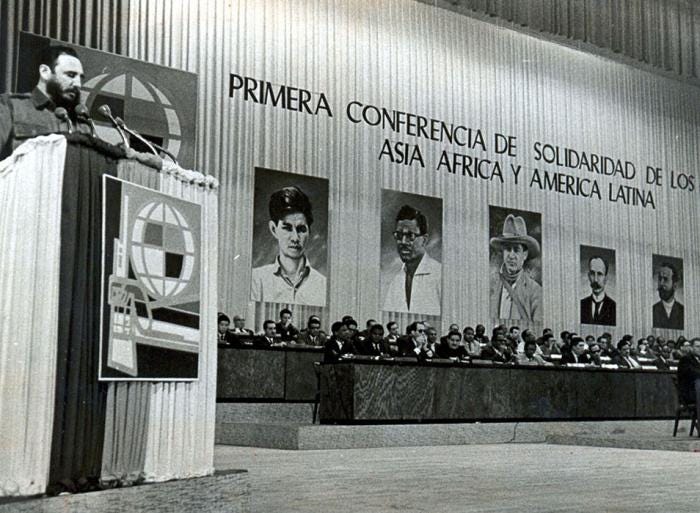
Cuba demonstrates perfectly that the mutation worked and is working, having grasped before Moscow did that the Third-Worldist frame traveled further than doctrinal orthodoxy and having built the institutional machinery to prove it. The Tricontinental Conference of January 1966 assembled delegates across countries and produced two permanent bodies, the Organization of Solidarity with the Peoples of Africa, Asia and Latin America and the Latin American Solidarity Organization.
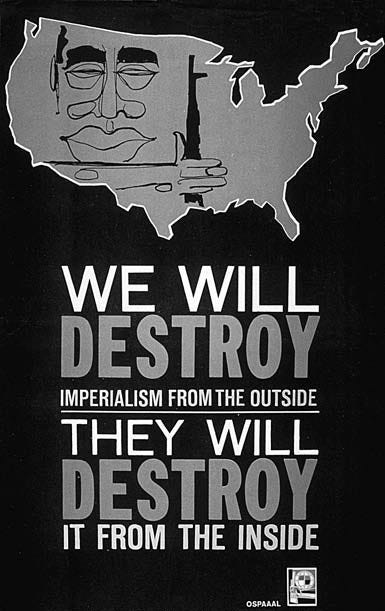
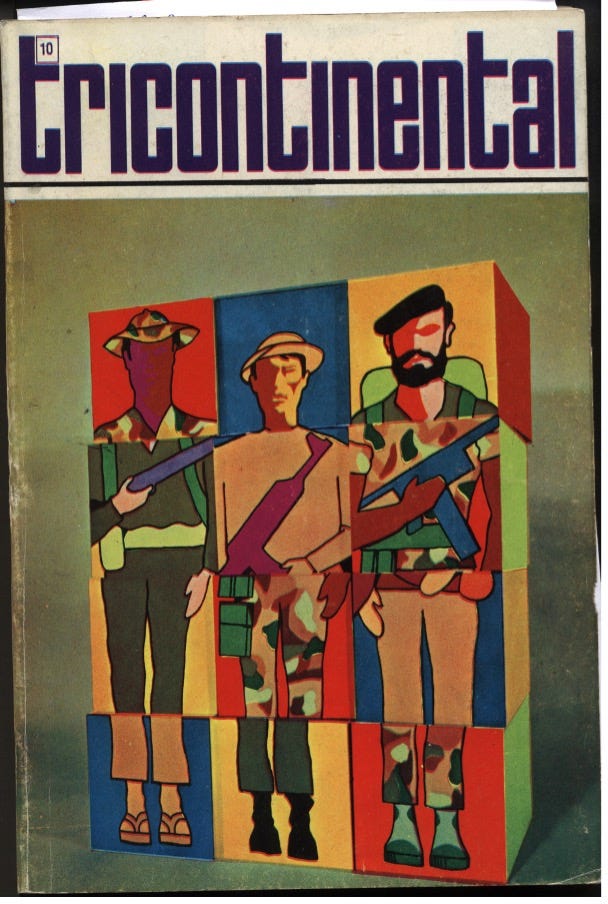
From those bodies came a journal circulating in several languages and a poster output running to hundreds of designs distributed worldwide, which promoted this sort of “global resistance” to audiences that never opened a page of Marx.
The 6th Non-Aligned Movement summit followed in Havana in 1979, handing Fidel Castro the chairmanship for three years, and the Havana Conference on Third World debt came in 1985 with representatives of high caliber. The catch was that participation in any of it required no communist commitment, which was precisely the point, and Cuban intelligence built slowly but surely its relationships within American academic, activist, and policy circles around the frame instead of the party, so that those relationships outlived the Soviet collapse entirely.
Cubans themselves are the first casualties of what their government exports, since decades organized around “resistance to imperial domination” have yielded ration books, a medical system in ruin that the regime continues to advertise abroad as a great success, and an exodus so large that the diaspora now constitutes a substantial fraction of the nation. And every material failure receives the same explanation: colonialism, a category convenient enough to absorb responsibility for outcomes the leadership's own decisions produced.
Iran adapted the model as well to a different context and region and produced its most operationally successful version, namely “Khomeinism”, presenting itself as the vanguard of the mustazafin, the oppressed of the earth, a formulation that carries the North-South ideological framework intact under theological terms.
Why this Matters
First, the State Department, like much of the national security establishment, has struggled for years to identify conceptually the threat.
Communism is an inadequate label. The term has lost much of its explanatory power in the American political imagination, burdened by the legacy of the Cold War and associated with an economic doctrine that few contemporary activists openly embrace. More importantly, today’s progressive movements draw their energy from universities, media, and cultural production rather than from the industrial working class that Marxism once claimed as history’s revolutionary agent.
Islamism is equally insufficient, though for the opposite reason. Most of the college-educated Americans advancing the ideas of Hamas or Jihadism hold no commitment to divine sovereignty, Islamic law (Shariaa), or religious governance. Shared opposition to the United States and Israel, rather than shared theology, explains their alignment with Islamist movements. Common enemies frequently produce political cooperation without ideological agreement.
Also, Third-Worldism explains the coalition’s looseness better than either label because the doctrine furnishes the shared premise both alternatives miss: the revolutionary subject cannot err, and anti-imperial grievance is fuel. A movement organized around grievance rather than program can migrate from climate to Gaza to Cuba without contradiction, because the object of protest is interchangeable so long as the accused remains the same.
The irony is that many societies classified as “the Global South” increasingly reject the revolutionary governments claiming to speak for them. Cubans flee Cuba. Iranians risk their lives protesting the Islamic Republic. North Koreans defect whenever escape becomes possible. Developing states seek closer relations with the United States, Europe, and Japan rather than with self-proclaimed revolutionary regimes. The principal constituency for Third-Worldism sits not in the Third-World but in the West.
Second, accommodation with Third-Worldism appears in the conduct of American foreign policy itself.
Washington has almost always treated revolutionary hostility as a negotiating posture to be managed rather than a declared purpose to be believed, extending recognition, multilateral standing, remittance channels, and sanctions relief to governments whose legitimacy rests on the promise of defeating the United States. Havana and Tehran, for example, have never concealed that resistance to the West forms the foundation of both regimes and the justification they offer their populations for everything withheld from them.
Third, anti-Zionism and anti-Americanism constitute one commitment expressed at two levels of a single hierarchy.
Anyone who accepts the case for decolonizing Israel has already accepted the case for decolonizing the United States, since the same premise governs both, and the Third-Worldist view has never permitted the exception that adherents assume they are drawing when they endorse the first and decline the second. Israel has always been the entry point in the longer argument against the United States.
Finally, and most importantly, the State Department for the first time explains to Americans why they should refuse the logic of decline that the Third-Worldist doctrine promotes.
The ideology asks a country to accept that its power is a historical accident awaiting either correction with a sort of new Red Terror or annihilation, that its founding contaminates everything built since, and that the proper posture toward the rest of the world is apology. One can entertain this only for so long, a country persuaded that its strength is illegitimate will not be able to keep it.
Glad you’re back!
Brilliantly put, as always