


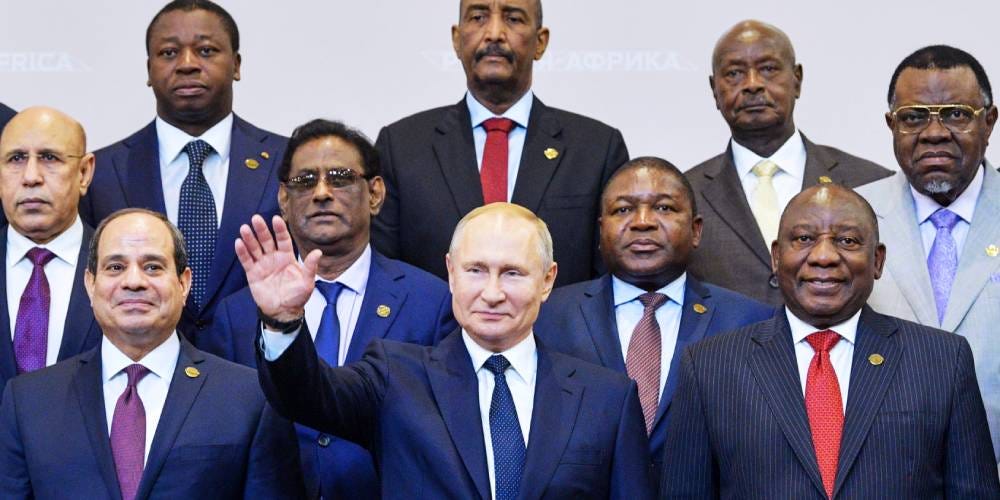
“The era when the destinies of entire continents were determined by a narrow bloc of states is coming to an irreversible end,” declared Russian President Vladimir Putin as he welcomed African leaders to Moscow on October 28 for the third Russia–Africa Summit. While European governments remain preoccupied with the war in Ukraine and their increasingly complicated relationship with Washington, Putin has been courting African leaders, portraying Russia as a defender of their sovereignty against Western interference. Behind this charm offensive, however, lies a broader strategy: exploiting Europe’s vulnerabilities along its southern flank to extend Moscow’s confrontation with the continent beyond Ukraine.
This latest diplomatic push is somewhat different from its predecessors. The first Russia–Africa Summit took place in Sochi on October 23–24, 2019, when Moscow was already benefiting from the operations of Yevgeny Prigozhin’s Wagner Group. By then, Russian mercenaries had established a presence in the Central African Republic, Sudan, and Libya, cultivating relationships with local governments and armed factions that Moscow could exploit without committing itself to conventional military deployments. Wagner’s subsequent arrival in Mali in 2021 further expanded this network, particularly in territories where French influence was rapidly deteriorating.
Prigozhin’s death on August 23, 2023, less than a month after the second Russia–Africa Summit in St. Petersburg, marked an important turning point. Rather than abandon the networks Wagner had accumulated, the Kremlin began bringing them under more direct state control, particularly through the Russian Defense Ministry’s Africa Corps. Putin was effectively transforming the military and political relationships developed by Prigozhin into a more permanent instrument of Russian foreign policy.
The consequences for France have been considerable. After nearly a decade of fighting jihadist insurgencies, French troops completed their withdrawal from Mali on August 2022. They subsequently left Burkina Faso in February 2023 and Niger in December of the same year. Military coups, deteriorating security conditions, and growing resentment toward France were already weakening Paris’s position. But Moscow exploited these developments, launching anti-French disinformation campaigns while positioning itself as an alternative security partner.
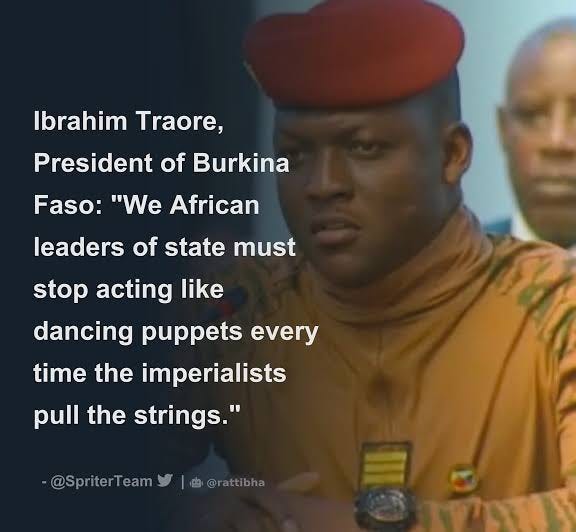
This is what makes Putin’s latest diplomatic outreach particularly significant. The Russia–Africa Summit may look like another exercise in political theater, with familiar declarations about sovereignty and Western interference reminiscent of the Soviet Union’s support for Pan-Africanism and anti-colonial movements during the Cold War. At the 2023 summit, Burkina Faso’s Ibrahim Traoré, for example, urged African leaders to stop behaving like “puppets who dance every time the imperialists pull the strings.” Yet behind the familiar rhetoric lies a concrete strategic objective: turning these political relationships into leverage against Europe, particularly along NATO’s vulnerable southern flank.
First, control over strategic ports and maritime chokepoints tied to European security. Russia’s military presence in Libya has given Moscow access to facilities along the Mediterranean, while its pursuit of a naval base in Sudan’s Port Sudan reflects ambitions to establish a foothold on the Red Sea, near the approaches to the Suez Canal. Although the Sudanese base agreement remains uncertain, these efforts point to a broader Russian strategy of positioning itself along maritime routes vital to European trade, energy supplies, and security. Such access would give Putin additional opportunities to project military power and complicate European operations along NATO’s southern flank.
Second, influence over the Sahel and its security networks. Russia’s expanding relationships with Mali, Burkina Faso, and Niger give Moscow a role in a region plagued by jihadist insurgencies and trafficking in migrants, weapons, and drugs. With French and other Western forces largely withdrawn, European governments have lost much of their ability to shape security developments there. Moscow can exploit this vacuum, particularly as instability and migration remain deeply divisive issues within the EU. For Putin, additional pressure from the south could easily aggravate European political divisions and distract governments already struggling to sustain their commitments in Ukraine but also in building their own military capacity and reviving their industrial base.
Third, access to strategic resources and the displacement of European commercial interests. The Alliance of Sahel States (AES), established by Mali, Burkina Faso, and Niger in 2023, encompasses countries rich in uranium, gold, and other minerals where European companies, particularly French firms, have historically enjoyed privileged positions. Niger’s nationalization of SOMAÏR, previously majority-owned by France’s Orano, illustrates how these relationships are being overturned. As Russian companies pursue mining, nuclear-energy, and infrastructure agreements, Moscow stands to gain commercial opportunities while making Europe’s access to important resources and contracts increasingly uncertain.
One can easily dismiss Putin’s Africa summit as “diplomatic theater,” but Europe would be making a serious mistake by ignoring what Russia is building in its southern neighborhood. Equally mistaken is the assumption that African leaders will eventually turn against Moscow because Russia has failed to solve their countries’ problems. That misses the point of Putin’s strategy. Stability in Africa was never his priority, in fact, instability can be an asset, keeping African governments dependent on Russian support while generating new pressures on Europe.