

“Europeans would like to escape from their history, a “great” history written in letters of blood. But others, by the hundreds of millions, are taking it up for the first time, or coming back to it.”
Clausewitz: Philosopher of War, Raymond Aron, 1976
The Obsolete Discourse
There is, as there has always been, a familiar criticism of European power. Everyone knows it. Europe is weak— a continent of impressive wealth, knowledge, and resources whose will to power stands on the brink of total exhaustion, held hostage by those who want more social welfare and by those who want more regulations at the expense of innovation. Yes, Europe is weak. But this conclusion does little to clarify the current geopolitical predicament, especially when we consider Iran.
What a more careful account demands is a reckoning with what European governments actually did in the months before Operation Epic Fury, and with what their public statements since have chosen to conceal.
Chancellor Merz’s suggestion that Iran fell outside NATO’s frame of concern revealed, as a matter of fact, considerably more about political calculation than about any genuine reading of the strategic environment or about Europe’s ability and capability to do anything about the Strait of Hormuz.
When one takes a closer look, the claim itself borders on antinomy. NATO’s own formal assessments identify Iran as a significant threat to Alliance security. A declaration of that kind, made before cameras with the full authority of high office, belongs therefore to the lexicon of domestic audience management, not to that of strategic analysis or assessment. In other words, it was a signal, just not a geopolitical one.
The Reality
That gap matters because the history of the preceding months tells a far more revealing story.
In fact, the first and most consequential of Europe’s contributions was the snapback of international sanctions. When Iran signed the 2015 nuclear agreement with France, Germany, and the United Kingdom, the deal included a critical provision: if Tehran failed to honor its commitments, any signatory could trigger the automatic restoration of all United Nations sanctions, with no possibility of a Russian or Chinese veto blocking the process.
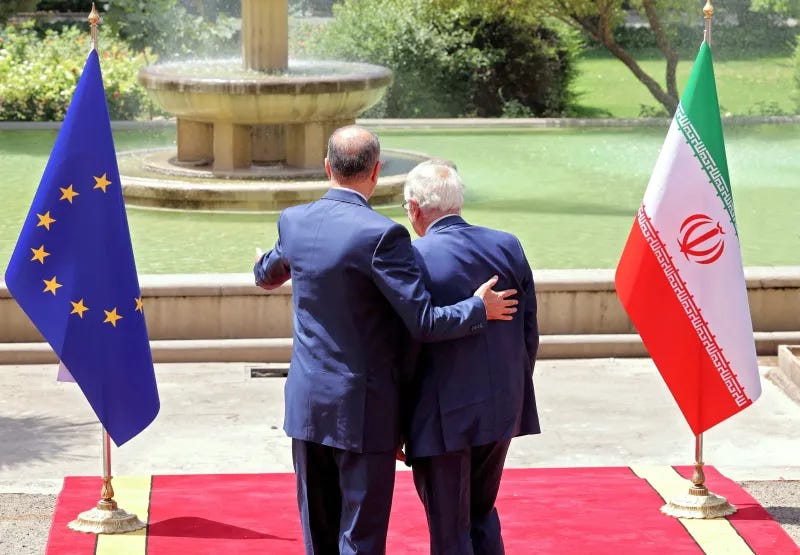
For years, European governments declined to use it, sustained by the hope that patience would yield a more constrained Iranian posture. That hope was exhausted. On August 28, 2025, the three European powers initiated the snapback, and by its conclusion, six United Nations Security Council Resolutions had been fully reactivated, restoring the comprehensive sanctions architecture that the 2015 agreement had suspended, including arms restrictions and constraints on Tehran's ballistic missile program. The regime found itself returned to the full weight of international pressure it had spent a decade working to escape. If the Islamic Republic regime is today broken, it’s also all thanks to Europe.
The second contribution was the formal designation of the Islamic Revolutionary Guard Corps as a terrorist organization and including it in the EU terrorist list. The IRGC had for years treated European territory as operational ground, directing assassination plots against dissidents, opposition figures, and journalists living under European legal protection, and running intelligence networks across the continent that formal diplomatic engagement had done little to curtail. EU member states had long resisted the designation, arguing that it would complicate nuclear negotiations. That argument dissolved as evidence of IRGC operations on European soil accumulated beyond what diplomacy could politely ignore. The designation, more importantly, ended a fantasy that Tehran had exploited for years: that a government sending assassination squads into European cities could simultaneously be treated as a credible negotiating partner.
The third contribution was the least visible and the most structurally important: Filling the vacuum in Syria. When Bashar al-Assad’s government collapsed in December 2024, it severed the central logistics corridor through which Iran had for decades supplied and directed Hezbollah, and it placed in sudden jeopardy Russia’s most consequential military foothold in the Mediterranean, the naval base at Tartus and the Hmeimim air base in Latakia, facilities through which Moscow had projected power across the Middle East and North Africa for years. European governments understood that the Syrian landscape emerging from Assad’s fall represented a unique and rare strategic opening of considerable significance, one in which the simultaneous erosion of Iranian and Russian influence (especially Iranian) created conditions for a serious stabilization effort to take hold. Working in coordination with Washington, they pursued reconstruction and governance with a concrete national interest at the center of their calculation: a stable, sovereign Syria was the only credible condition under which the millions of Syrian refugees who had reshaped European domestic politics for a decade could finally return home.
The Real Question
What these three actions reveal is a European political class very capable of consequential strategic action but deeply reluctant to claim that capacity before its own publics. The reluctance, I believe, is not primarily electoral, though electoral considerations provide its most straightforward explanation. It is also fundamentally civilizational.
To acknowledge what European governments actually did would require confronting a proposition that the dominant assumptions of postwar European political culture have made extraordinarily difficult to absorb: that the Islamic Republic, whose revolutionary theology is organized around the negation of the Western order, had for decades been waging a patient and largely uncontested campaign against European societies from within. That proposition alone would demand a fundamental revision of how European elites have framed the sources of disorder in the world.
The second proposition is still more demanding: that Israeli and American military power, which European political discourse has for a generation assigned the role of provocateur and obstacle to regional peace, was in fact countering the very forces that posed a direct threat to European life and order, doing so with the capability and resolve that European governments conspicuously lacked.
Admitting as much is a price most European leaders have decided not to pay. The other important question is whether their publics would actually refuse to hear that truth, or whether it is the leaders themselves who cannot bring themselves to speak it.
Europe helped against Iran. So why can't it just say so?
Thoughtful as ever. Europe cannot acknowledge its weakness (hence its hatred of Trump who exposes its nakedness so to speak). Furthermore by acknowledging Irans’s hostility and actions, Europe would then have to accept the validity of Trump’s approach. What is perhaps harder to understand is their reluctance to assist in the SOH operation which is most definitely in their economic interest.
From the use in the preamble of Aron's prescient and fatidic observation to your masterful description and analysis of the strange and self defeating posture of many of the EU's leading members, this essay strikes all the right notes.