

The Asset That Did Not Move
Most of the analysis surrounding Operation Epic Fury has concentrated on the battlefield. On the strikes, the damage assessments, the Iranian military’s capacity to absorb and respond. That focus is understandable. What has received far less attention is what the operation is failing to produce, and what it is failing to produce is the one asset the Islamic Republic has spent four decades treating as its ultimate strategic reserve: the Muslim and Arab street.
To appreciate the full weight of that failure, one must first understand what kind of state Iran is. The Islamic Republic was never a conventional government that occasionally dabbles in propaganda. Fundamentally a revolutionary regime, its entire institutional identity rests on the perpetual production of ideological energy, on the broadcasting of grievance, the choreography of rage, and the transformation of foreign policy into a continuous performance addressed simultaneously to domestic audiences and to the wider Muslim world.
Information warfare and psychological operations stand among the Iranian state’s primary functions. The clerical establishment has worked with considerable sophistication to shape how populations across the Muslim world understand American power, Israeli policy, and the obligations of Muslim solidarity.
As a matter of fact, the Islamic Republic wagered very early on a deceptively simple premise: the Muslim world can be reliably activated against American power and Israeli existence whenever Tehran needs cover, leverage, or time. Iran cultivated that resource through an estimated 700 million dollars in annual spending on satellite broadcasting across the Arab world, the financing of religious seminaries stretching across three continents, and the inflation of the Palestinian cause into an all-purpose mobilization myth. The Arab street, in this conception, serves as a permanent force in reserve, one that no Arab government can entirely ignore and that Washington must always price into its calculations.
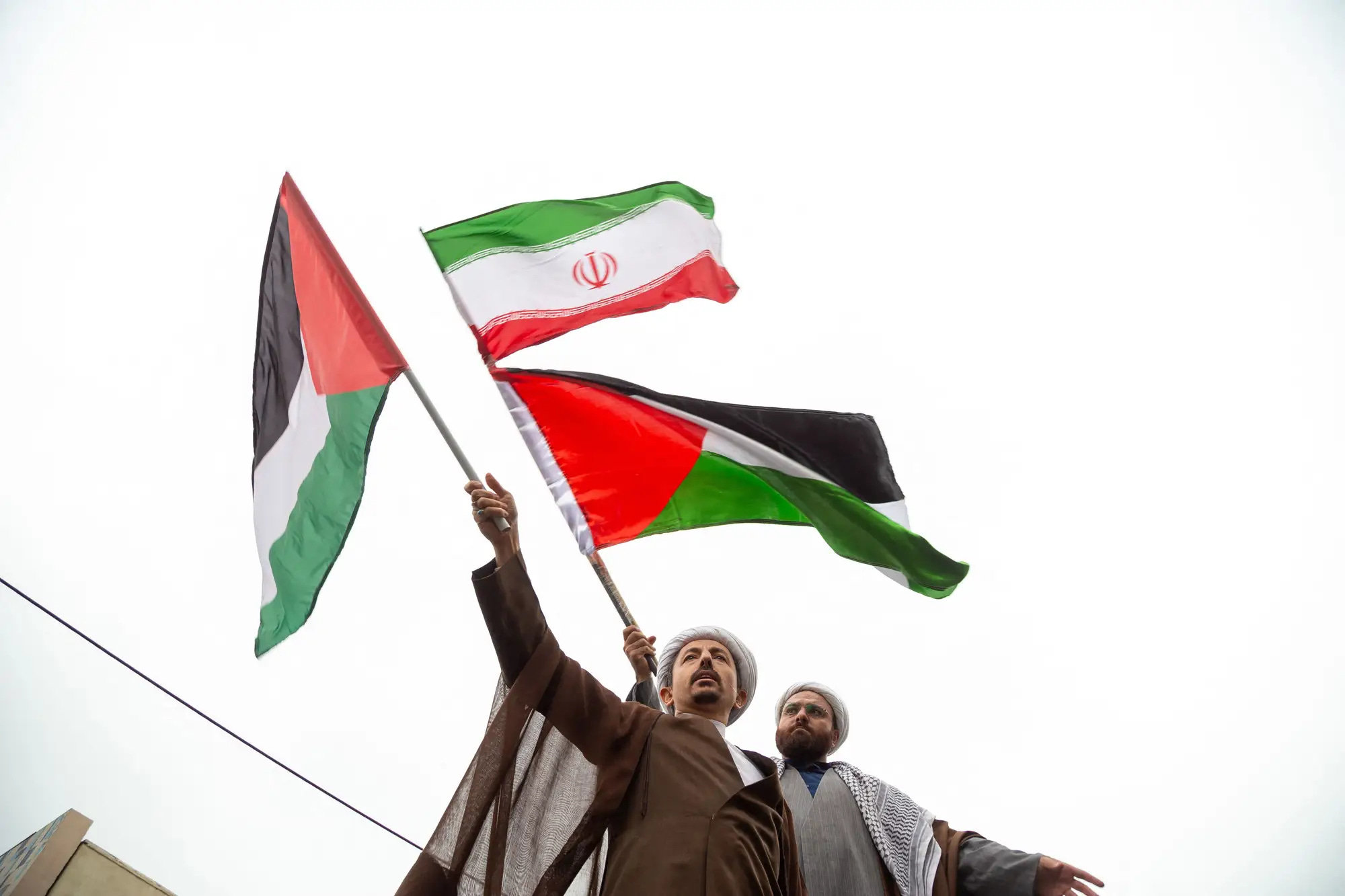
Operation Epic Fury was always going to test that assumption and Tehran’s response was never conceived as purely military. It wanted images, wanted the streets of Cairo and Casablanca filled with crowds chanting for the resistance, wanted the spectacle of Muslim solidarity to flood Western television screens and force an American president to hesitate, to calculate the political cost of continuing, to flinch. Hitting Gulf targets was one lever. Triggering a civilizational parade was the other. Neither produces what Tehran needs.
The Compounding Miscalculations
To understand why that premise is collapsing, one must return to October 7.
Iran deployed its surrogate militias in the weeks that followed as proof of concept, a living demonstration that the Ummah could be summoned on command. When Hezbollah opened its northern front within 24 hours of the Hamas attack, before any Israeli ground operation had begun, Tehran read that coordination as validation that the architecture it had built was solid, reliable, and frightening. Hamas in Gaza, Hezbollah in Lebanon, the Houthis in the Red Sea corridor served simultaneously as pressure and advertisement, each rocket a signal addressed to the broader Muslim world that Iran retains the power to set the region in motion.
What Tehran fails to reckon with is a compounding series of miscalculations about the region it claims to lead.
First, Arab populations have not forgotten what Iranian power actually looks like when exercised without restraint. The IRGC helped suppress the Iraqi popular uprising of 2019, leaving hundreds of protesters dead in Baghdad and Karbala. Iranian-backed forces reduced whole quarters of Aleppo and Deir ez-Zor to rubble in defense of a Syrian government that had gassed its own people. The humiliation embedded in those episodes runs deep, the spectacle of Arab states weakened by militias answerable to Tehran rather than to any elected government or national interest.
Second, the populations Tehran believes it can mobilize have fundamentally reoriented their aspirations. The Arab world of 2026 bears little resemblance to the Arab world of 1979 or even 2006. Governments across the Gulf have spent a decade building investment corridors and diversifying their economies as the organizing framework of the future. Their populations, exhausted by decades of conflict exported in Tehran’s name, have largely accepted that bargain. People want business, want foreign investment, want precisely what Iranian proxy warfare has consistently destroyed. The revolutionary romantic who once burned American flags in solidarity with Tehran has been replaced, in most Arab capitals, by a generation that associates Iranian influence with militia checkpoints and ruined cities.
Third, and most damaging to Tehran’s self-conception, the ideology underwriting the entire project has lost its purchase even inside Iran itself. The Islamic Revolutionary model commands no genuine popular enthusiasm among Iranians. The protests of 2019 and 2022 made that visible to the world. A governing creed that can no longer inspire the population on whose behalf it claims to rule has no serious prospect of inspiring the Ummah abroad, and the absence of street mobilization across the Muslim world following the American and Israeli campaign confirms as much.
The Geography of a Diminished Cause
More importantly, by casting itself as the guardian of Muslim political and religious authenticity, and by treating Gulf governments as compromised by their ties to Washington and their accommodation of Israel, Iran assumed those governments would absorb direct strikes rather than respond.
Between 2022 and 2025, Tehran dispatched more than 300 Houthi drones and missiles toward Emirati and Saudi territory while sustaining financial pressure on Bahrain’s ruling family through Shia patronage networks. Each action rested on the same calculation: that Arab populations would welcome Iranian assertiveness against governments they had been encouraged to distrust, and that Riyadh and Abu Dhabi would absorb the pressure in silence. Saudi Arabia’s declaration of five Iranian diplomats persona non grata in the weeks surrounding Operation Epic Fury, including the military attaché and his assistant, is the answer to that calculation. Riyadh does not issue such answers spontaneously.
But the Arab world’s silence and defiance is not matched elsewhere. Western university campuses produce what passes for solidarity with Iran. London, Paris, and a handful of American cities generate the encampments, the debates over supporting Khamenei, the demonstrations supporting the Resistance Axis, all delivered at a very comfortable distance from what the IRGC has done to the region.
After all, the populations most receptive to Iran’s framing of the conflict as a civilizational assault on Muslim dignity are those furthest from Iranian regional power, Western audiences free to receive Tehran’s propaganda on its own terms. The Islamic Republic forfeits the Arab street and finds, as consolation, the sympathy of a Western progressive milieu that the regime would imprison without hesitation were it ever to encounter them at home.
Operation Epic Fury has not yet produced its final verdict, but one thing is certain: the Arab world has already produced its own. Four decades of Iranian claims to speak in its name, and the streets offer nothing in return.
The civilizational confusion and moral bankruptcy of parts of the West are being laid bare every day the war goes on … worst of all are the West Euro leaders … As Zineb puts it, maybe too mildly: “The Islamic Republic forfeits the Arab street and finds, as consolation, the sympathy of a Western progressive milieu that the regime would imprison without hesitation were it ever to encounter them at home.”
India is probably the only place (Shia) Muslims are protesting Khamenei’s death in the streets, instigated, I guess, by the local mullahs who want to keep their Iranian paymasters happy (who else would be paying to put up Khamenei billboards in Kashmir?). The protests barely get any coverage as the crippling LPG shortage dominates the news—and people blame it on Iran. The Indian government and the Sunni majority DGAF about Khamenei.