
Hamas and the West’s NGO-ization Trap
The Crisis of Humanitarian Governance

Since October 7, the dominant narrative has held that Israel alone produced Gaza’s humanitarian crisis, a narrative so powerful that it fueled boycotts, diplomatic ruptures, international isolation, and a level of political shunning unprecedented for a democratic state fighting a terrorist organization. The newly exposed internal Hamas documents show that this narrative rests on a false premise and that Hamas in fact engineered the crisis through a coercive system of control over aid, NGOs, and civilian infrastructure.
Indeed, what emerges from the documents assembled in the report titled “Puppet Regime: Hamas’ Coercive Grip on Aid and NGO Operations in Gaza” by NGO Monitor is not really a story of isolated or fringe infiltration but a real structural indictment of an NGO system that lacks political accountability and of a Western foreign policy establishment that has outsourced vital strategic functions to unreliable or compromised institutions.
The documents show that Hamas constructed an entire shadow governance apparatus that operated through them and within them, folding humanitarian activity into Hamas’ broader political-military ecosystem.
This mattered for Hamas for two reasons.
First, it enabled the organization to blur the distinction between civilian and militant spheres, making any external intervention politically costly and operationally complex.
Second, it allowed Hamas to entrench itself as the indispensable intermediary for all humanitarian activity in Gaza, strengthening its authority at home and elevating its legitimacy abroad despite being a designated terrorist organization.
In fact, the documents show that Hamas went even further by using the physical presence of NGOs as a way to conceal military activity, since foreign personnel on the ground created an environment in which scrutiny of Hamas’ infrastructure became more politically costly and logistically difficult for outside actors. What NGOs and Western governments portrayed as an Israeli-made crisis was in reality the intentional outcome of Hamas’ own strategy.
A deeper reading of the documents also shows that the problem extends far beyond operational interference and points to a larger pattern that Western governments failed to confront. It confirms what many observers suspected but what NGOs consistently denied: that Hamas treated the NGO sector as an extension of its political machinery, and that NGOs either did not recognize the degree of penetration or chose not to acknowledge it to preserve their access.
It is striking, since the papers outline a formal, bureaucratized apparatus of control in which Hamas appointed guarantors who were vetted local actors serving as official liaisons to international organizations such as Doctors Without Borders, Oxfam, Save the Children, the Norwegian Refugee Council, and numerous others operating in Gaza.
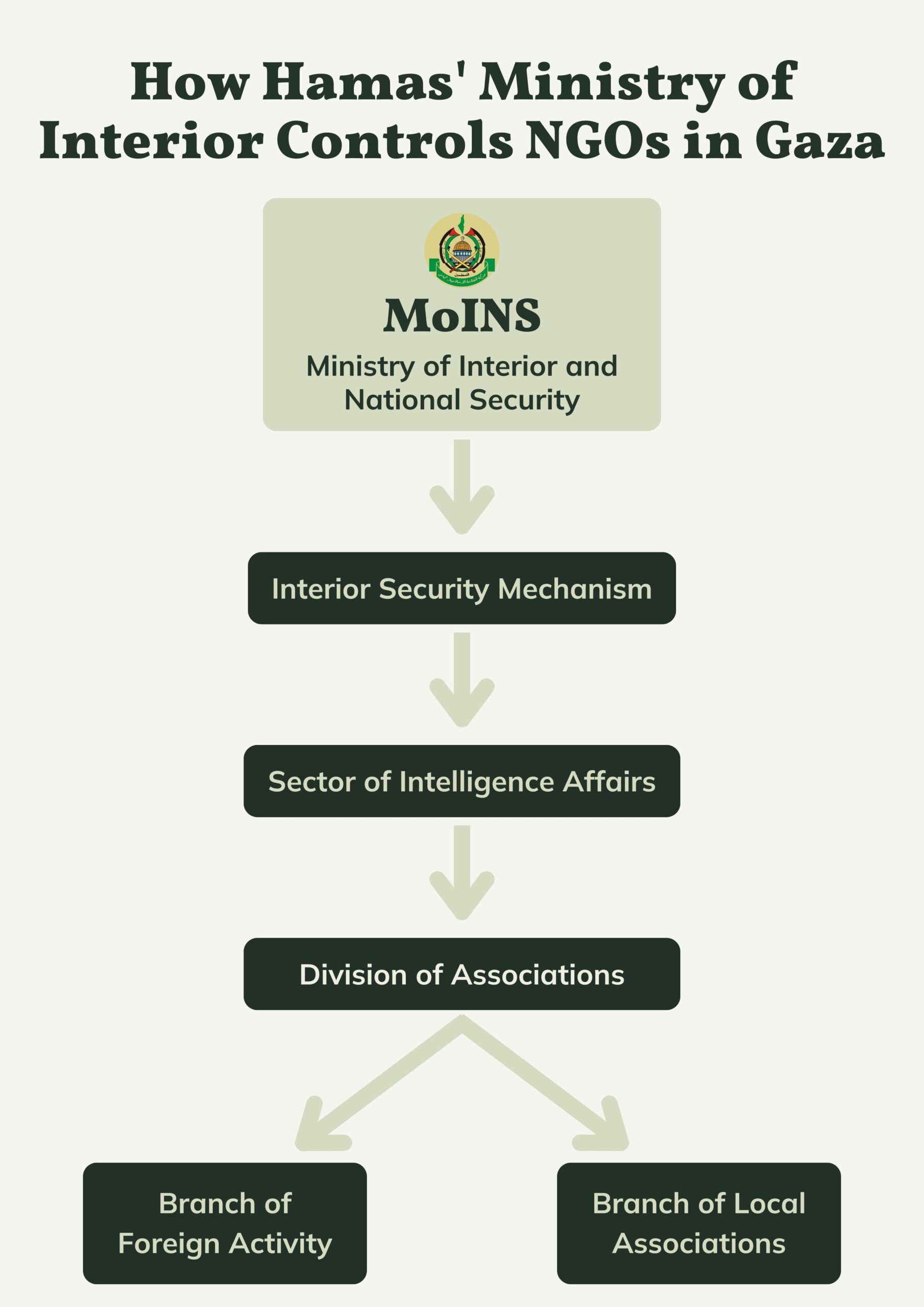
The tragic part is that these guarantors were not neutral facilitators but individuals occupying senior administrative positions, including directors, deputy directors, and board chairs, and their placement was contingent on direct approval from Hamas’ internal structures.
This meant the NGOs were not operating independently but were instead operating within an environment deliberately engineered by an armed organization.
But this is not a Gaza-specific failure. It exposes a structural flaw in the NGO model, which claims neutrality while operating with expansive authority that collapses the moment an armed group controls access. As Hudson Institute Scholar John Fonte has argued, NGOs function today more as political actors without democratic accountability, shaping narratives and policy while lacking the legitimacy required to withstand coercion or manipulation.
It goes without saying that NGOs play crucial roles in humanitarian relief and post-conflict stabilization, and many of their contributions are indispensable, however, their operational logic depends on obtaining and preserving permission from local power centers in order to function at all.
In conflict zones where armed actors monopolize coercive authority, this dependency produces a predictable dynamic in which those actors view NGOs as resources to capture and information channels to shape. In contrast, NGOs prioritize access over strategic clarity, since the loss of access would terminate their programs and jeopardize their funding streams.
This creates an implicit bargain in which NGOs mute or suppress evidence of coercion to continue operating. They cannot openly confront the authorities that host them, because confrontation risks immediate expulsion and the closure of entire aid pipelines. As a result, they often withhold what their own staff witness about militarization and coercive control, and this omission turns into distorted reporting that shapes how Western governments interpret the situation on the ground.
In Gaza, this created a closed loop:
Hamas engineered a humanitarian collapse.
NGOs operating inside Hamas-controlled networks documented the crisis without naming Hamas.
Western governments treated these reports as neutral and adopted their framing.
International media amplified the same framing and repeated it as fact.
Hamas’ propaganda ecosystem used this coverage to reinforce its own narrative of victimhood.
Hamas gained a strategic advantage from the misattribution, which increased pressure on Israel while shielding Hamas from accountability.
If NGOs are to remain credible actors in crises, they need credible oversight, independent verification, and monitoring systems that do not rely on the very authorities that manipulate them. Without these safeguards, NGOs will continue to produce information shaped by parameters they cannot challenge.
This is especially consequential in the Middle East, where Israel has been trying to integrate into the region, build normal relations with its neighbors, and expand the momentum of the Abraham Accords. A false perception of Israeli responsibility for a crisis engineered by Hamas has jeopardized this progress and distorted how regional states interpret Israeli intentions.
This is the core problem of the NGO-ization of foreign policy. Western governments have outsourced critical analytical functions to organizations whose incentives reward access over accuracy, creating a system in which captured NGOs can distort policy debates without acknowledging the coercive environments that shape their reporting. The result is an aid sector funded by European and American taxpayers who believe they are supporting humanitarian relief but are, in practice, reinforcing an information environment that amplifies Hamas’s claims.
As long as this structure remains intact, NGOs will remain vulnerable to manipulation, media narratives will continue to mirror the interests of armed groups rather than the facts on the ground, and Western states will keep turning against Israel, an ally confronting a terrorist organization that threatens regional stability.
Riboua confirms here what I have been suspecting for some time. Many if not all of these NGOs are not honest with their contributors. I have been and continue to be one of them. Overstating the horror of the conditions in Gaza is almost forgivable when trying to gain support. Providing cover for the complicity of Hamas in creating those conditions is not. Nor is placing the onus on the state of Israel for them.
This is a deeply clarifying piece — one of the few that actually examines the architecture of how this narrative was built, rather than just lamenting its effects.
One nuance I’d add: I don’t think Western governments were ever fully “duped.” Most intelligence agencies have long understood Hamas’ operational embed within the aid sector. The real vulnerability is at the level of public perception. Voters absorb NGO-framed narratives as neutral truth, and democratic governments then adjust policy to avoid massive domestic blowback.
That dynamic becomes even more lopsided in our current media environment, where attention is votes and raw numbers matter more than expertise or accuracy. A tiny global population of Jews and Israel supporters is inevitably at a signal disadvantage against vastly larger audiences shaping online sentiment. That imbalance is structural, not moral — but it drives political outcomes. And it is almost never acknowledged in these discussions.
Hamas didn’t just manipulate NGOs — it successfully weaponized the incentive structure of democracies, where narrative pressure from misinformed publics can outweigh classified intelligence and strategic clarity. The tragedy is not merely the distortion of facts — it’s how easily that distortion can steer the foreign policy of free societies.
Your analysis helps illuminate what must change if democracies want to defend themselves against information capture.