

Short note on some developments worth watching across different sectors.
1. DRC’s Ebola Outbreak
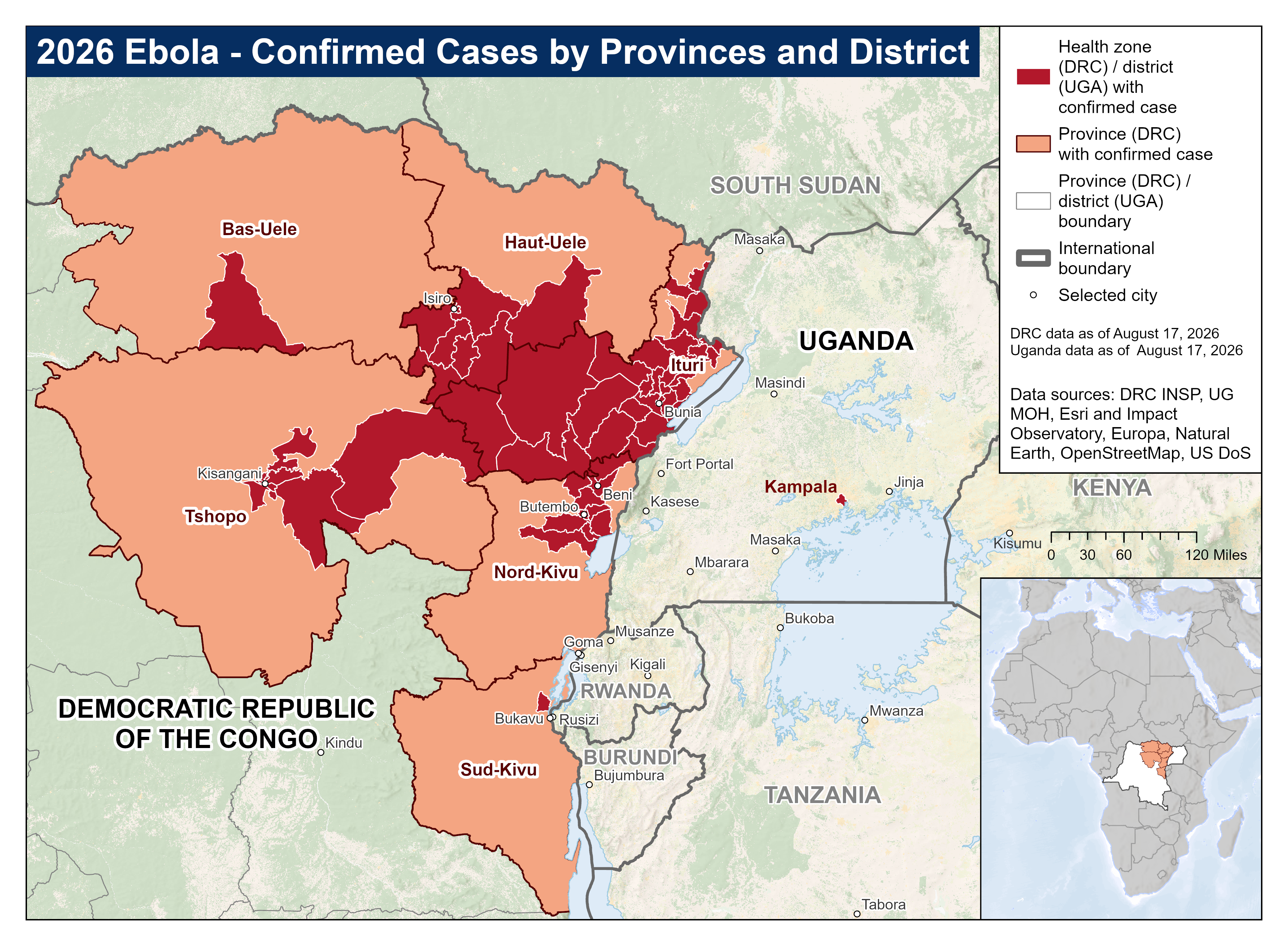
It has been reported that the Democratic Republic of the Congo (DRC) is currently facing the largest and deadliest Ebola outbreak in its history, with more than 5,000 confirmed cases and 2,500 deaths. This week, UN officials have warned that transmission of Ebola is accelerating rapidly across the country, in fact, the disease is now spreading across more than 50 health zones in six provinces.
Important to note that containing the outbreak has historically been complicated for DRC, especially given the ongoing armed conflict in eastern Congo, as the groups involved have restricted access to affected communities and disrupted the movement of medical supplies.
Outbreaks result from zoonotic spillover – animal to human transmission. Infected humans, which can include dead bodies, then pass on the disease to others through body fluids such as vomit, blood and semen. Symptoms include fever, fatigue, muscle pain and headache followed by vomiting, diarrhoea, rash and internal and external bleeding. It has a 50% death rate.
There are four types or strains of Ebola that affect humans: Zaire, Sudan, Bundibugyo and Tai Forest. The latest outbreak involves the rare Bundibugyo virus. There have only been two previous outbreaks involving this strain, in 2007 and 2012.
Source: The Guardian
The other problem DRC is facing is that while the government is trying to contain the outbreak, the Congo River and its tributaries are major transportation routes connecting remote communities with large urban areas, allowing suspected cases to infect others over considerable distances before being identified.
2. Somali Piracy Is Back?
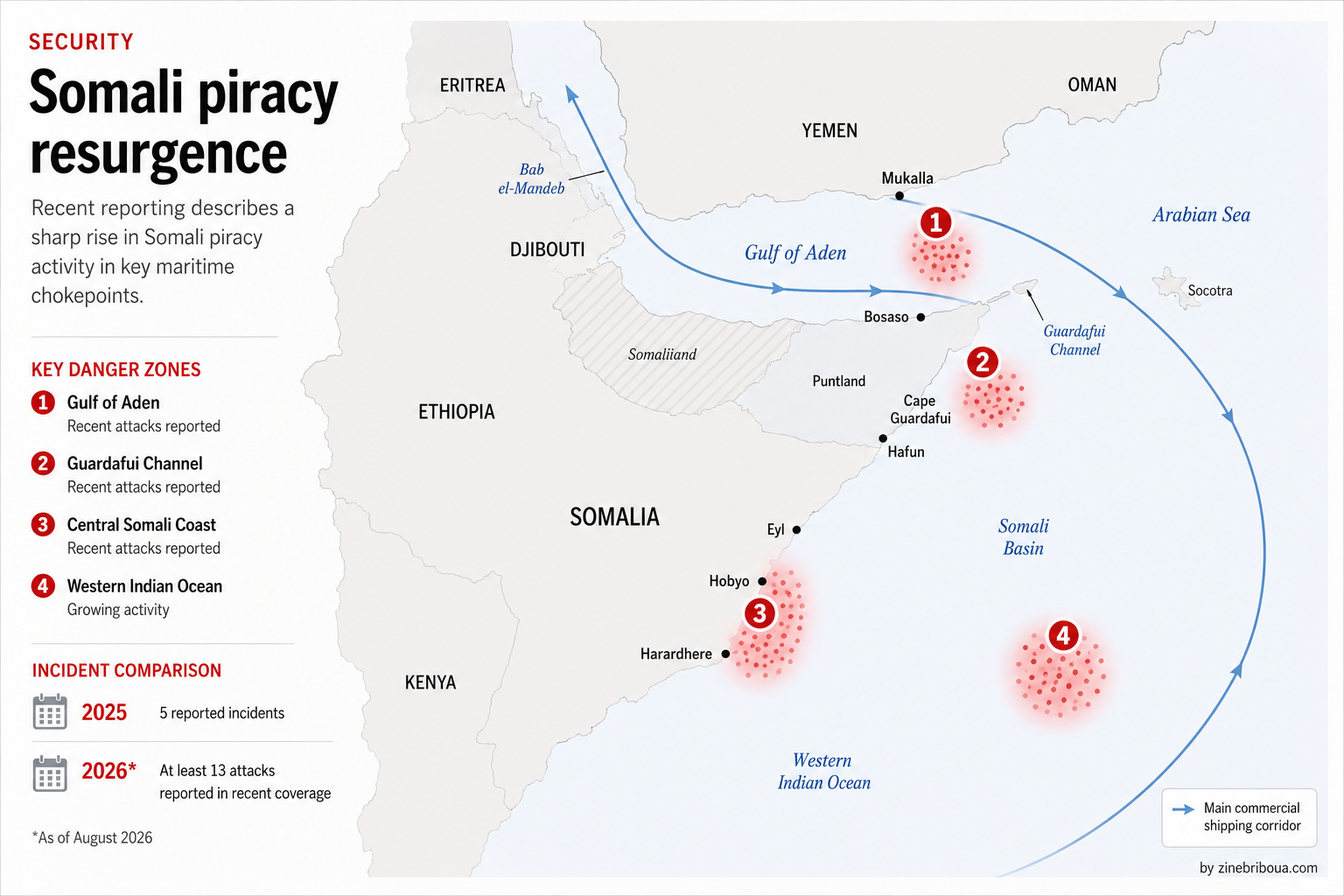
The NYT reported that Somali piracy is experiencing its sharpest resurgence in years. At least 13 vessels have been attacked off Somalia or in the Gulf of Aden in 2026, compared with 5 in 2025. The latest target was the Eritrea-flagged Sibu 1, which was part of Iran’s shadow fleet of ships exporting oil around the world, was boarded off Yemen on 20 August and diverted toward Somalia.
This further complicates the security picture in the Red Sea. The Houthis have already shown, especially since October 7, that they can threaten and disrupt shipping through one of the world’s most important maritime corridors. Somalia’s instability adds another layer of risk while the U.S.- Israel conflict with Iran is still ongoing.
Somalia has also become a battleground between Turkey and the United Arab Emirates, though for different reasons. On one hand, Ankara has aligned itself closely with the federal government in Mogadishu, where it operates a large military facility and trains Somali forces, on the other hand, the UAE has built deeper ties with Puntland, whose strategic position is only growing.
Puntland finds itself at a critical political crossroads, confronting a dilemma that is both unavoidable and increasingly urgent. On one side stands the United Arab Emirates, a key provider of security assistance and economic investment. Emirati support has strengthened the Puntland Defense Force and police, contributed to counter-terrorism operations against ISIS, and financed major infrastructure projects, notably the expansion of Bossaso Port and Bossaso International Airport—assets central to Puntland’s economy and to wider regional stability.
Source: wardheernews
3. Instability in Libya
Libya’s fragile political balance is being tested by a new wave of violence. A series of drone attacks around Zawiya in western Libya struck fuel storage tanks, an oil-blending facility and a power substation, causing fires and electricity outages. The National Oil Corporation warned that continued attacks could force it to declare force majeure and suspend operations at Zawiya, Libya’s largest operating refinery.
The attacks are significant because Libya remains heavily dependent on oil while much of its energy infrastructure sits within areas controlled by armed groups that are only loosely tied to the state. Zawiya alone has recorded more than 30 armed clashes this year. Direct drone attacks on infrastructure introduce another vulnerability, particularly as Libya is trying to increase oil production and attract foreign investment.
Political tensions have risen at the same time. Fawzi Al Mansouri, the head of military intelligence in eastern Libya, was killed in a car bombing in Benghazi, while Central Bank governor Naji Issa submitted his resignation to Libya’s rival legislative bodies. His attempted departure is especially important because his appointment in 2024 had itself been one of the few successful compromises between eastern and western Libyan authorities.
All of this comes just as there had been some movement toward reunifying Libya’s institutions. Eastern and western military leaders met in Sirte in July, the rival camps approved the country’s first unified national budget in more than a decade, and US and UN efforts continue to push toward a unified executive and eventual national elections. Dbeibah has also continued developing Libya’s relationship with Italy, particularly around economic, security, and Mediterranean cooperation. The latest violence is another reminder that political deals at the top remain vulnerable to armed groups and institutions that have never been fully brought back under state control, the crux of all issues.
UN Special Representative for Libya Hanna Serwaa Tetteh told the Security Council that the country faces a “striking paradox”: around $1 billion is spent each month on fuel imports, yet electricity systems remain vulnerable to fuel shortages.
Tetteh also raised concerns over the alleged large-scale diversion of subsidized fuel in the electricity and security sectors. She called for stronger oversight, accountability and coordination to ensure public resources are used to provide essential services.
The crisis has also triggered protests in the capital, Tripoli. Weeks earlier, more than 100 protesters dumped rubbish outside a Libyan oil company, chanting against the authorities and demanding an end to prolonged power outages.
The UN says those responsible for diverting subsidized fuel must be investigated and held accountable.
Source: AfricaNews
4. Egypt, Ethiopia, and the Politics of the Nile
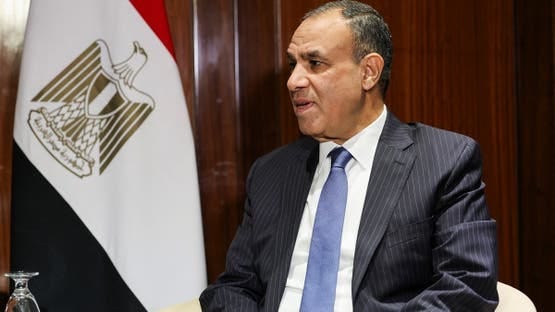
Egypt has renewed its opposition to Ethiopia’s Grand Ethiopian Renaissance Dam (GERD). Irrigation Minister Hani Sewilam told Al Arabiya that Cairo continues to see the dam as “illegitimate,” arguing that Ethiopia constructed and operates it unilaterally, without a binding agreement with the two downstream countries, Egypt and Sudan.
The stakes are particularly high for Egypt, which depends on the Nile for the overwhelming majority of its freshwater. Cairo has also become more concerned about what comes after GERD. Reports that Ethiopia could build additional dams on the Nile prompted Sewilam to say that Egypt “will not allow” new projects that threaten its water interests.
The dispute also sits inside a wider geopolitical competition. Sudan has coordinated closely with Egypt in demanding an end to unilateral Ethiopian measures, while Saudi Arabia, Jordan, Iraq and the broader Arab camp have repeatedly backed Egyptian water security.
The United States has also moved closer to Cairo under President Trump, who offered to restart mediation and said in June that Egypt had been “very unfairly treated” over the dam. China is in a more complicated position. Chinese financing and companies helped build the transmission infrastructure connected to GERD, and Beijing has deep economic ties with Ethiopia, but China also has a major strategic relationship with Egypt and has generally preferred African Union-led negotiations rather than openly taking Ethiopia’s side. The disagreement now reaches beyond one dam to the balance of power in the Nile Basin and the Horn of Africa.
5. Iraq Tries to Reclaim the State
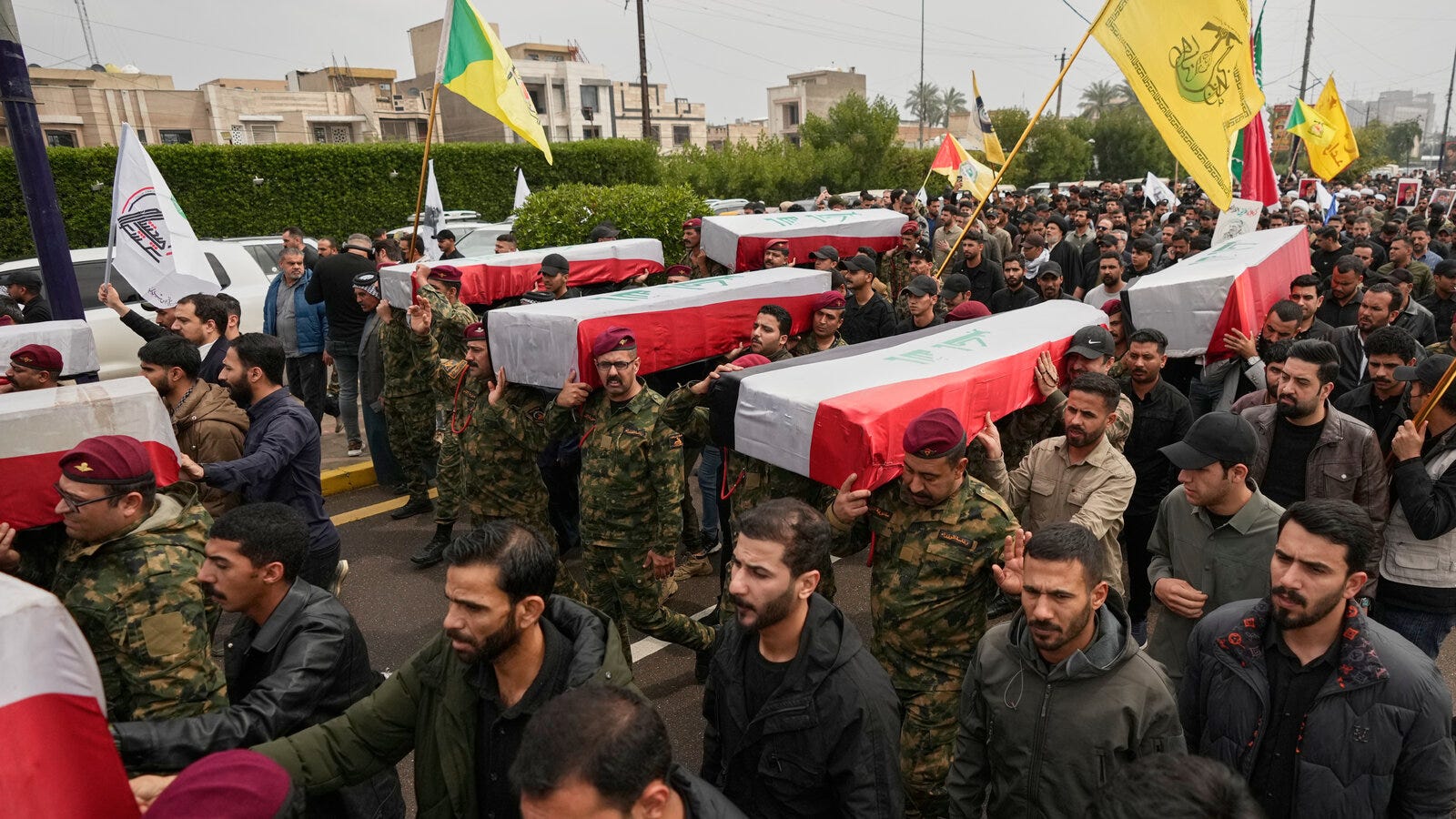
Iraq is making a renewed attempt to bring Iran-backed militias under state control.
Prime Minister Ali al-Zaidi has set a September 30 deadline for armed factions to surrender or integrate their weapons. Several groups have accepted the principle, but Kataib Hezbollah has refused and insists that it will retain its “resistance weapons.” The difficulty is that these groups are no longer simply militias operating outside the state. Many are embedded in Iraq’s political, security, and economic institutions, which makes disarmament a test of how much authority Baghdad can actually recover.
The stakes are particularly high for Saudi Arabia. Iran-backed groups operating from Iraq have been accused of launching drones against Saudi oil infrastructure, prompting joint US-Saudi strikes on militia positions in July. Riyadh wants a stronger Iraqi government capable of preventing its territory from being used against the Gulf, while also expanding economic ties with Baghdad. Zaidi has sent senior officials to Saudi Arabia to seek a larger OPEC production quota, giving the relationship an important economic dimension as well as a security one.
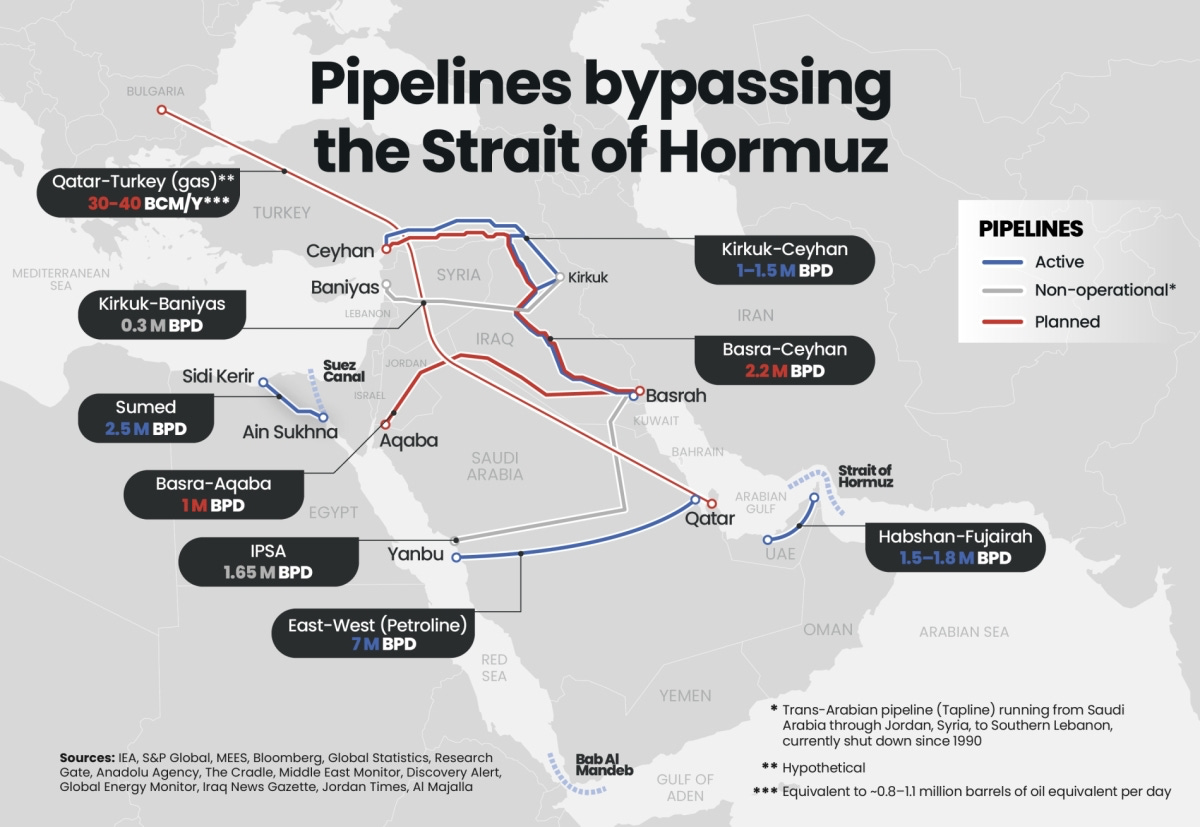
For Turkey, a stronger central government in Baghdad could open a different kind of opportunity. Iraq is trying to reduce its dependence on the Strait of Hormuz by expanding oil exports through Turkey’s Ceyhan port and developing additional routes toward the Mediterranean. Ankara has already been building influence through trade, infrastructure, and security cooperation. If Baghdad succeeds in weakening autonomous armed factions, Turkey would gain a more reliable state partner and greater leverage over the commercial corridors linking Iraq to Europe.
For Iran, the same process would amount to an immense strategic loss. Quds Force commander Esmail Qaani and parliament speaker Mohammad Bagher Ghalibaf have both traveled to Baghdad as Tehran tries to preserve its position, with Ghalibaf calling for a “new regional order” with less U.S. influence. Historically, Iraq’s militias have given Iran immense political leverage and the ability to threaten US and Gulf interests without acting directly. Their disarmament would weaken one of Tehran’s most important regional networks.
And north Iraq? Is turkey gonna leave that or stay. Anything on the Kurds I heard some speratist group was talking with IR again
Hormuz Strait crisis and bypassing it by constructing pipelines is an important development, but sounds more like a headline news for now. Building undersea pipelines takes years and $billions to build. United States is in the business of controlling major chock points. This is going to be the American B&R equivalent of global trade dominance.