


![Emperor" Jean-Bedel Bokassa , seated on his golden throne for his coronation, Bangui, Central African Republic - December 4, 1977 [1064 x 794] : r/HistoryPorn](https://substackcdn.com/image/fetch/$s_!4pom!,f_auto,q_auto:good,fl_progressive:steep/https%3A%2F%2Fsubstack-post-media.s3.amazonaws.com%2Fpublic%2Fimages%2F1eaa0e18-f09e-4b09-8c64-00072a24c145_1064x704.jpeg "Emperor\" Jean-Bedel Bokassa , seated on his golden throne for his coronation, Bangui, Central African Republic - December 4, 1977 [1064 x 794] : r/HistoryPorn")
“Madness alone is truly terrifying, inasmuch as you cannot placate it by threats, persuasion, or bribes.”
― Joseph Conrad, The Secret Agent
When I was 14, my grandfather told me the story of Jean-Bédel Bokassa, and since then, he has haunted my thoughts whenever I think about power.
The Central African Republic offers a rare clarity about the nature of power. There, politics is stripped of illusion. In Bokassa’s life, one sees how ambition can lift a man from obscurity, how weakness can invite conquest, and how the longing to command can destroy the one who commands.
He was born in 1921 in Bobangui, a small village at the heart of what was then French Equatorial Africa. His father, Mindogon Gboundoulou, a village chief, was beaten to death by colonial officials after refusing to provide villagers for forced labor. His mother, Marie Yokowo, unable to bear the loss, took her own life soon after. Orphaned in a world ruled by others, Bokassa was taken in by Catholic missionaries from the École Sainte-Jeanne d’Arc, who saw in him a bright and restless child.
It was the age of the mission civilisatrice, France’s “civilizing mission,” born of the belief that French values were universal truths. They clothed him, taught him French, and filled his imagination with the stories of saints and warriors. The missionaries hoped to make him a priest, but his temperament bent toward command.
In May 1939, at the age of 18, Bokassa enlisted in the Tirailleurs sénégalais, a colonial infantry unit of the French Army. For him, the uniform was more than just clothing, no, it was an initiation, a delicate ritual into the empire’s grandeur, a promise of belonging to something vast and victorious. When France fell in 1940, he courageously joined General de Gaulle’s Free French Forces, fighting in Provence and along the Rhine. He rose to the rank of sergeant and was greatly admired for the ease with which he embodied the empire’s ideal of assimilation.
After the war, he continued his training at the École Militaire Interarmes in Saint-Louis, Senegal, and later at Fréjus and Châlons-sur-Marne in France. The little boy who once religiously prayed in a missionary classroom now marched among the students of Napoleon, speaking their language and mastering their discipline. In Napoleon, he saw the purest form of power, a man who had risen from nothing and bent history to his will. That vision became his measure of greatness.
The French Empire was his career, and its wars gave him a sense of purpose. He fought in Indochina and in Algeria, where he served under Colonel Marcel Bigeard, one of France’s most brilliant commanders. From Bigeard, Bokassa learned the theater of command, tactics, and discipline. His courage on the battlefield earned him the Légion d’Honneur and the Croix de Guerre.
By 1964, he had risen to the rank of captain, one of the highest-ranking African officers in the French colonial forces. When he returned home, he carried with him the discipline of the French army, the pride of service, and the firm conviction that he was destined to rule. In his imagination, Napoleon’s voice still murmured in his ear, urging him toward greatness.
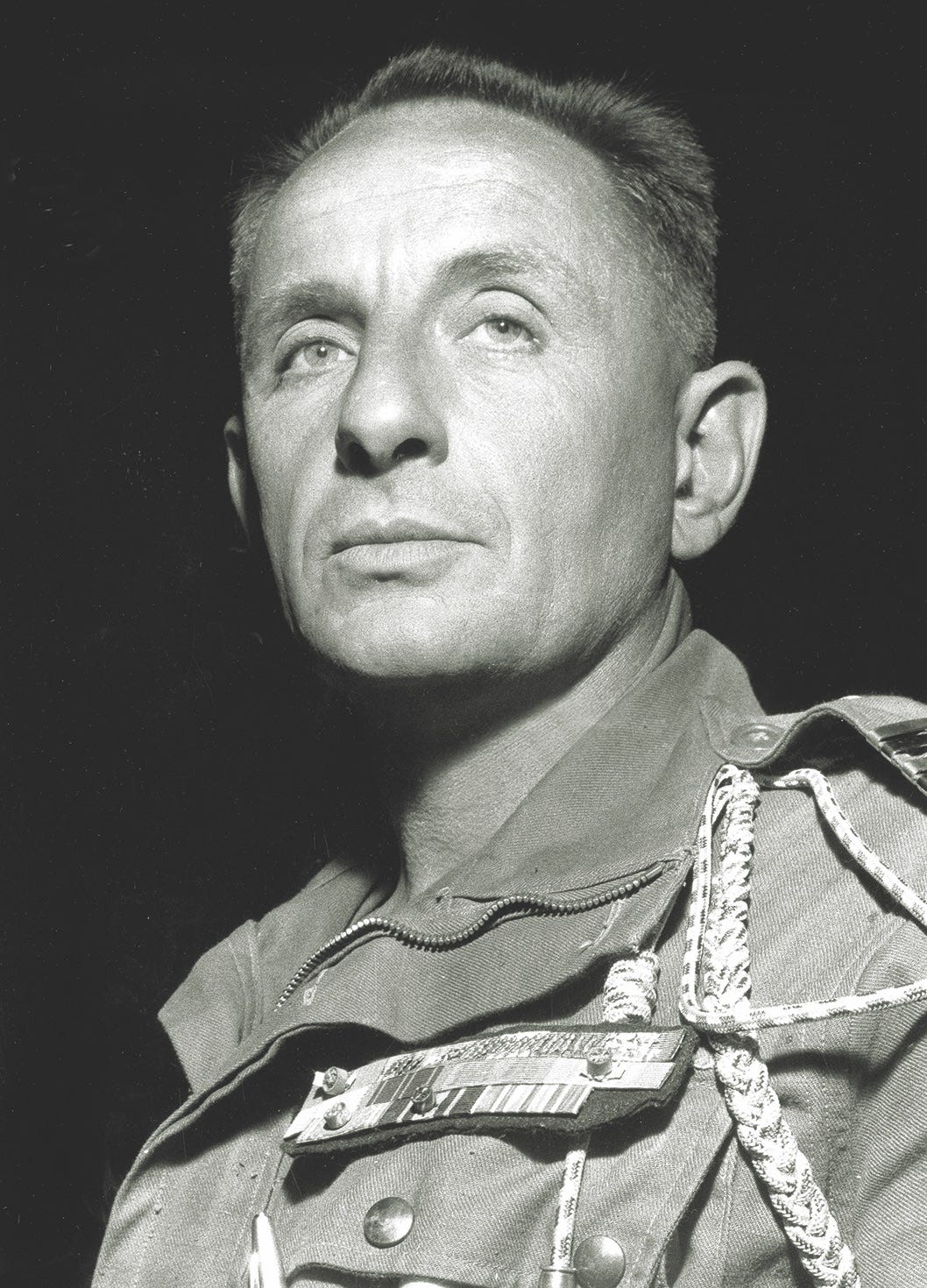
Back in the Central African Republic, he found a nation still searching for itself, suspended between imitation and decay. Remembering Napoleon, he saw not chaos but a calling. He wanted to be a prince, a king, a reformer, a scholar, a poet, he wanted to be everything and everywhere at once.
In fact, a few years later, he acted, overthrew President David Dacko in a coup d’état, humiliated him, and declared himself head of state. Meanwhile, in Paris, General de Gaulle was confronting the weariness of empire. Thinkers like Raymond Aron wrote of a France fatigued by history, uncertain of its purpose in a changing world. Bokassa, by contrast, was all energy and appetite. He embodied the very force the old empire had once celebrated, a figure seen in Paris as a grotesque parody of grandeur by some and as its final echo by others.
Through Jacques Foccart, the architect of Françafrique, France maintained its web of influence across its former colonies, favoring loyal soldiers. Bokassa fit the design perfectly. He promised reform and order. But by 1976, his obsession had slipped into delusion. That September, he dissolved the government and replaced it with the Central African Revolutionary Council, ruling by decree. Three months later, he proclaimed a new constitution that turned the Central African Republic into the Central African Empire.
On December 4, 1977, at exactly 10:43 a.m., he crowned himself His Imperial Majesty Bokassa I, Emperor of Central Africa, by the will of the Central African people.
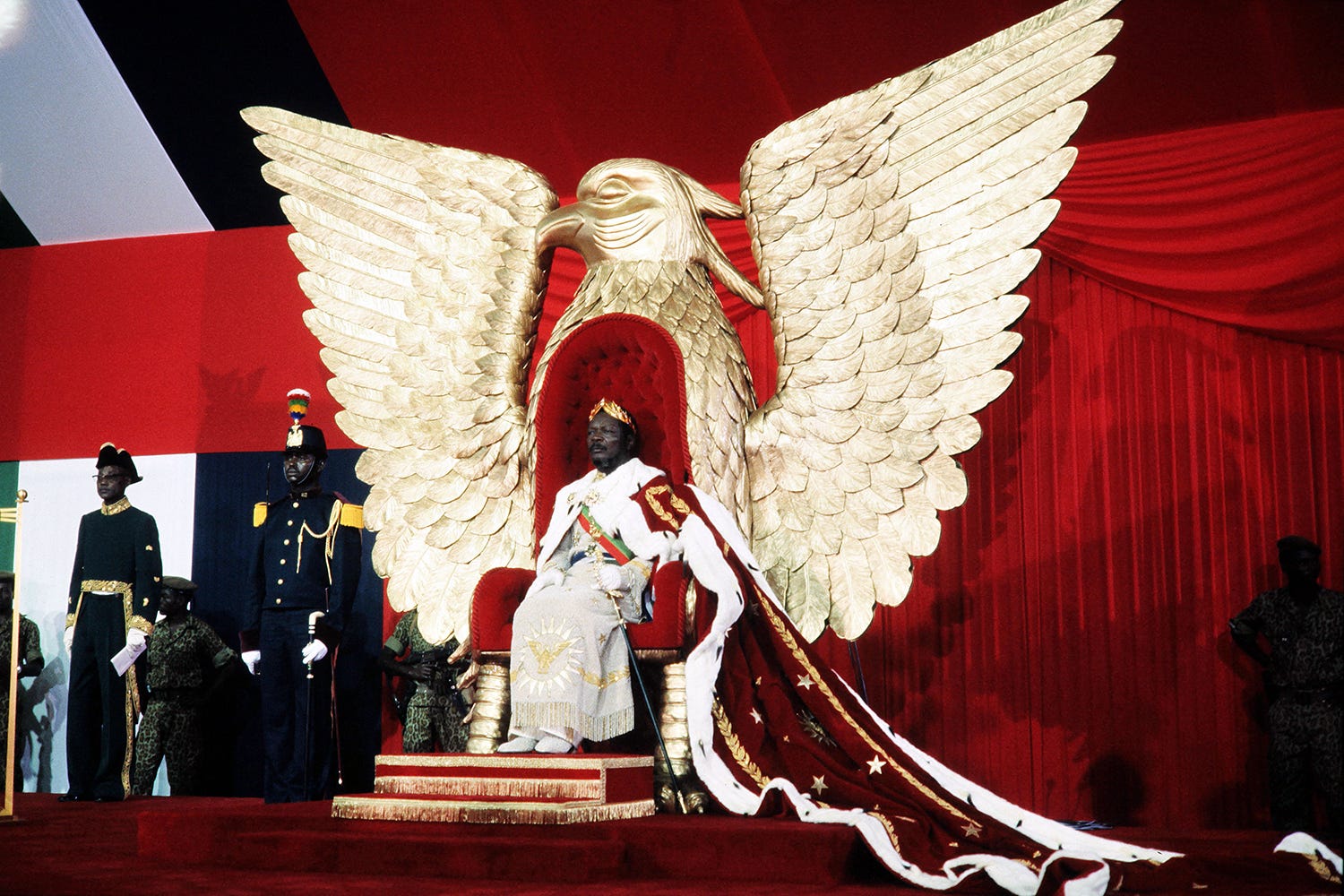
His coronation probably unfolded like an old dream. Under the equatorial sun, the heat shimmered over Bangui as if the air itself were burning. The velvet, the trumpets, the gold, all of it seemed surreal. However, for Bokassa, the ghosts that had shaped his life gathered there: the saints of his orphaned childhood, the French soldiers, and the shadow of Napoleon. They had never left him, they had merely waited for this moment to return.
His ceremony had been rehearsed for months, a masterpiece of Napoleonic imitation. The beautiful velvet and delicate robes were stitched in Paris, the laurel wreath cast in gold, the throne carved from imported mahogany and gilded like a relic from Versailles. The champagne came from Reims, the petits fours from Bordeaux. Outside, barefoot children watched from the dust, their country bankrupt, their emperor beautiful, radiant. It cost nearly $20 million, one-third of the national budget, all of France’s aid.
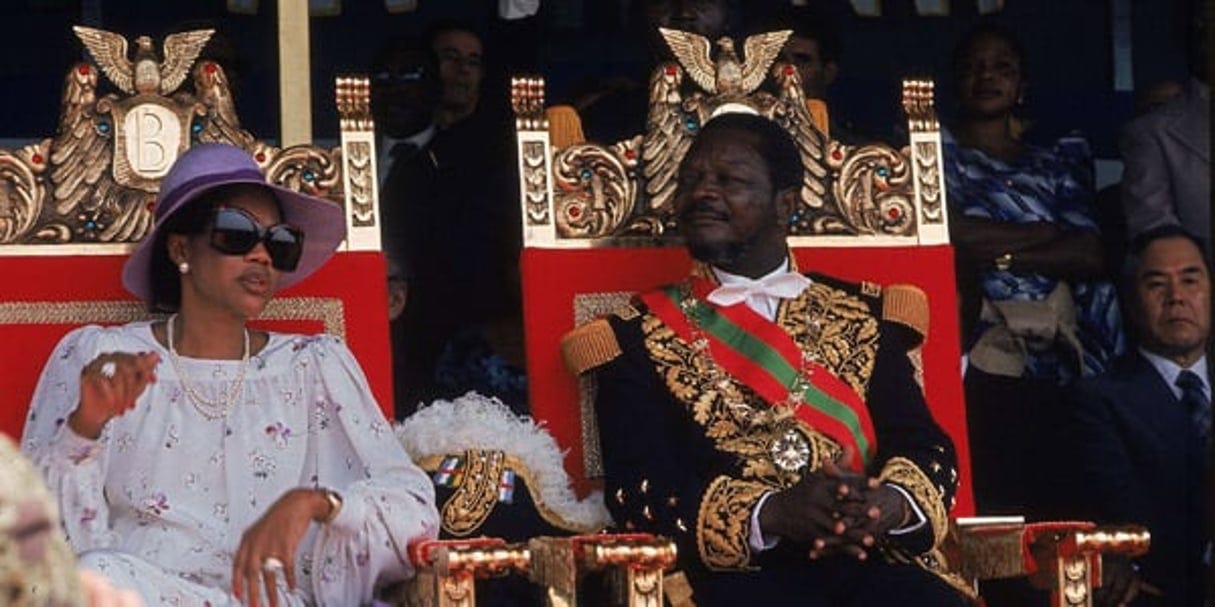
However, what is interesting about the story is that, fundamentally, Bokassa’s coronation expressed a man consumed by himself, convinced that appearance could replace essence. The tension between what he had and what he desired grew unbearable. He wanted to be emperor and savior, reformer and monarch, both the child of Africa and the heir of France. That inner conflict probably gave rise to his madness, although, according to many historians, something more profound was at work.
Maupassant understood that kind of descent. In "The Horla," he tells the story of a man haunted by an invisible presence that slowly takes control of his mind. The horror of the tale lies not in the ghost itself but in the realization that the tormentor may be the self. Bokassa lived a similar possession.
What is most fascinating is that he called his ceremony “a bid for honor”, claiming that monarchy would give Central Africa the stature it lacked. In truth, he was speaking of himself. He was a man constantly seeking recognition, driven by a need to be seen and remembered. His reasoning followed the logic of the narcissist who confuses admiration with legitimacy. Power, for him, was not a means but a mirror, something that reflected rather than restrained the self.
He also remembered all the wrong lessons from Napoleon. Napoleon knew that power rested on construction, not display. He was a builder of laws, institutions, and order. Bokassa saw only the spectacle. He mistook symbols for substance and sought to embody history without earning it. I won’t go into details regarding his other failures, violations, and other intrigues with the French.
What stays with me from Bokassa’s story is that he was not, and is not, the only one. He embodied the distance between what a nation desires and what it can sustain. Many reach for greatness before they have built the strength to bear it. After the coronation, he remained in power for less than two years. His empire collapsed, and the country returned to a republic. It was a harsh return to reality, the end of an imperial illusion, and the awakening of a nation exhausted by the excess of one man.
Power without foundation always collapses, first in illusion, then in ruin. We should look back at Bokassa not to laugh but to be frightened. The empire he imagined has vanished, leaving behind one of the poorest countries on earth, where the traces of his grandeur lie buried under dust and neglect. Nothing he built endured because nothing was built to last.
As the Arabic proverb says, man bunya ʿalā bāṭil fahuwa bāṭil — what is built on falsehood is false.
Great read. I also wrote about CAR here. I think people forget or arent aware that CAR is in an over a decade long civil war and that it is basically a vassal of Russia. Even before colonialism that land was probably one of the most unfortunate places to be born to on earth.
https://open.substack.com/pub/yawboadu/p/the-economic-history-of-central-african?utm_source=share&utm_medium=android&r=garki
Very interesting. Great read. I was fascinated reading this piece. Thank you very much.