
Babel at Davos: Why the Transatlantic Alliance Is Talking Past Itself
Transatlantic Misunderstanding

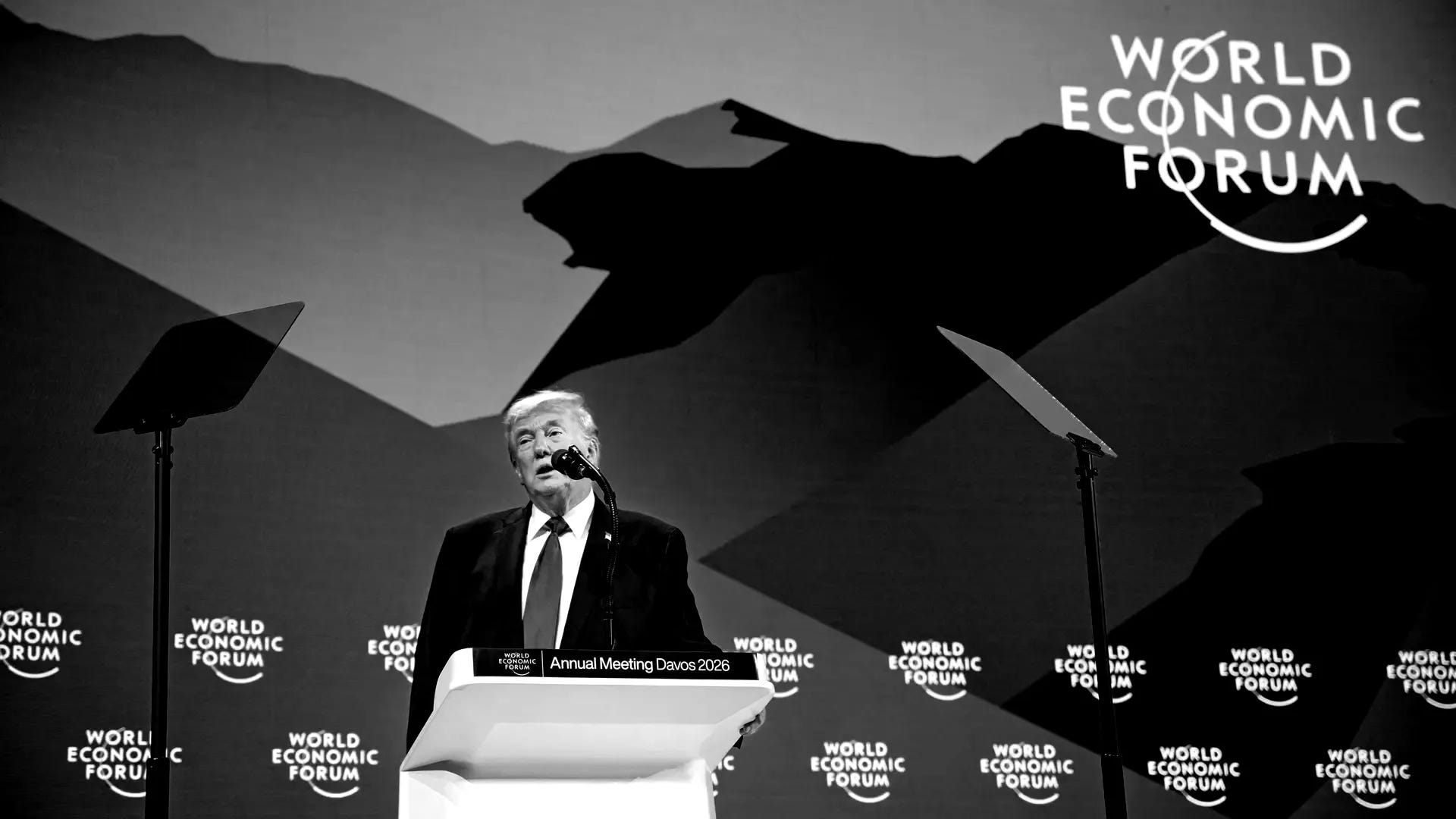
“We’re all islands shouting lies to each other across seas of misunderstanding.”
The Light That Failed, Rudyard Kipling
I’ve watched several speeches at Davos this morning. Some were substantive. Others were revealing in less flattering ways. What stood out was not disagreement but dissonance.
Indeed, Allies no longer interpret the international environment through the same strategic frame, even as they continue to rely on a shared vocabulary that masks how far their assumptions have drifted.
Davos resembled a Tower of Babel in a precise sense. The language of security, commitment, and deterrence circulated easily, but it referred to different logics of power. Participants were not failing to communicate, they were just totally describing different worlds.
Misunderstanding Trump’s America
This divide appeared most clearly in discussions of American leadership. In Europe, Trump’s style is treated as destabilizing in itself. What was missing was any serious attempt to think through how that disruption might be leveraged, particularly against Vladimir Putin. Volatility was absorbed as risk rather than directed as pressure.
But more importantly, two moments in the Davos discussions on American leadership revealed more than intended. Unpredictability was repeatedly described as erosion rather than as pressure. A European official remarked that the international system was drifting away from the rule of law. The statement carried a broader anxiety, but its immediate referent was unmistakable. Trump appeared not as a variable in strategic interaction, but as a symptom of systemic decay.
From Washington’s vantage point, unpredictability operates differently. It interferes with adversarial planning, unsettles reliance on fixed red lines, and compels continuous adjustment. In strategic terms, it degrades anticipatory equilibrium. What appears in European discourse as disorder functions in American practice as imposed uncertainty.
This difference extends beyond style to institutions themselves. In Washington, there is a growing assessment that many major international organizations and multilateral bodies no longer function as neutral arenas, having been steadily captured by China and its party-state proxies. Trump’s response has been to construct parallel arrangements that bypass these institutions altogether. In Europe, this move is seen as destabilizing the international order. In Washington, it is understood as an adaptation to institutional failure. The disagreement is not over the value of rules, but over whether the existing system still enforces them or merely provides cover for their erosion.
A second issue surfaced alongside this one, and it was structural rather than perceptual. It has less to do with material capacity than with incentives. European political systems are organized to avoid being the primary mover in escalation. Responsibility for risk is displaced upward to institutions, outward to alliances, or forward into process. Disruption, by definition, requires ownership of consequences. European governance is designed to minimize precisely that.
In this context, unpredictability becomes politically dangerous. It forces leaders to accept responsibility for outcomes that cannot be fully controlled or safely narrated. Trump’s leadership style strips away procedural buffers and exposes decision-makers directly to risk, retaliation, and blame. The prevailing response is not to exploit disruption but to neutralize it.
This helps explain another pattern that surfaced at Davos. Rather than engaging seriously with Trump’s leverage, some European leaders behave as if they possess alternatives by signaling openness to Beijing. The move is meant to restore balance. In practice, it validates Trump’s diagnosis while deepening dependence on a hostile regime. What is presented as strategic autonomy functions instead as strategic evasion.
Misunderstanding America’s Strategic Imperatives
Beneath the surface of these exchanges lies also a harder difference about power itself. The Arctic makes it visible without rhetorical scaffolding.
In Washington, the Arctic is treated as a zone of great-power competition. Access, infrastructure, energy corridors, and denial capabilities are understood as instruments through which future leverage is accumulated. Russian militarization and Chinese capital are read as positional moves that alter the balance of constraints over time. The concern is not really dialogue or cooperation, but advantage.
Across much of Europe, the Arctic is still approached primarily as a governance problem. The focus falls on environmental protection, confidence-building measures, and the preservation of institutional frameworks. Strategic competition is not denied, but it is absorbed into procedures and norms rather than treated as a struggle over position and control. Power is exercised through regulation and consensus, not accumulated through presence, access, or denial.
The geography is identical. The logic applied to it is not. One side approaches the Arctic as a field in which control and leverage are built incrementally. The other continues to treat it as a domain in which order can be maintained through management.
These different frameworks produce different conclusions across the board. When the United States looks at Russia, China, or Iran, it sees adversaries probing for advantage and testing enforcement over time. When many European governments look at the same actors, they see risks to be managed, delayed, or compartmentalized in order to preserve domestic stability and political cohesion. Agreement on who the adversaries are fails to translate into agreement on what confrontation requires.
Political constraints reinforce this divergence. In Europe, aging populations, coalition politics, and deeply embedded welfare commitments push leaders toward minimizing visible cost and escalation. In the United States, global commitments, industrial competition, and expectations of primacy force prioritization, trade-offs, and explicit burden calculations. These pressures shape not only policy outcomes but the way threats are conceptualized.
This is why dialogue increasingly breaks down. When American officials argue for capacity, production, and sustained deterrence, they are operating from a model that assumes prolonged competition under scarcity. When European leaders emphasize unity, restraint, and institutional process, they are responding to political systems built to avoid disruption. Each side hears the words. Neither recognizes that its assumptions are being challenged.
The result is divergence masked by “shared” language. One side is preparing for a world defined by endurance and enforcement. The other remains oriented toward preserving equilibrium in a system it hopes to stabilize.
From a strategic standpoint, this matters more than any single policy dispute. Alliances function through shared models of how power operates. When those models diverge, coordination weakens, and adversaries gain room to maneuver.
Davos exposed a structural shift. The Western alliance no longer agrees on the nature of competition itself. Until that divergence is confronted directly, transatlantic coordination will continue to strain, not because values differ, but because allies are no longer navigating the same strategic reality.
WOW !!! Absolutely brilliant insight ...
Superb analysis. Thank you.